








Skin cycling has become a popular way to simplify a skincare routine without piling multiple powerful ingredients onto the skin at the same time. The basic idea is simple: instead of using exfoliating acids and cretinous every night, you rotate them through a planned schedule and dedicate the remaining nights to hydration and recovery.
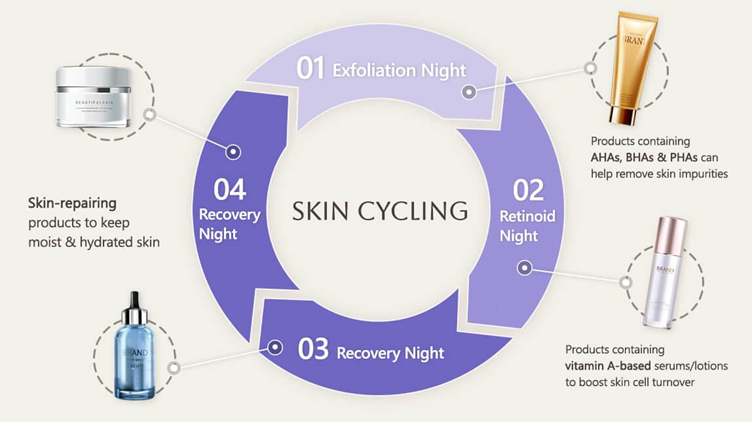
The concept was popularized by dermatologist Dr. Whitney Bowen, and the commonly described routine follows a four-night cycle: exfoliation, retinue, recovery, and recovery.
For beginners, the appeal is obvious: fewer active ingredients, a clearer routine, and more time for the skin to recover. However, skin cycling isn’t a magic formula or a requirement for healthy skin. Your skin type, existing products, medications, and individual concerns should determine how you build your routine.
What Is Skin Cycling?
Skin cycling is a structured nighttime skincare routine that alternates active ingredients with recovery nights.
A traditional four-night approach looks like this:
| Night | Main Focus | Typical Product |
| Night 1 | Exfoliation | AHA or BHA |
| Night 2 | Retinoid | Retinol or another retinoid |
| Night 3 | Recovery | Moisturizer + hydrating ingredients |
| Night 4 | Recovery | Moisturizer + hydrating ingredients |
Then the cycle starts again.
The philosophy behind the schedule is not that exfoliates and cretinous are inherently bad for the skin. Both can be useful ingredients. The issue is that repeatedly combining or overusing active products can increase dryness, peeling, redness and irritation.
The American Academy of Dermatology (AD) specifically warns that exfoliating while using products such as retinol or prescription cretinous can worsen dry or irritated skin.
Why Skin Cycling Can Be Helpful for Beginners
One of the biggest challenges with modern skincare is knowing when enough is enough.
A beginner may purchase a cleanser, exfoliating toner, vitamin C serum, retinol, acne treatment, several masks and multiple moisturizers—and attempt to use everything at once.
That can make it difficult to identify which product is helping and which is causing irritation.
Skin cycling introduces a simple principle: give powerful ingredients their own nights.
It can also encourage consistency. A manageable routine that someone follows regularly is generally more practical than an elaborate routine that constantly irritates the skin.
Importantly, skin cycling itself isn’t a medically necessary treatment. It’s better viewed as a routine-management strategy.
The Four-Night Skin Cycling Schedule
Night 1: Exfoliation
The first night focuses on chemical exfoliation.
Common exfoliating acids include:
- Alpha hydro acids (Aha), such as glycol or lactic acid
- Beta hydro acid (BAH), particularly salicylic acid
- Polyhedron acids (Phase), which are often considered gentler options
Chemical exfoliates help loosen and remove dead skin cells from the surface.
However, stronger does not automatically mean better. The AD recommends choosing an exfoliation method according to your skin type and avoiding over-exfoliation because excessive exfoliation can result in irritation and redness.
Beginner approach: cleanse gently, apply your chosen exfoliate according to its instructions, and finish with moisturizer.
Don’t add a retinue on the same night when you’re starting.
Night 2: Retinue
Night two is dedicated to a retinue.
Cretinous are vitamin-A-derived ingredients with well-established dermatological uses. Depending on the product, they can help with acne, clogged pores, uneven pigmentation, skin texture and signs of photo aging.
For beginners, an over-the-counter retinol may be easier to introduce than a prescription-strength retinue.
The important word here is slowly.
The AD notes that starting cretinous gradually can help reduce irritation. Dermatologists may recommend beginning two or three times per week and increasing frequency as tolerated.
A simple Night 2 routine could be:
- Gentle cleanser
- Allow skin to dry
- Apply a small amount of retinue
- Follow with moisturizer
If cretinous make your skin particularly dry, moisturizer can be used before the retinue as a buffering step.
Night 3: Recovery
This is where the routine becomes deliberately boring—and that’s a good thing.
Skip exfoliating acids and cretinous. Instead, concentrate on supporting comfortable, hydrated skin.
Look for a gentle moisturizer containing ingredients such as:
- Ceramides
- Glycerin
- Hyaluronic acid
- Squalidness
- Other well-tolerated moisturizing ingredients
The goal isn’t to “activate” your skin. It’s simply to give it a break from potentially irritating actives.
Night 4: Recovery Again
Repeat the recovery routine.
This second recovery night is particularly useful for beginners who are still learning how their skin responds to active ingredients.
After Night 4, you can begin the cycle again with exfoliation.
But here’s an important point: you don’t have to follow the schedule rigidly.
If your skin remains dry, tight, burning or visibly irritated, extending the recovery period is more sensible than forcing yourself to restart the cycle.

What Should You Do in the Morning?
Skin cycling is primarily a nighttime strategy, but the morning routine remains extremely important.
A simple morning routine can include:
1. Gentle cleansing
Use a mild cleanser if you need one, or simply rinse with water if that works better for your skin.
2. Moisturizer
Apply one appropriate for your skin type.
3. Broad-spectrum sunscreen
Use sunscreen as the final skincare step before makeup.
Sun protection becomes particularly important when using cretinous and exfoliating products because irritation and sun exposure can contribute to unwanted pigmentation and other skin problems. The AD recommends broad-spectrum SPF 30 or higher for sun protection.
Skin Cycling Isn’t One-Size-Fits-All
One of the biggest mistakes beginners make is treating the four-night schedule as a universal prescription.
Your skin may need a different approach.
If You Have Dry or Sensitive Skin
You may need more recovery nights and less frequent exfoliation.
Start conservatively rather than trying to match someone Elsie’s routine.
If You Have Oily or Acne-Prone Skin
A retinue or salicylic acid may be useful depending on your specific concerns. However, adding several acne treatments simultaneously can increase irritation.
The AD notes that topical cretinous can help unclog pores and treat several forms of acne.
If You Have Darker Skin
Be particularly cautious about irritation.
Inflammation can sometimes trigger post-inflammatory hyper pigmentation, meaning an overly aggressive skincare routine can potentially leave dark marks behind.
The AD specifically highlights this concern for people with darker skin tones using cretinous.
Common Skin-Cycling Mistakes to Avoid
Using Too Many Actives
Skin cycling isn’t an invitation to use every active ingredient you own.
If Night 1 contains an exfoliating acid and Night 2 contains a retinue, adding several additional acids or acne treatments may defeat the purpose of simplifying the routine.
Exfoliating Until Your Skin Feels “Squeaky Clean”
That tight, stripped feeling isn’t proof that exfoliation worked.
Over-exfoliation can cause irritation and dryness.
Starting With the Strongest Retinue
Beginners sometimes assume that a stronger product will produce faster results.
In reality, irritation can make it harder to maintain a routine.
Cretinous can take weeks before visible improvements become noticeable, so patience matters.
Ignoring Your Skin’s Warning Signs
Persistent burning, significant redness, cracking, swelling or worsening irritation means it’s time to stop and reassess.
A skincare schedule should serve your skin—not the other way around.
A Beginner-Friendly Example
Imagine someone who has never used a retinue and occasionally experiences dryness.
Instead of immediately following the full four-night cycle, they might begin with:
Week 1–2
- Night 1: Gentle exfoliation
- Night 2: Recovery
- Night 3: Recovery
- Night 4: Recovery
Then repeat.
Once the skin tolerates exfoliation comfortably, a beginner could introduce a low-strength retinol on a separate night.
The lesson is simple: introduce one active at a time and observe how your skin responds.
This approach also makes troubleshooting easier. If irritation develops, you’ll have a much better idea of what caused it.
When You Should Talk to a Dermatologist
Skin cycling is not appropriate for every situation.
Consider professional advice if you have persistent acne, rosacea, eczema, significant pigmentation, severe sensitivity or another diagnosed skin condition.
You should also seek medical guidance before introducing a retinue if you’re unsure whether it is appropriate for you.
The AD notes that people with significant redness or inflammation may not be good candidates for cretinous and recommends discussing treatment options with a board-certified dermatologist.
And if you’re pregnant, speak with your healthcare professional before using cretinous; the AD advises against their use during pregnancy.
Conclusion: Keep Your Routine Consistent, Not Complicated
Skin cycling isn’t about discovering a secret ingredient or following a perfect four-night formula. Its real value is that it gives beginners a structured way to use active ingredients while leaving room for recovery.
Start slowly. Use fewer products. Introduce one active at a time. Moisturize generously when needed, and don’t skip daytime sun protection.
Most importantly, listen to your skin.
A routine that looks impressive on a bathroom shelf isn’t necessarily a good routine. A simple routine that your skin tolerates—and that you can consistently follow—is often the more sustainable choice.
Skin cycling may not literally “save” every face, but for beginners overwhelmed by modern skincare, the principle behind it is valuable: thoughtful scheduling, moderation and consistency can be more useful than constantly adding another product.


1 Comment
This answered my questions. Also recommend AI Hotel Lobby: / for a one-click hotel-lobby performance. AI Hotel Lobby