

Clean beauty has become a dominant trend in modern skincare.
If you walk into a beauty store or browse media, you will see products labeled natural, non-toxic, chemical-free, or synthetic-free.
Moreover, these labels can mislead consumers, as The Clean Beauty Myth: Why Synthetic Ingredients Aren’t Always Bad argues.
However, The Clean Beauty Myth: Why Synthetic Ingredients Aren’t Always Bad shows that the science is more nuanced.
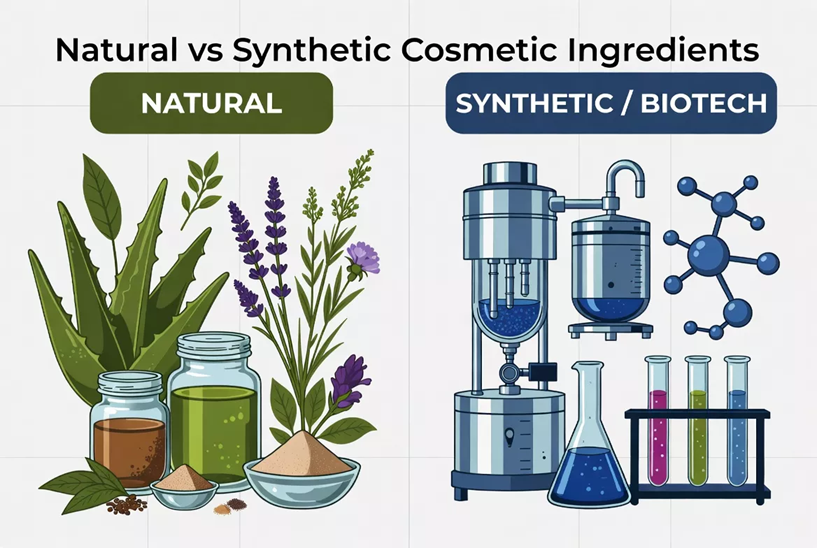
Everything in a cosmetic product is made of chemicals. These chemicals come from plants, minerals, fermentation, or laboratories. More importantly, being natural or synthetic does not determine safety or effectiveness by itself. The Clean Beauty Myth: Why Synthetic Ingredients Aren’t Always Bad frames how we evaluate ingredients. The relevant questions are what the ingredient is. They include how much is used. They include how the finished product is formulated, how it is applied, and what safety evidence exists.
The U.S. FDA notes that the ingredient source does not determine safety. Manufacturers remain responsible for ensuring cosmetic products are safe when used as directed. Moreover, The Clean Beauty Myth: Why Synthetic Ingredients Aren’t Always Bad informs consumer expectations.
What Does “Synthetic” Actually Mean?
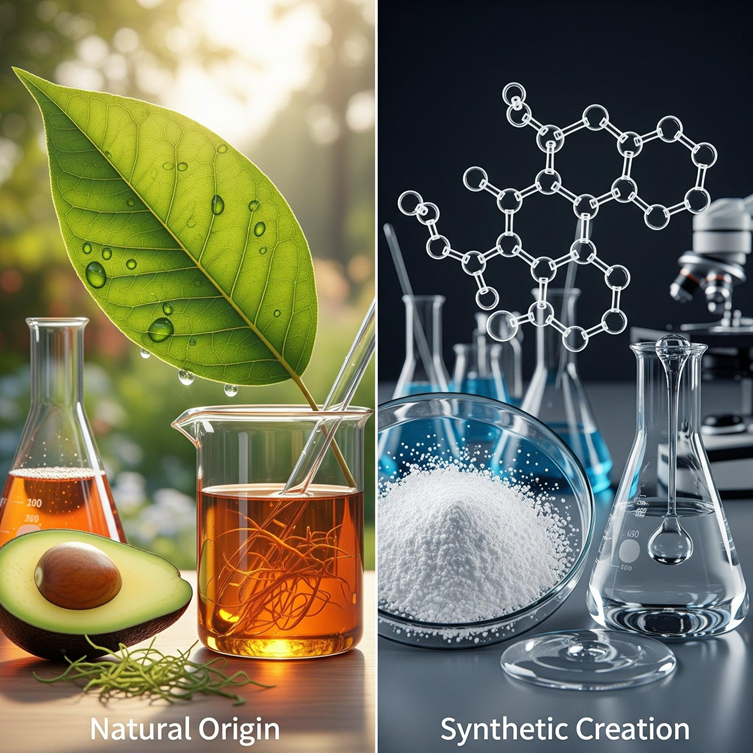
A synthetic ingredient is generally produced or modified through a controlled manufacturing process rather than being extracted directly from nature.
That doesn’t automatically make it harmful.
In fact, many synthetic ingredients are chemically identical or closely related to substances found naturally. For example, synthetic ceramics are commonly used in skincare to help replenish components of the skin barrier.
Similarly, allantoin can occur naturally, but the allantoin used in many cosmetic products is commonly produced synthetically.
The important distinction is therefore not simply:
Natural = good
Synthetic = bad
A more scientifically useful approach is:
Ingredient + concentration + formulation + exposure + evidence = safety assessment
Why Synthetic Ingredients Can Be Useful
1. They can provide consistency
Plant extracts can vary according to growing conditions, harvesting, storage, and processing. Carefully manufactured synthetic ingredients can provide much greater consistency from one production batch to another.
For skincare manufacturers, consistency matters because consumers should ideally receive a predictable formulation every time they purchase the same product.
2. They can improve product stability
Skincare products often contain water, oils, botanical extracts, and other components that can degrade or become contaminated.
Preservatives are particularly important because microorganisms can grow in inadequately protected cosmetic products. The FDA specifically identifies ineffective preservation systems as one potential contributor to microbial contamination.
A preservative isn’t necessarily something to fear simply because it was manufactured synthetically. In many formulations, preservation is an important part of product safety.
3. They can improve texture and performance
Synthetic or highly purified ingredients can be designed to deliver particular sensory or functional properties.
Dimethicone, for example, is a silicone-based ingredient widely used in moisturizers and hair products. It can help create a smooth skin feel and reduce friction.
Rather than judging an ingredient solely by its origin, consumers should consider what role it plays in the finished formula.
Natural Doesn’t Automatically Mean Safer
One of the biggest misconceptions surrounding clean beauty is that naturally derived ingredients are inherently gentle.
They aren’t.
Essential oils, botanical extracts, and plant-derived fragrance compounds can cause irritation or allergic reactions in some individuals. Cleveland Clinic notes that natural skincare products can still contain ingredients associated with contact dermatitis.
This is particularly important for people with sensitive or reactive skin.
The American Academy of Dermatology recommends testing new skincare products on a small area before incorporating them into a routine, because ingredients—including preservatives—can trigger allergic contact dermatitis.
The “Chemical-Free” Problem
Perhaps the most misleading phrase in beauty marketing is “chemical-free.”
Water is a chemical. Glycerin is a chemical. Hyaluronic acid is a chemical. Vitamin C is a chemical. Plant extracts are mixtures of chemicals.
So a genuinely chemical-free cosmetic product is not a meaningful scientific concept.
What consumers usually mean by “chemical-free” is that a product excludes particular ingredients they consider undesirable. That can be a perfectly reasonable personal preference, but it should not be confused with a scientific measurement of safety.
The FDA also cautions consumers not to assume that “natural” or “organic” automatically means safer.
A Better Way to Think About “Clean”
Look beyond the front of the package
Instead of focusing entirely on claims such as “clean,” “natural,” or “non-toxic,” examine the complete ingredient list.
Ask:
- What is the ingredient?
- What function does it serve?
- Is it appropriate for my skin?
- Is there credible safety information?
- How frequently will I use the product?
- Is the product formulated for leave-on or rinse-off use?
The same ingredient can behave differently depending on how and where it is used. FDA guidance emphasizes that ingredients considered safe in one type of application may not necessarily be appropriate for another exposure scenario.
Don’t confuse “free from” with “better”
A product labeled “paraben-free,” “silicone-free,” or “synthetic-free” may be perfectly suitable for someone who prefers those formulations.
But removing an ingredient doesn’t automatically make the replacement formulation superior.
For example, a manufacturer may need to replace a preservative system, emulsifier or texture-enhancing ingredient with another substance. The replacement should still be evaluated based on its own properties rather than receiving an automatic “safer” label.
Three Real-World Examples
Synthetic ceramics
Ceramides naturally occur in the skin and play an important role in the skin barrier. Synthetic ceramics can be incorporated into moisturizers to help support that barrier.
Their laboratory origin does not make them inherently inferior to naturally occurring ceramics.
Synthetic allantoin
Allantoin occurs naturally in the body and some plants, but cosmetic manufacturers commonly use synthetically produced allantoin. Its usefulness comes from the properties of the molecule—not simply from where it originated.
Preservatives
Preservatives are another excellent example of why “synthetic” isn’t synonymous with “bad.”
A water-based cosmetic can provide an environment in which microorganisms grow. An appropriately designed preservation system helps control that risk. FDA information on cosmetic microbiological safety highlights the importance of effective preservation and manufacturing practices.
When Synthetic Ingredients Deserve Scrutiny
None of this means that every synthetic ingredient is automatically safe.
Some substances can present legitimate safety concerns depending on their identity, concentration, route of exposure, and use conditions. Regulatory authorities can prohibit or restrict specific cosmetic ingredients when evidence indicates a safety concern.
The FDA also monitors emerging concerns involving particular groups of substances, such as PFAS in cosmetics, and has reported significant data gaps for some cosmetic uses.
This is why responsible beauty advice should avoid both extremes:
“All synthetics are dangerous.”
and
“All synthetic ingredients are perfectly safe.”
Neither statement reflects how toxicology and cosmetic formulation actually work.
How Consumers Can Make Smarter Choices
1. Focus on your skin’s needs
If your skin tolerates a well-formulated product, there is little scientific reason to reject it solely because an ingredient was produced synthetically.
If you have sensitive skin, fragrance sensitivity, or a history of contact dermatitis, your priorities may be different.
2. Be cautious with fragrance
Natural fragrance isn’t automatically gentler than synthetic fragrance. Fragrance components can cause irritation or allergic reactions in susceptible individuals. FDA notes that fragrance ingredients are subject to the same basic safety requirements as other cosmetic ingredients.
3. Patch-test unfamiliar products
When introducing a new skincare product, test it before applying it broadly. The American Academy of Dermatology recommends testing a product on a small area for several days to help identify potential reactions.
4. Choose evidence over marketing
A product’s effectiveness should ideally be supported by credible ingredient research, appropriate formulation, and realistic claims—not simply by words such as “clean,” “pure,” or “natural.”
For a beauty article intended for a general audience, these sources are particularly useful because they move the discussion away from marketing terminology and toward dermatology, formulation, and safety evidence.
Conclusion
The clean beauty movement has encouraged consumers to pay closer attention to what they put on their skin—and that is a positive development. The problem begins when “natural” becomes synonymous with “safe” and “synthetic” becomes synonymous with “harmful.”
Chemistry doesn’t work that way.
A synthetic ingredient can offer purity, consistency, stability, and useful performance. A natural ingredient can also be beneficial, but it can potentially cause irritation or allergy just as a synthetic ingredient can.
The smarter approach is not to fear synthetic ingredients or blindly trust natural ones. Read the ingredient list, understand the product’s purpose, consider your individual skin needs, and prioritize credible safety evidence over attractive marketing claims.
In clean beauty, the most useful definition of “clean” may ultimately be the simplest one: transparent, appropriately formulated, and supported by evidence.
