

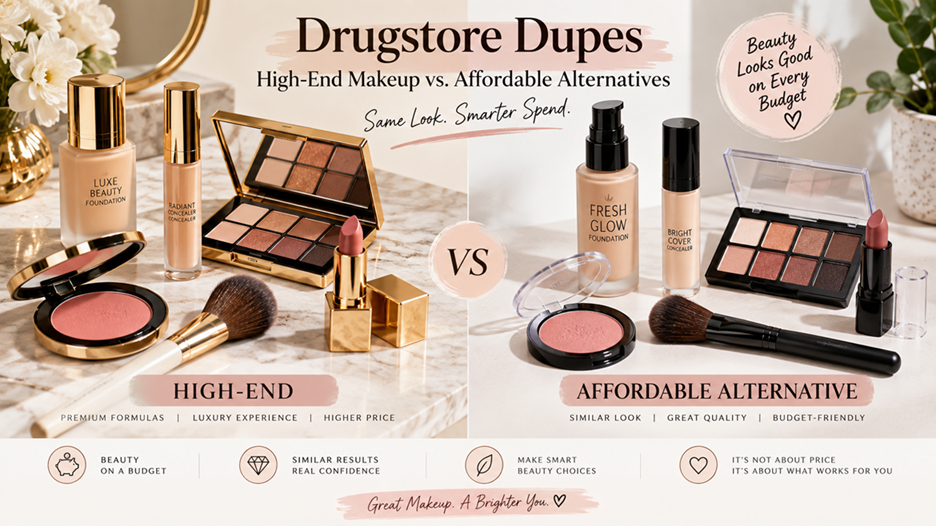
Luxury makeup has long been associated with beautiful packaging, sophisticated formulas, celebrity endorsements, and premium price tags. But in recent years, drugstore beauty brands have significantly expanded their product ranges, offering foundations, concealers, blushes, eye shadows, mascaras, and lip products at much lower prices.
This has made drugstore makeup dupes increasingly popular among beauty shoppers who want a similar finish without spending as much. However, a dupe is not necessarily an identical replacement. Two products can create a similar appearance while differing in ingredients, texture, longevity, shade range, application, or packaging.
So, how should you compare high-end makeup with affordable alternatives? The answer is to look beyond the price tag and evaluate what actually matters for your individual makeup routine.
What Is a Makeup Dupe?
A makeup dupe is an affordable product that is considered similar to a more expensive product, usually in terms of appearance, finish, color, texture, or overall performance.
The word “dupe” does not mean the products are officially identical. A drugstore foundation may provide a similar finish to a luxury foundation but use a different formulation. Likewise, two lipsticks can have nearly identical colors while differing considerably in comfort and wear time.
For example, comparisons between prestige and drugstore makeup have appeared in beauty media for years. Forbes has previously documented comparisons between luxury cosmetics and lower-priced alternatives, while noting that price alone does not necessarily determine product quality.
Why Are Drugstore Dupes So Popular?
1. Lower Cost
The most obvious advantage is affordability. Instead of spending $40–$70 on several prestige products, consumers can build a complete makeup collection for considerably less.
This is particularly useful for beginners who are still learning which formulas, shades, and finishes work best for them.
2. More Freedom to Experiment
Affordable products make experimentation easier. You may be more willing to try a bold eye shadow palette, unusual lipstick shade, or new blush formula when the financial risk is relatively low.
3. Improved Drugstore Formulas
Today’s drugstore makeup market is much more competitive than it was in the past. Allure’s testing of affordable eye shadows, for example, has highlighted drugstore formulas offering strong pigmentation, blend ability, and lasting performance.
That doesn’t mean every inexpensive product performs like a luxury product. It means shoppers have more high-quality choices than the old “cheap versus expensive” comparison suggests.
High-End Makeup vs. Drugstore Dupes: What Really Differs?
The biggest mistake when comparing makeup is focusing only on the ingredient list or price.
A better comparison considers several performance factors.
Formula and Texture
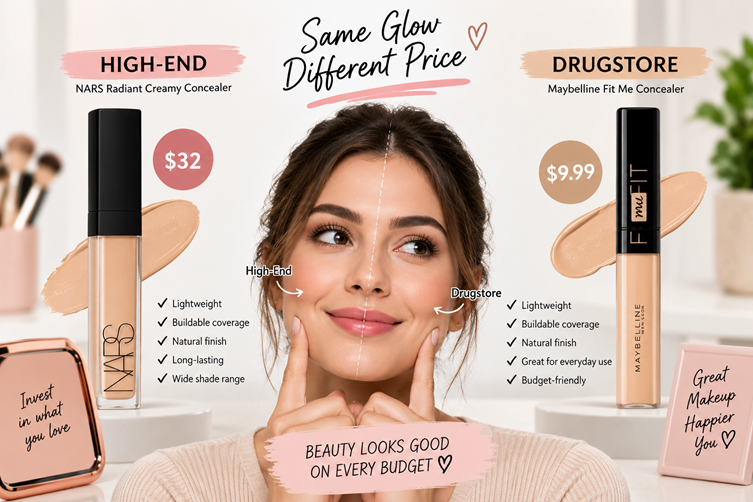
Foundation, concealer, cream blush, and lipstick can feel dramatically different even when their colors appear similar.
A high-end product may have a more refined texture, easier application, or particular finish that a cheaper alternative does not reproduce.
However, the reverse can also happen. Some affordable formulas may perform extremely well for a particular skin type or makeup style.
Pigmentation
Pigmentation is especially important for eye shadow, blush, bronze, and lipstick.
A highly pigmented product requires less product to achieve the desired intensity. But extremely high pigmentation is not automatically better. Beginners may actually prefer a build able formula because it provides more control.
Longevity
A product that looks identical immediately after application may perform differently several hours later.
When evaluating a dupe, consider:
- How long the foundation remains comfortable
- Whether concealer creases
- Whether blush fades evenly
- Whether eye shadow loses intensity
- Whether lipstick transfers easily
- How the product reacts to heat, humidity, or oil
This is one reason online “side-by-side” comparisons should be treated carefully. A photo or short video may show similar initial results without demonstrating how products perform throughout a full day. Allure made a similar observation in an earlier high-end-versus-drugstore makeup comparison.
Where Drugstore Dupes Often Make Sense
Mascara
Mascara is one category where spending more is not automatically necessary.
Since mascara is replaced relatively frequently, an affordable option can make practical financial sense. Look for the characteristics you actually need, such as lengthening, voluminous, curling, tubing, or smudge resistance.
Eyeliner
Drugstore eyeliners can offer excellent pigmentation and smooth application. For everyday black or brown eyeliner, a lower-priced product may provide everything you need.
Blush
Powder and cream blushes are another category where affordable products can be surprisingly effective. The key is finding the right undertone, pigmentation level, and finish.
Lip Products
Lipsticks, lip liners, and glosses are particularly easy to compare because color and finish are immediately visible.
A drugstore lipstick can reproduce the general appearance of a luxury shade without being chemically identical to it.
Eye shadow
Affordable eye shadows have improved considerably, although performance varies between formulas.
When comparing palettes, look at:
- Pigment intensity
- Blend ability
- Fallout
- Shimmer texture
- Matte performance
- Wear time
- Shade selection
Where a High-End Product May Still Be Worth Considering
Choosing a more expensive product isn’t necessarily wasteful. Sometimes the additional cost can be justified by characteristics that matter to a particular consumer.
Complexion Products
Foundation is highly individual. Undertone, oxidation, texture, coverage, skin type, and finish can all affect whether a product works.
Someone with dry skin may value a particular hydrating formula, while someone with oily skin may prioritize oil control and durability.
Therefore, a foundation should be judged on how it performs on your skin rather than simply whether it is expensive or inexpensive.
Specialized Formulas
Some premium products offer unusual finishes, sophisticated textures, or specialized shades that may be harder to find at lower price points.
Packaging and User Experience
Luxury makeup frequently places considerable emphasis on packaging, applicators, presentation, and the overall experience.
Those features don’t necessarily improve the makeup result, but they can still have genuine value to consumers who enjoy the experience of using premium cosmetics.
How to Find a Good Drugstore Dupe
Instead of searching for products based purely on viral recommendations, use a structured comparison.
Step 1: Identify the Product’s Main Benefit
Ask what you actually like about the expensive product.
Is it:
- The color?
- The finish?
- The coverage?
- The texture?
- The longevity?
- The pigmentation?
- The application?
Once you know the primary benefit, finding an alternative becomes much easier.
Step 2: Compare the Shade
For complexion products, shade matching is more important than brand reputation.
Check undertone as well as depth. A foundation with the correct depth but the wrong undertone can look noticeably different.
Step 3: Compare the Finish
Determine whether the original product is:
- Matte
- Natural
- Satin
- Radiant
- Dewy
- Shimmering
A similar color with a completely different finish is not necessarily a successful dupe.
Step 4: Read the Ingredient List
Ingredients can provide useful information, but don’t assume that two products will perform identically simply because they contain several of the same ingredients.
Cosmetic performance depends on the overall formulation, concentrations, manufacturing process, and interaction between ingredients.
For consumers shopping in the United States, the FDA provides information about cosmetic ingredient labeling and explains that retail cosmetics generally must declare ingredients on their labels.
Step 5: Look Beyond Influence Claims
Influence comparisons can be useful for discovering products, but they should not be your only source of information.
Look for independent testing, professional makeup artist opinions, multiple user experiences, and information from established beauty publications.
A Practical Duping Strategy
Suppose you love an expensive $50 foundation but don’t want to repurchase it every few months.
Instead of searching for a product described as its “exact dupe,” break the product down:
Original:
Medium coverage + natural finish + neutral undertone + long wear
Affordable alternative:
Medium coverage + natural finish + similar neutral undertone + acceptable wear
The affordable product doesn’t need to be chemically identical. If it meets the characteristics that matter most to you, it may be a practical alternative.
This approach is much more useful than expecting two products to be completely identical.
Are Expensive Makeup Products Always Better?
No simple rule can determine makeup quality based on price.
Price can reflect many factors, including packaging, brand positioning, research and development, distribution, marketing, retail margins, ingredients, manufacturing, and the overall consumer experience.
Forbes has previously reported on luxury-versus-drugstore cosmetic comparisons, illustrating that less expensive products can sometimes offer comparable results in specific categories.
At the same time, one successful dupe does not prove that every affordable product is equivalent to its luxury counterpart.
The right question is not:
“Is expensive makeup better?”
Instead, ask:
“Which characteristics am I paying for, and do those characteristics matter to me?”
Makeup Safety Matters More Than the Price
Whether you purchase luxury or drugstore makeup, product safety should remain a priority.
The U.S. Food and Drug Administration recommends reading cosmetic labels, following directions and warnings, keeping containers clean and closed, avoiding sharing makeup, and discarding products when their color or smell changes.
It’s also important not to assume that terms such as “natural” or “hypoallergenic” automatically mean a product is safer or suitable for everyone. The FDA specifically notes that “hypoallergenic” does not have a standardized FDA definition.
For eye makeup in particular, avoid using products that have changed in smell, color, or texture and follow the manufacturer’s usage recommendations.
Final Thoughts
Drugstore dupes have changed the way consumers think about makeup. A lower price does not automatically mean lower quality, just as a luxury price does not guarantee that a product will work better for every person.
The smartest approach is to compare formula, shade, finish, pigmentation, longevity, application, ingredients, and personal preferences rather than judging a product solely by its price.
For everyday products such as mascara, eyeliner, blush, lipstick, and many eye shadows, affordable alternatives can be worth exploring. For foundation and other complexion products, individual skin type, undertone, texture, and wear requirements may matter more than the brand name.
Ultimately, makeup is personal. The best product is the one that delivers the result you want, fits your budget, feels comfortable to use, and meets appropriate safety and labeling expectations. A thoughtful approach to drugstore dupes can help you spend less without turning your beauty routine into a compromise.
