

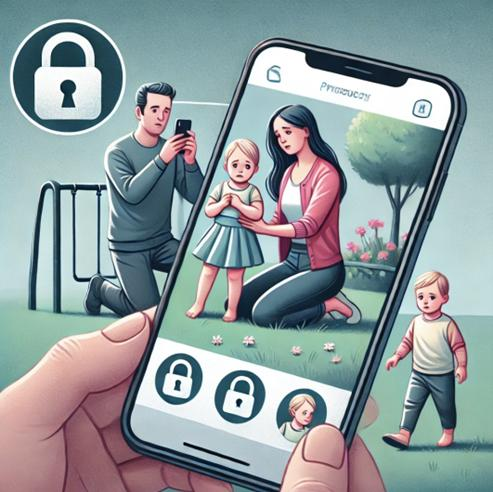
Sharing a child’s photo online can feel like a harmless way to celebrate birthdays, school achievements, family trips, or everyday moments. Social media makes it easy for parents and relatives to keep friends and family updated. However, once a child’s face and personal information are posted publicly, the child may have very little control over where that content goes or how it is used.
This practice is commonly called “sharenting”—sharing information, photos, or videos about children online. UNICEF notes that sharenting can create privacy and safety concerns while also raising important questions about children’s autonomy and consent.
The issue is not that every photo posted online will cause harm. Rather, parents should understand that a seemingly innocent image can contain more information than expected, and the long-term consequences may be difficult to predict.
What Is Sharenting?
A post might contain much more than a child’s face. A photograph taken outside school, for example, could reveal:
- The child’s name
- School uniform or logo
- School location
- Approximate home or neighborhood
- Sports team or extracurricular activities
- Birthday or age
- Family members
- Daily routines
- Places the child regularly visits
Individually, these details may appear harmless. Together, they can create a surprisingly detailed digital profile.
1. Loss of Privacy and Personal Control
One of the biggest concerns is that children do not always have a meaningful opportunity to decide whether their photographs should be shared.
A young child cannot fully understand what it means for a photograph to remain accessible online for years. Even older children may not appreciate the potential consequences of having personal images publicly available.
UNICEF emphasizes that involving children in decisions about sharing can help parents model the concepts of privacy and consent.
Why This Matters
Imagine a parent posting hundreds of photographs from a child’s early childhood. Years later, that child may dislike certain images or feel uncomfortable that personal moments were made public.
The parent may see those photographs as treasured memories. The child may see them as information that should have remained private.
2. A Permanent or Difficult-to-Control Digital Footprint
Once an image is uploaded, the original poster may lose control over it.
Other people can:
- Screenshot the image
- Download it
- Repost it
- Save it to another device
- Share it privately
- Modify it
- Upload it to another platform
Deleting the original post therefore does not necessarily mean the photograph has disappeared completely.
UNICEF similarly warns that information shared online can contribute to a child’s long-term digital footprint and may be difficult to remove later.
3. Exposure to Unwanted Attention
Publicly visible photographs can potentially attract attention from people the parent does not know.
This does not mean that every person viewing a child’s photograph has harmful intentions. However, parents generally cannot know exactly who is downloading, saving, or redistributing public images.
The National Center for Missing & Exploited Children (NCMEC) recommends using privacy settings and teaching children that online information can affect their safety and reputation.
For this reason, a private family-sharing environment is usually safer than a completely public profile when the purpose is simply keeping relatives informed.
4. Risk of Revealing a Child’s Location and Routine
A photograph can unintentionally provide clues about where a child lives, studies, or spends time.
For example, a caption such as:
“First day at ABC School!”
combined with a visible school uniform, school sign, street name, or location tag could reveal useful information about the child’s routine.
Similarly, repeated posts from the same playground, sports club, tuition center, or school can establish patterns.
Parents should therefore look beyond the child’s face and examine the entire photograph and caption before posting.
5. Cyberbullying and Embarrassment
Children’s opinions about their photographs can change dramatically as they grow.
A funny photograph that seems adorable to a parent may become embarrassing to a teenager. An image from childhood could later be shared by classmates or used to tease the child.
UNICEF identifies embarrassment, bullying, and loss of privacy among concerns associated with sharenting.
A Simple Example
Consider a parent posting a photograph of a child having an emotional tantrum with the caption, “Our little drama queen!”
The parent may consider it funny and harmless. At age 14, however, the child may feel humiliated if classmates discover the photograph.
The lesson is simple: before posting, consider whether the child would reasonably want the image online years later.
6. Images Can Be Manipulated by Artificial Intelligence
The growth of artificial intelligence has introduced another dimension to children’s online privacy.
Photographs can potentially be copied, manipulated, altered, or incorporated into synthetic content without the original family’s permission. UNICEF has specifically raised concerns about AI-generated sexualised images involving children and the misuse of children’s photographs.
This does not mean that every child’s photograph will be manipulated. It does mean that parents should recognize that publicly available images can be exposed to technologies that did not exist—or were far less accessible—when many parents first began sharing family photographs online.
Covering a child’s face with an emoji is also not a complete privacy solution. Other identifying features, backgrounds, clothing, or previously available photographs may still reveal information about the child.

7. Identity and Data-Privacy Concerns
A child’s identity can become increasingly visible through years of online posts.
For example, separate posts might reveal:
1: Child’s first name
2: Birthday
3: School
4: Sports team
5: Family members
6: Neighborhood or location
Individually, these details may not appear significant. Together, they can create a detailed record of the child’s life.
The American Psychological Association notes that sharenting raises concerns involving children’s privacy, autonomy, safety, identity theft, cyberbullying, and data exploitation.
8. Children Deserve a Voice in Their Digital Identity
Parents naturally make many decisions on behalf of young children. But a child’s digital identity can last far beyond childhood.
As children become old enough to understand social media, parents can begin asking:
- “Are you comfortable with me posting this?”
- “Would you want your friends to see it?”
- “Should I share this privately instead?”
- “Would you still be comfortable with this photograph in five years?”
This approach teaches children that photographs and personal information belong to real people—not simply to social-media feeds.
9. Public Posting Is Different From Private Family Sharing
Parents do not necessarily have to stop taking or sharing photographs altogether.
The more useful distinction is who needs to see the photograph.
If the goal is to update grandparents or close relatives, a private family group or secure sharing method may be more appropriate than a public social-media account.
UNICEF recommends considering the intended audience, privacy settings, identifiable information, locations, and possible future consequences before sharing children’s content.
How Parents Can Share More Safely
1. Think Before Posting
Ask three questions:
Who can see it?
What information does it reveal?
Could my child dislike this later?
If the answer to any of these raises concerns, reconsider the post.
2. Avoid Sensitive Information
Avoid including:
- Full name
- Home address
- School details
- Real-time location
- Daily routine
- Contact information
- Private medical information
- Embarrassing stories
- Photographs showing children undressed
3. Review the Background
Before uploading a photograph, check for:
- School signs
- House numbers
- Street signs
- Vehicle registration plates
- Location tags
- Uniform logos
- Documents
- Other identifying information
Even when the caption is vague, the background can provide clues.
4. Use Strong Privacy Settings
Private accounts can reduce exposure, although privacy settings are not a guarantee of complete privacy. NCMEC recommends using privacy controls to help manage who can see children’s online content.
Parents should periodically review their followers and remove people they no longer know or trust.
5. Give Older Children a Say
As children mature, involve them in decisions about their photographs.
Respecting a child’s “no” can be an important practical lesson in consent and digital responsibility.
6. Review Older Posts
Parents who have already shared many photographs do not need to panic.
A useful approach is to review old posts periodically and remove content that is unnecessarily personal, embarrassing, outdated, or no longer appropriate.
UNICEF specifically recommends reviewing previously shared content and considering deletion where appropriate.
A Practical “Before You Post” Test
Before publishing a child’s photograph, pause for 30 seconds and ask:
Privacy: Does this reveal personal information?
Audience: Do I really want everyone who can access my account to see it?
Consent: Is my child old enough to express an informed preference?
Future: Could this embarrass them later?
Safety: Does it reveal their school, home, location, or routine?
Permanence: Would I be comfortable if someone saved a copy?
If the answer to any question is “no,” consider keeping the photograph private.
High-Quality Visual Resources
For a publication, infographic, or educational article, the UNICEF sharenting visual is particularly relevant because it directly illustrates the idea of protecting children’s identities online.
Conclusion
Posting children’s faces on social media is not automatically harmful, but public sharing deserves careful consideration. The important issue is that children may have little control over photographs and personal information that adults publish about them.
The potential problems range from loss of privacy and embarrassment to unwanted exposure, identity and data concerns, cyberbullying, and the misuse or manipulation of images. These risks become more important as technology evolves.
The safest approach is not necessarily to eliminate every family photograph from the internet. Instead, parents can adopt a “share less, share thoughtfully” mindset: limit audiences, remove identifying information, avoid sensitive images, use privacy controls, and involve children in decisions whenever they are able to participate.
A photograph may capture a moment from childhood, but the digital record can last much longer. Protecting a child’s privacy today helps give them greater control over their identity tomorrow.
Recommended High-Authority Sources

2 Comments
Hilfreich! Text zu Song mit Text, Melodie und Gesang: Happy Shrimp unter /. Happy Shrimp
Praktisch. Schau dir WanVideoGen an: . WanVideoGen