






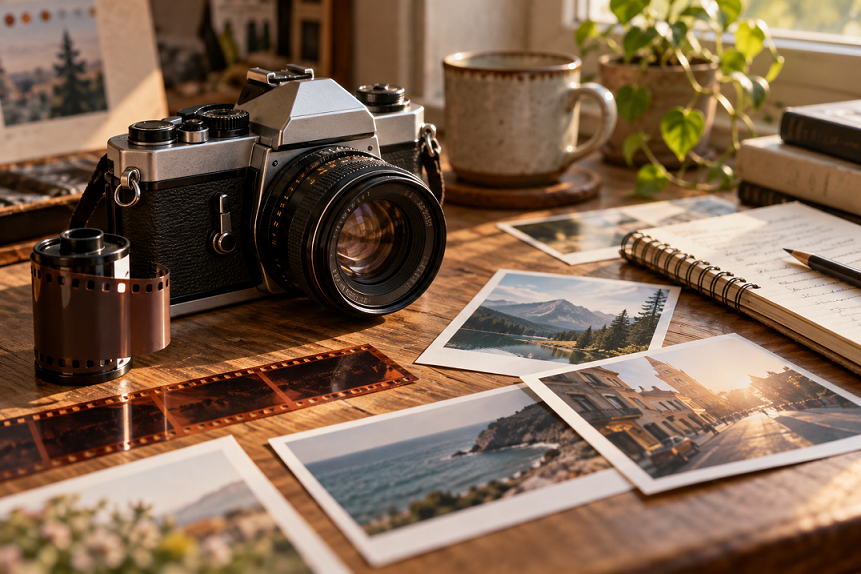
In an age when smartphones can capture thousands of high-resolution photographs without changing a roll of film, analogue photography might seem like a technology that belongs to another era. Yet film cameras have been attracting renewed attention from photographers, artists, collectors, and younger audiences.
The comeback is not simply about nostalgia. Film offers a different photographic experience: fewer exposures, deliberate composition, physical negatives, distinctive rendering, and a slower process that encourages photographers to pay attention to the moment.
Recent reporting from Forbes has highlighted renewed interest in Kodak and analogue cameras, including growing demand for film associated with the broader revival of physical and retro media.
What Is Analogue Photography?
Analogue photography uses light-sensitive photographic film rather than a digital sensor to record an image.
When a photograph is taken, light passes through the camera lens and exposes the film. The exposed film must then be chemically processed before the resulting negative or positive image can be viewed properly.
The most common formats include:
- 35mm film – widely used for everyday photography and still popular with enthusiasts.
- 120 medium-format film – produces larger negatives and is valued for detail and tonal quality.
- Large-format film – commonly used for specialized landscape, architectural, and fine-art photography.
- Instant film – produces a physical photograph shortly after exposure.
Unlike digital photography, the original image is physically recorded on film. That physical quality is an important part of analogue photography’s appeal.
Why Are Film Cameras Making a Comeback?
1. Photography Becomes More Deliberate
One of the biggest differences between film and digital photography is the limited number of exposures.
A typical 35mm roll may contain 24 or 36 frames. Every photograph therefore has a cost, both financially and physically.
This limitation can change the way a photographer works.
Instead of taking ten versions of the same photograph and selecting the best one later, you may spend more time considering:
- Composition
- Lighting
- Focus
- Exposure
- Subject movement
- Timing
That slower approach can be particularly useful for people who want photography to become a creative practice rather than simply a way of documenting everything.
National Geographic has previously discussed this characteristic of film, noting how the limited number of exposures can encourage photographers to think more carefully about composition and the moment they are photographing.
2. Film Produces a Distinctive Look
Film is not simply a lower-resolution version of digital photography.
Different films have different characteristics. Color-negative films, black-and-white films, and slide films can produce noticeably different colors, contrast, grain, and tonal transitions.
Even two films with the same ISO rating can produce different visual results.
Film grain, highlight behavior, color response, and the characteristics of lenses and scanning processes all contribute to the final image.
This is one reason photographers sometimes choose film for portraits, street photography, fashion, travel, and personal projects.
3. The Physical Experience Matters
Digital photographs usually exist as files on phones, computers, cloud storage, or social platforms.
Film creates something tangible.
A photographer can hold:
- A developed negative
- A contact sheet
- A printed photograph
- A slide
- A roll of undeveloped film
That physical connection gives analogue photography an archival and creative dimension that a collection of JPEG files does not necessarily provide.
The wider revival of physical media has also been documented by Forbes, which reported renewed interest among younger consumers in analogue products and other physical formats.
The Role of Nostalgia
Nostalgia undoubtedly contributes to the renewed interest in film cameras.
Older photographers may return to cameras they used decades ago, while younger photographers discover mechanical cameras through family collections, second-hand shops, social media, and photography communities.
But nostalgia alone does not explain the appeal.
Many photographers have never used film before and are attracted to the process precisely because it differs from smartphone photography.
A mechanical 35mm camera can feel refreshingly straightforward: choose the aperture, shutter speed, focus, compose the photograph, and press the shutter.
There may be no large screen demanding immediate attention.
Film Photography Encourages Screen-Free Creativity
Modern photography is closely connected to screens.
After taking a digital photograph, photographers often immediately:
- Review the image.
- Zoom in to check focus.
- Delete unsuccessful photographs.
- Edit the image.
- Upload it.
- Share it.
Film removes much of this immediate feedback.
You press the shutter and continue photographing. The results may not be visible until hours or days later.
This delay can be surprisingly valuable.
It allows the photographer to experience the event first and review the photographs later.
For travel photography, for example, this means spending more time looking at a city, landscape, or cultural experience rather than constantly checking the camera display.
Film Cameras Can Also Be Affordable
Although professional film cameras and collectible models can become expensive, analogue photography does not necessarily require a large investment.
The second-hand market contains enormous numbers of older 35mm cameras.
Models from manufacturers such as Canon, Nikon, Minolta, Olympus, Pentax, and others can sometimes be found through used-camera dealers and local markets.
However, condition matters.
Before purchasing a used film camera, check:
Camera body
Look for:
- Corrosion
- Broken battery compartments
- Damaged film doors
- Sticky controls
- Cracks
- Signs of water damage
Shutter
Test different shutter speeds if possible. A camera that has been sitting unused for years may require servicing.
Light seals
Old foam light seals can deteriorate. Replacing them is relatively common but should be considered when evaluating the condition of a vintage camera.
Lens
Inspect the lens for:
- Scratches
- Fungus
- Haze
- Excessive dust
- Damaged aperture blades
A cheap camera with a poor lens may not be a bargain.
Film Is Only Part of the Cost
One common mistake beginners make is considering only the price of the camera.
Analogue photography has several ongoing costs.
You may need to pay for:
- Film
- Development
- Scanning
- Printing
- Batteries
- Camera servicing
For example, someone shooting five rolls every month will spend considerably more on film and processing than someone who photographs only occasionally.
For beginners, this is not necessarily a disadvantage. The cost can encourage a more intentional shooting style.
Choosing Your First Film
Color-negative film
Color-negative film is a practical starting point for many beginners.
It offers considerable exposure latitude and is suitable for portraits, travel, street photography, and everyday images.
Black-and-white film
Black-and-white film is particularly useful for photographers interested in contrast, texture, architecture, documentary work, and classic photographic aesthetics.
It also provides an excellent way to learn how light and tonal relationships affect an image.
Slide film
Slide or transparency film produces a positive image that can be viewed directly or scanned.
It can deliver beautiful color and fine detail but generally requires more precise exposure than color-negative film.
Film Photography in Professional Work
Analogue photography is not restricted to hobbyists.
Film continues to have applications in fine-art photography, editorial work, fashion, cinema, archival projects, and specialized photographic practices.

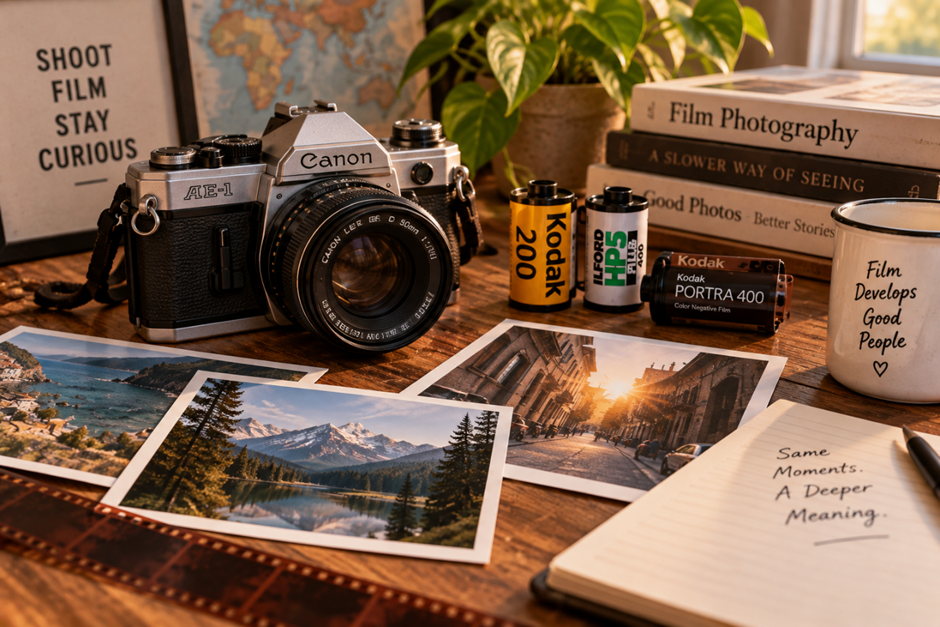
The continuing existence of film manufacturing also demonstrates that the medium has not simply disappeared. Forbes reported in 2025 that film remained an important part of Kodak’s business and that the company had experienced increased demand for film as interest in retro technology grew.
Film also remains important in motion-picture production. Industry discussions around the resurgence of large-format film have included major filmmakers and cinematographers who continue to use film for particular creative projects.
Analogue vs Digital Photography
Neither medium is universally superior. They solve different photographic problems.
| Feature | Analogue | Digital |
| Immediate preview | No | Yes |
| Number of exposures | Limited | Very large |
| Processing | Chemical/scanning | Digital |
| Physical negative | Yes | No |
| Shooting cost | Ongoing film cost | Usually lower per exposure |
| Editing | Scanning/printing or darkroom | Highly flexible |
| Workflow | Slower | Faster |
| Learning experience | Encourages deliberate shooting | Encourages experimentation |
| Convenience | Lower | Very high |
For professional assignments requiring hundreds or thousands of photographs, digital cameras are often more practical.
For personal projects where the process itself is important, film can offer a completely different experience.
Practical Example: A Weekend Film Project
Imagine taking a 36-exposure camera on a weekend trip.
Instead of photographing every street, meal, building, and landscape, you decide to make the roll tell a story.
You might allocate:
- 5 frames to landscapes
- 5 to architecture
- 10 to people and candid moments
- 5 to details
- 5 to experimental compositions
- 6 to spontaneous photographs
The limitation forces you to make decisions.
When the developed negatives arrive, the photographs become a record not only of the trip but also of what you considered worth photographing at the time.
That is one of the unique experiences film provides.
The Downsides of Film Photography
The resurgence should not hide the practical disadvantages.
Film photography is slower and can be more expensive than digital photography.
There is also no guarantee that every frame will work.
Incorrect exposure, camera problems, accidental double exposures, light leaks, poor development, or focusing mistakes can affect the final image.
Film also requires proper storage. Heat, humidity, and inappropriate storage conditions can negatively affect photographic materials.
Digital photography, by comparison, provides immediate feedback and makes it easier to correct mistakes while shooting.
For many professionals, that convenience is decisive.
Is Film Photography Really Coming Back?
The evidence points to renewed interest rather than a return to the dominant position film once held.
Digital photography remains the primary technology for most everyday photography, particularly because smartphones have made high-quality image capture almost universal.
The more accurate description is therefore a film revival within a predominantly digital photography world.
The renewed demand appears connected to several overlapping factors: interest in retro technology, creative experimentation, physical media, slower experiences, and the distinctive visual characteristics of film. Recent Forbes reporting has specifically connected analogue cameras with the broader resurgence of physical media among younger consumers.
How to Start Shooting Film
If you want to try analogue photography, keep your first setup simple.
Step 1: Find a functioning 35mm camera.
Step 2: Choose a widely available color-negative or black-and-white film.
Step 3: Learn the basics of ISO, shutter speed, and aperture.
Step 4: Start with one roll rather than buying large quantities.
Step 5: Have the film professionally developed and scanned.
Step 6: Review the results carefully.
Instead of judging the photographs only by whether they look attractive, ask what happened technically. Was the subject underexposed? Was the shutter speed too slow? Did the composition work? Was the depth of field appropriate?
That approach turns every roll into a practical photography lesson.
.
Conclusion
Analogue photography is not replacing digital photography. Instead, film is finding a new role in a world dominated by smartphones, digital cameras, and instant sharing.
Its appeal comes from the combination of craft, limitation, physicality, and visual character. A roll of film encourages photographers to slow down, think before pressing the shutter, and engage more deliberately with their surroundings.
For some photographers, the greatest attraction is the final image. For others, it is the process of loading the film, manually composing the frame, waiting for development, and finally holding a physical negative.
That distinction explains why film cameras continue to attract new photographers. In a world where taking a photograph has become almost effortless, analogue photography makes the act of taking one feel meaningful again.


