

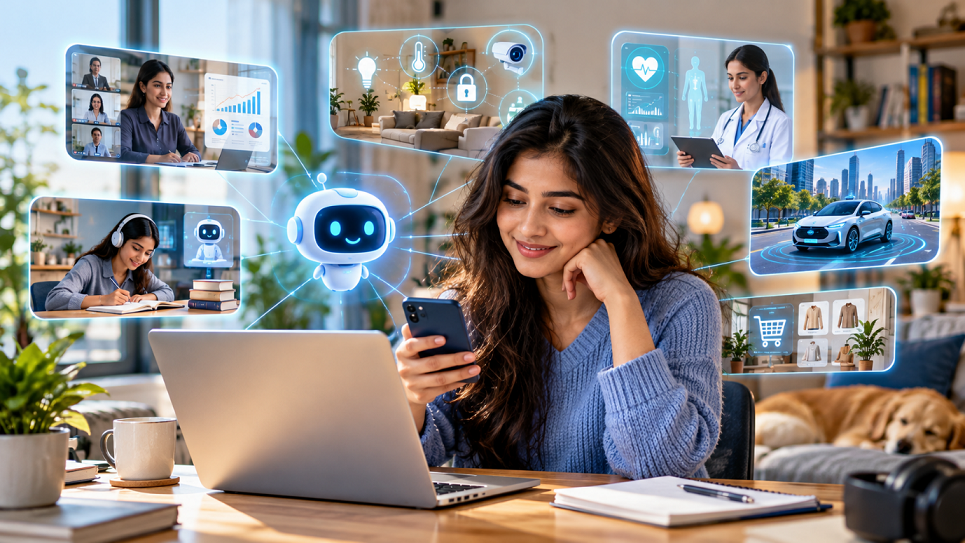
Artificial intelligence is becoming an increasingly important part of how people work, learn, communicate, shop, manage their health, and organize their daily routines. As AI tools become more accessible, their impact is extending beyond technology companies into homes, schools, offices, hospitals, and small businesses.
In 2027, understanding AI will be less about knowing how advanced technology works and more about recognizing how to use it responsibly in everyday situations. From virtual assistants that help manage schedules to intelligent learning platforms that adapt to individual needs, AI is changing how people solve problems and make decisions.
This article explores the practical applications of AI in daily life, the benefits it offers, the challenges people should understand, and the skills needed to make the most of this technology.
1. AI-Powered Personal Assistants and Smart Homes
One of the most visible ways AI is changing everyday life is through digital assistants and connected devices. AI-powered tools can help people organize their schedules, summarize information, draft messages, set reminders, and control compatible smart-home devices.
Everyday examples
- Personal productivity: An AI assistant can turn a list of tasks into a daily schedule and help prioritize urgent work.
- Smart homes: Compatible systems can learn household routines and help manage lighting, heating, and energy consumption.
- Communication: AI can translate languages, summarize long conversations, and assist with writing emails.
- Accessibility: Speech recognition, text-to-speech, and image descriptions can help people interact with digital information more easily.
For example, a busy professional could use an AI assistant to summarize meeting notes, prepare a shopping list, and organize appointments in less time.
However, AI assistants do not always understand context correctly. Users should check important details and avoid sharing sensitive information unnecessarily.
2. AI Is Transforming Education and Learning
Education is another area where AI can make a practical difference. AI-powered learning tools can explain difficult concepts, generate practice questions, provide language support, and adapt explanations to different skill levels.
Personalized learning experiences
Imagine a student learning mathematics who struggles with fractions. An AI tutor can explain the concept using simple examples, generate additional exercises, and offer alternative explanations when the student makes mistakes.
Similarly, professionals can use AI to learn new skills, practice a foreign language, understand technical subjects, or prepare for job interviews.
AI can also help teachers create lesson plans, develop quizzes, and adapt learning materials for different students.
The important distinction is that AI should support learning rather than replace it. Students still need to develop critical thinking, independent research, and problem-solving skills. AI-generated answers can contain factual errors, so educational claims should be checked against reliable sources.
3. AI in Healthcare and Personal Well-Being
AI is increasingly being used in healthcare research, medical imaging, administrative work, and clinical decision-support systems. Depending on the application, these technologies can help healthcare professionals identify patterns, process information, and manage workloads.
How AI can support healthcare
- Health monitoring: Wearable devices can use algorithms to identify patterns in activity, sleep, and certain physiological measurements.
- Medical research: AI can help researchers analyze large datasets and investigate potential treatments.
- Administrative support: Healthcare organizations can use AI to assist with documentation, appointment management, and information processing.
- Clinical support: Validated systems may help trained professionals interpret medical information or identify findings that need further examination.
For example, a person might use a health application to review sleep patterns and activity levels. These insights may encourage healthier habits, but they cannot establish a medical diagnosis on their own.
The World Health Organization emphasizes the importance of ethics, safety, accountability, and human rights when AI is used in healthcare. Read its guidance on AI ethics and governance in health for further information.
AI can assist healthcare professionals, but it should not replace qualified medical advice or emergency care.
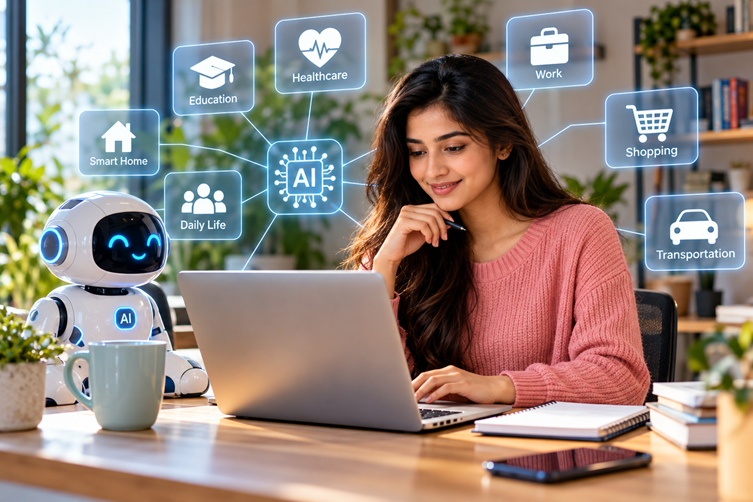
4. AI Is Changing the Way People Work
AI is changing workplace routines by helping people complete repetitive tasks, analyze information, and create first drafts of documents and other materials.
Practical applications across professions
| Profession | How AI can help |
| Digital marketing | Research ideas, analyze campaign data, and develop content outlines |
| Customer service | Categorize inquiries and draft responses |
| Accounting | Organize records and flag unusual transactions for review |
| Software development | Explain code, suggest improvements, and assist with debugging |
| Human resources | Draft job descriptions and organize recruitment information |
| Administration | Summarize documents and prepare meeting notes |
For example, a small business owner can use AI to prepare a draft email campaign, summarize customer feedback, and brainstorm promotional ideas. The owner still needs to check the facts, refine the message, and ensure that the campaign complies with applicable rules.
The most useful approach is to treat AI as a productivity tool, not an unquestionable authority. People who combine subject knowledge with the ability to evaluate AI outputs are better positioned to use it effectively.
5. AI Is Personalizing Shopping and Entertainment
Many digital services already use AI to recommend products, music, films, videos, and other content. In 2027, these applications are likely to remain an important part of how consumers discover information and make purchasing decisions, although the specific capabilities will vary by service.
Personalized recommendations
An online shopping platform may recommend products based on previous searches, purchases, or browsing activity. A streaming service may suggest films based on viewing history. Music applications may recommend playlists based on listening patterns.
AI can make these services more convenient by reducing the time needed to find relevant options.
However, personalization also has disadvantages. Recommendation systems may repeatedly present similar content, encourage unnecessary purchases, or limit exposure to different viewpoints.
Consumers can respond by reviewing privacy settings, comparing products independently, and avoiding the assumption that a recommended product is automatically the best or most affordable option.
6. AI Is Improving Transportation and Navigation
AI supports several transportation technologies, including traffic prediction, route planning, driver-assistance systems, and fleet management.
Navigation applications can estimate travel times using traffic information and suggest alternative routes. Delivery companies can use optimization systems to plan routes, while public transport operators may use predictive tools to help manage schedules and maintenance.
Driver-assistance features can help identify certain hazards or maintain distance from other vehicles, depending on the system.
Fully autonomous driving, however, remains subject to significant technical, legal, and geographic limitations. AI-supported navigation should not be confused with a vehicle that can safely drive itself in every situation.
In daily life, the most practical benefit is often straightforward: better information for planning journeys, managing deliveries, and reducing avoidable delays.
7. AI Is Supporting Small Businesses and Entrepreneurs
AI tools are making some business tasks more accessible to entrepreneurs who do not have large teams or extensive budgets.
Small businesses can use AI to brainstorm product ideas, prepare customer communications, analyze sales patterns, develop website content, and automate selected administrative tasks.
For example, a small online store could use AI to draft product descriptions, classify common customer questions, and summarize feedback from reviews. A business owner can then review the results and focus on decisions that require personal judgment.
AI also creates opportunities for freelancers and digital professionals in content production, marketing, design, software development, and data analysis.
Nevertheless, AI-generated content and automated workflows require quality control. Businesses must consider copyright, customer privacy, factual accuracy, and the risk of publishing misleading information.
8. The Challenges of Using AI in Everyday Life
Although AI offers significant benefits, responsible adoption requires an understanding of its limitations.
Privacy and data security
Some AI services process information submitted by users. Before uploading personal documents, customer records, financial information, or confidential business material, review the service’s privacy policy and data controls.
Misinformation and inaccurate answers
AI can produce convincing but incorrect statements, fabricated references, or outdated information. Verify important claims using primary sources, especially when dealing with health, legal, financial, or safety-related matters.
Bias and fairness
AI systems can reflect limitations or biases in their training data and design. Their recommendations and decisions should be evaluated carefully, particularly when they affect employment, access to services, or other important opportunities.
Employment and changing skills
Automation may reduce the need for certain repetitive tasks while changing the responsibilities of existing jobs and creating demand for new skills. The effect varies across occupations, organizations, and industries; it is not accurate to assume that every job will disappear or remain unchanged.
The National Institute of Standards and Technology provides a useful framework for understanding these concerns through its AI Risk Management Framework, which addresses reliability, safety, security, transparency, privacy, and fairness.
9. Essential AI Skills for Everyday Life in 2027
You do not need to become a programmer to benefit from AI. However, developing a few practical skills can help you use it more effectively.
- Writing effective prompts: Explain your goal, provide relevant context, and specify the format you want.
- Fact-checking: Verify important information using trusted publications, official websites, and original research.
- Digital privacy: Understand what information you should and should not share with AI tools.
- Critical thinking: Compare AI-generated recommendations with your own knowledge and judgment.
- Continuous learning: Keep developing communication, analytical, creative, and technical skills as workplace tools evolve.
UNESCO’s Recommendation on the Ethics of Artificial Intelligence is another useful resource for understanding the importance of human rights, transparency, and responsible AI use.
A practical way to start is to choose one repetitive task each week and test whether AI can make it easier. Measure the time saved, check the quality of the results, and continue only if the tool provides genuine value.
10. What Does the Future of Everyday AI Look Like?
By 2027, AI’s influence will depend not only on technological progress but also on affordability, accessibility, regulation, infrastructure, and public trust.
Some people may benefit from increasingly integrated assistants, more personalized digital services, and tools that can coordinate multiple steps in a workflow. Others may face barriers related to internet access, cost, language availability, digital literacy, or disability access.
The pace of adoption will differ between countries and communities. It is therefore more accurate to view 2027 as a period of continuing development than to assume that every household or workplace will use the same advanced AI technologies.
The strongest long-term approach is to combine useful automation with human judgment, accountability, and clear safeguards.
Conclusion
AI is changing everyday life by helping people organize tasks, learn new skills, access digital services, support healthcare, improve workplace productivity, and discover products and entertainment. These applications can save time and make certain activities more accessible, but their benefits depend on how the technology is designed and used.
The key is not to rely on AI for every decision. Instead, learn where it performs well, understand where it can fail, and verify important information before acting on it.
In 2027, people who use AI thoughtfully while maintaining their creativity, expertise, and critical thinking will be better prepared to adapt to a changing digital world.
