


Introduction to AI-Generated Text Detection
Artificial intelligence has transformed how people write articles, academic assignments, business reports, product descriptions, emails, and social media posts. Tools powered by large language models can produce fluent, well-structured text in seconds, making content creation faster and more accessible than ever. However, this convenience has created a new challenge: how can you determine whether a piece of writing was created by a human, generated by an AI tool, or produced through a combination of both? For teachers, publishers, website owners, editors, and employers, answering this question can be important when evaluating originality, credibility, and compliance with writing policies.
The good news is that several methods can help you assess whether text may have been generated by AI. These include examining writing patterns, checking factual accuracy, reviewing document history, using AI detection software, and comparing the text with the author’s established writing style. The important distinction is that identifying signs of AI-generated writing is not the same as proving who wrote a document. AI detection tools estimate the likelihood that text resembles machine-generated content, and their results can be wrong. Research and official guidance continue to highlight these limitations, so the most reliable approach combines technical analysis with human judgment and supporting evidence.
This guide explains how to detect AI-written text more accurately, which signals deserve attention, how to use detection tools responsibly, and what to do when different methods produce conflicting results. Whether you are reviewing an SEO article, checking a student assignment, or evaluating a professional document, you will learn how to make a more informed assessment without relying on a single score.
Why Detecting AI-Written Content Matters
Understanding whether AI contributed to a piece of writing can help organizations make better decisions about quality, transparency, and accountability. In education, an institution may need to determine whether a student’s work complies with its rules regarding AI assistance. In publishing, an editor may want to verify that an article contains accurate information, meaningful analysis, and appropriate sourcing rather than automatically accepting polished prose at face value. Businesses may also need to understand whether AI was used to prepare customer communications, reports, or other documents subject to internal policies. In each situation, the central concern should be the purpose and quality of the work, not simply whether a machine helped produce it.
For website owners and SEO professionals, AI detection has become another consideration in editorial quality control. AI can help generate outlines, summarize research, and improve readability, but a draft may still contain unsupported claims, repetitive explanations, or incorrect details. A publisher who focuses exclusively on whether a detector labels an article as AI-written can overlook these more consequential problems. Conversely, a human-written article can be inaccurate, unoriginal, or poorly researched even when every detector identifies it as human content. A stronger review process evaluates originality, usefulness, factual reliability, and the author’s contribution together.
There is also an important fairness issue. A false accusation can damage a student’s reputation, undermine trust between colleagues, or create unnecessary conflict between a writer and an editor. People who use simple vocabulary, write in a highly structured style, or work in a second language may produce text that resembles patterns associated with AI systems. That does not mean they used AI. The responsible goal is therefore to establish what evidence exists, understand the limits of each detection method, and avoid treating an automated prediction as a final verdict.
Common Signs of AI-Generated Text
AI-generated writing sometimes displays recognizable patterns, especially when a prompt asks for a general explanation without supplying specific experiences, research, or examples. The text may appear polished and organized while saying relatively little that is distinctive or useful. You might notice repeated transitions, predictable paragraph structures, broad statements, and conclusions that restate the introduction without adding a new insight. These clues can help you decide which parts of a document deserve closer examination, but none of them proves that AI was involved. Human writers also use templates, formal language, and repetitive structures, particularly when preparing technical documents or SEO-focused articles.
The most effective way to use stylistic clues is to examine several characteristics together. Ask whether the writing contains concrete examples, whether the arguments progress naturally, whether the author demonstrates knowledge beyond commonly available information, and whether the level of detail remains consistent throughout the document. Then compare those observations with other evidence, such as the author’s previous writing or the history of the document. A single unusual phrase is weak evidence, whereas several unexplained inconsistencies may justify a more thorough review. Even then, the correct conclusion is that the text deserves further investigation, not that its origin has been established.
Repetitive Language and Predictable Sentence Patterns
One common feature of generic AI-generated writing is repetition disguised as explanation. A paragraph might introduce the benefits of automation, the next might describe how automation improves efficiency, and a third might explain that efficiency saves time. Although the sentences differ, the underlying message remains nearly identical. AI systems can also produce familiar introductory phrases, balanced lists, symmetrical headings, and conclusions that repeat earlier points instead of advancing the discussion. When these patterns appear throughout a long document, they can indicate that the author relied heavily on a template or generated draft.
However, repetition alone is not a dependable detection method. SEO articles frequently repeat target keywords because the subject requires consistent terminology, while educational materials may repeat important concepts to support learning. Professional writers also use standard transitions and predictable structures to make complex information easier to understand. Rather than counting phrases mechanically, examine whether repeated statements add new evidence, examples, or interpretation. If a document repeatedly makes the same point without explaining how it works in practice, that is a legitimate quality concern regardless of whether AI produced it.
Generic Information and a Lack of Personal Experience
Another possible clue is the absence of meaningful specificity. AI-generated text may describe a topic in broad, grammatically correct terms without explaining what happened in a real situation, what decision was made, or what the consequences were. For example, an article about website optimization might recommend improving page speed, creating helpful content, and building back links without identifying a particular technical problem, presenting original research, or showing how a recommendation could be implemented. The advice might be broadly correct, but it could have been written for almost any website. This lack of depth is often more useful to an editor than simply asking whether the language sounds machine-generated.
Still, personal anecdotes are not proof of human authorship. AI can invent stories, imitate first-person writing, and generate plausible examples when prompted to do so. Human writers, meanwhile, may deliberately avoid personal details in formal reports, product documentation, and scientific papers. A better test is to verify specific claims and ask whether the writer can explain the reasoning behind them. If a text describes an experiment, check whether its methods and results are documented. If it describes a business experience, look for appropriate supporting records. Verifiable substance matters more than an apparently human voice.
How AI Text Detection Tools Work
AI detection tools generally analyze patterns in language and use statistical or machine-learning techniques to estimate whether a passage resembles text produced by AI systems. Depending on the detector, these patterns may include word choices, sentence structure, token probabilities, predictability, and features learned from examples of human-written and machine-generated material. The software then returns a classification, a probability estimate, or a score that indicates how the submitted text compares with patterns represented in its model. These outputs can be useful for prioritizing further review, but their meaning depends on the tool’s design and validation.
It is important to distinguish a detector’s score from a verified probability of authorship. A tool reporting that 80% of a passage appears AI-generated does not necessarily mean there is an 80% chance that AI wrote it. Some systems display percentages that represent estimated text coverage, confidence, or another proprietary measure rather than a calibrated probability. Before interpreting a result, read the tool’s documentation to understand what the number represents, what languages it supports, and how it performs on different types of writing. Without that context, even a precise-looking percentage can create a misleading sense of certainty.
Independent evaluation is particularly important because detector performance varies across models, domains, and writing conditions. A 2025 study published in the Findings of NAACL examined several AI text detectors and found that their performance could deteriorate when tested on unfamiliar generators or under relatively modest attempts to evade detection. The researchers emphasized that detection systems can struggle to maintain high sensitivity while keeping false-positive rates low. This is why a detector should be treated as one source of evidence rather than a universal authorship test.
Perplexity, Burstiness, and Linguistic Patterns
Two concepts often discussed in AI text detection are perplexity and burstiness. Perplexity is broadly related to how predictable a sequence of words is under a language model. Text containing highly predictable word sequences may receive a lower perplexity score under that model, while more surprising sequences may receive a higher score. Burstiness is commonly used to describe variation in features such as sentence length, structure, or linguistic complexity. Some AI-generated passages have relatively uniform sentence patterns, whereas natural human writing can display substantial variation. These are tendencies, not universal rules, and different tools may define or measure such features differently.
Imagine reading a passage in which almost every sentence follows the same rhythm and every paragraph introduces a point, provides three examples, and ends with a summary. That regularity might justify closer inspection, especially if the content is also vague and repetitive. Now imagine a human-written technical manual that deliberately uses consistent sentence structures to avoid ambiguity. The same regularity would be entirely appropriate in that context. Similarly, a skilled AI prompt can produce varied sentence lengths, while a human writer can produce highly predictable prose. Linguistic statistics become meaningful only when interpreted alongside genre, subject matter, and other evidence.
There is another limitation: perplexity depends on the model used to calculate it, and different systems can evaluate the same passage differently. Editing, translation, paraphrasing, and changes in vocabulary may also alter the measured patterns. Consequently, neither perplexity nor burstiness can establish authorship on its own. Use them as technical concepts that help explain how some detectors work, not as simple formulas that reliably separate every human writer from every AI system.
Step-by-Step Methods to Identify AI-Written Text
The most defensible approach is to use a consistent review process instead of making a snap judgment. Begin by defining the question you actually need to answer. Are you checking whether an article contains unreliable information, whether a student followed an AI-use policy, whether a writer has disclosed AI assistance, or whether a document is likely to have been generated almost entirely by a language model? These are different questions and require different evidence. A detector may help assess stylistic similarity, but document history and direct clarification may be much more useful when the issue concerns how a piece of work was produced.

Step 1: Read the document carefully
Look for repeated arguments, unsupported generalizations, abrupt changes in tone, questionable quotations, and examples that lack verifiable details. Record specific passages and explain what concerns you about them instead of labeling the entire document based on its overall appearance.

Step 2: Check the facts and references
Select important claims, statistics, quotations, and citations, then verify them against original documents or trustworthy sources. A fabricated reference is a serious reliability problem, although it is not exclusive to AI-generated writing. Verify the actual source rather than trusting a citation merely because it looks professionally formatted.

Step 3: Review writing history when available
Drafts, revision history, tracked changes, research notes, and source files can show how a document developed. A sudden appearance of a complete document may be worth asking about, but it is not proof of AI use because people can draft offline or paste text from other editors. Respect privacy and only review records you are authorized to access.
Step 4: Use a reputable AI detector
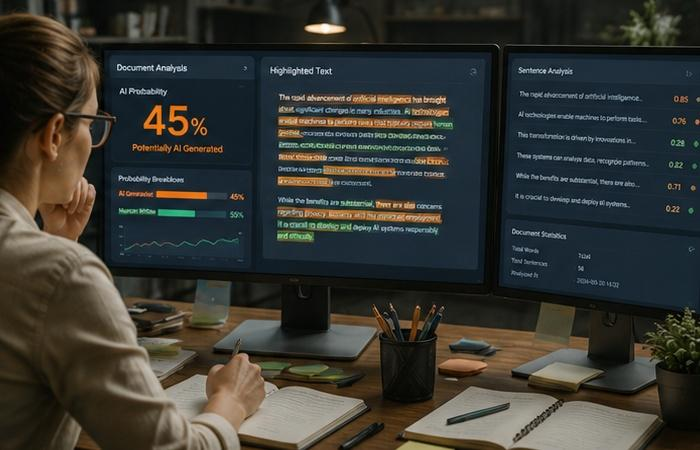
Submit the text to a tool that supports its language and document type. Check the tool’s limitations, text-length requirements, privacy policy, and explanation of its score. If the passage is short, heavily edited, translated, or highly formulaic, interpret the result especially cautiously.

Step 5: Compare results and seek clarification
If appropriate, compare the document with the author’s previous work and ask them to explain key arguments, sources, or drafting decisions. Look for agreement among independent evidence sources rather than repeatedly running the same text through similar detectors and treating every score as a separate confirmation.
This process is useful because it separates two tasks that are often confused: evaluating a document’s quality and determining how it was created. An article with false claims needs correction whether it was written by a person or generated by AI. A document that appears statistically similar to AI output needs further investigation before anyone makes an authorship claim. If the evidence remains inconclusive, record that uncertainty and apply the relevant policy fairly rather than forcing a definitive answer.
Best AI Text Detection Tools to Consider
Several tools offer AI writing detection or related writing-analysis features, but their capabilities, supported languages, pricing, and reporting methods can change. The right choice depends on whether you are reviewing student work, website content, professional documents, or large volumes of submissions. Before selecting a service, examine its documentation and seek independent evaluations relevant to your use case. A vendor’s own accuracy claims can provide useful information, but they should not replace testing on representative samples of your own content.
| Tool or resource | Potential use | Important limitation |
|---|---|---|
| GPTZero | Screening essays and other writing for patterns associated with AI generation | A flagged result is not proof; performance depends on the text and evaluation conditions |
| Copyleaks | Reviewing documents for AI-related indicators and, where available, plagiarism | AI detection and plagiarism detection answer different questions |
| Originality.ai | Reviewing web articles and editorial content | Results should be independently validated before making consequential decisions |
| Turnitin | Academic writing review where an institution has access to supported features | Institutional settings, coverage, and reporting rules matter |
| Manual review and document history | Checking facts, source quality, revision patterns, and author explanations | Requires time and contextual judgment; history may be incomplete |
These names are examples of services to investigate, not a ranking or an endorsement of their current accuracy. Feature availability and access conditions may vary, so check the providers’ official documentation before relying on a particular capability. A sensible evaluation should measure both false positives and false negatives using a collection of human-written and AI-generated samples representative of the documents you expect to review.
For a more rigorous comparison, use samples with known origins and evaluate them separately by writing type, length, language, and degree of editing. Measure how often the detector identifies AI-generated samples correctly and how often it incorrectly flags human-written ones. Do not judge a tool solely by its overall accuracy, because that number can conceal poor performance on a particular group or document type.
How to Verify AI Detector Results
A detector result becomes more useful when you test it against evidence that can be independently checked. Start by identifying exactly what the software flagged. Did it highlight the entire article, only a few paragraphs, or a passage containing standardized language? Read those sections in context and compare them with the rest of the document. Then verify the facts, examine the quality of the sources, and consider whether the writing style is appropriate for the intended audience. If the detector identifies a paragraph as likely AI-generated but the passage contains a documented quotation or standard technical definition, the score may tell you very little about authorship.
The next step is to look for evidence of the writing process. If you have legitimate access to document history, successive drafts may reveal how the writer developed the argument, incorporated research, or responded to feedback. A writer may also be able to explain why a source was selected, how a calculation was performed, or how a particular conclusion was reached. These explanations should be evaluated on their merits, not treated as an interrogation or a test that someone must pass to prove innocence. An unfamiliar writing style or an inability to recall every drafting decision is not proof of misconduct.
When the consequences are significant, use a documented review process. Record the tool name, date, version if available, the text analyzed, and the specific evidence supporting your concern. Separate observations from conclusions: “The report contains three unverifiable citations” is an observable finding, while “AI definitely wrote this report” is an authorship claim that requires different evidence. Where possible, ask an independent reviewer to assess the material. If the evidence is mixed, say so explicitly. Accurate detection is not about finding the most convincing score; it is about reaching the most defensible conclusion.
Why AI Detection Tools Sometimes Fail
AI detectors face a fundamental challenge: modern AI systems can generate text that closely resembles human writing, and humans can write in ways that resemble machine-generated output. Because the two categories overlap, a detector examining only the final text cannot always distinguish between them. Editing, translation, paraphrasing, and collaboration make the task more complicated, especially when a document combines human ideas with AI-generated passages. Even a technically sophisticated system can make mistakes when the text differs from the examples used during its development.
Two errors are particularly important. A false positive occurs when human-written text is incorrectly identified as AI-generated. A false negative occurs when AI-generated text is incorrectly classified as human-written or fails to trigger the detector’s threshold. Both errors matter, but their consequences depend on the situation. In an academic setting, false positives can lead to unfair accusations; in editorial screening, false negatives can allow a reviewer to overlook content that deserves additional quality checks. The right balance depends on the intended use, and neither error can be eliminated simply by choosing a higher confidence threshold.
OpenAI’s experience illustrates the problem. The company discontinued its own AI text classifier on July 20, 2023, citing low accuracy. In its original evaluation on a challenge set of English texts, the classifier correctly identified only 26% of AI-written text as likely AI-written and incorrectly labeled 9% of human-written text as AI-written. These figures describe that specific historical classifier and evaluation, not the performance of every detector available today. Nevertheless, they demonstrate why detection claims need to be assessed against real testing results rather than accepted at face value.
Language and writing style create additional challenges. Research and guidance have raised concerns that some detectors can perform poorly on writing produced by people who are not native speakers of English, particularly when their writing uses simpler or more predictable language. Translated text, formulaic technical prose, short passages, and heavily edited documents may also behave differently from the samples on which a tool was evaluated. This makes it especially important to avoid using a detector score as the sole basis for a disciplinary decision, employment action, or public accusation.
AI Detection for SEO, Education, and Business
Detecting AI-Written Content for SEO

For SEO professionals, the goal should be to publish useful, original, trustworthy content rather than to achieve a particular AI detector score. An AI-assisted article can offer value when an editor verifies its claims, adds meaningful analysis, includes relevant examples, and makes the information genuinely useful to readers. By contrast, a human-written article can perform poorly if it merely repeats existing information, targets keywords unnaturally, or fails to answer the reader’s question. The more productive editorial process is to examine whether the content satisfies search intent, provides evidence for its claims, demonstrates appropriate expertise, and offers something valuable beyond generic explanations.
AI detection can still be used as an optional screening step. If an article contains repetitive passages or broad statements, a detector may prompt an editor to investigate those sections more closely. However, rewriting content solely to make a detector report a lower AI score is not a reliable quality strategy. Instead, improve the underlying work by checking every factual claim, removing redundancy, adding original research where possible, and making recommendations specific to the audience. Search visibility and reader trust depend on the quality of the published page, not on whether an automated classifier considers its prose human-like.
Detecting AI Use in Education
Teachers and educational institutions should distinguish between unauthorized AI use and legitimate assistance. A student may use an AI tool to brainstorm ideas, improve grammar, translate a phrase, or organize research, depending on the institution’s rules. These activities are not necessarily equivalent to submitting an entirely AI-generated assignment as independent work. Before evaluating a submission, educators should communicate which uses are allowed, what disclosure is required, and what evidence may be considered during a review.
When a concern arises, compare the assignment with the student’s previous work, review available drafts and notes, and discuss the reasoning behind important arguments. Differences in style can justify a conversation, but they cannot establish misconduct by themselves. Institutions should follow established procedures, allow students to respond, and account for the limitations of automated detection. A fair process protects academic integrity while recognizing that a detector can misclassify genuine human writing.
Detecting AI Use in Business and Publishing
Businesses and publishers may use AI detection as one part of a broader content governance process. For example, an organization might require writers to disclose AI assistance when preparing regulated communications, confidential reports, or material that must meet specific authorship standards. In these situations, the organization should define the policy clearly and specify what level of assistance is permitted. A detector cannot determine whether an employee followed a disclosure rule because it cannot reliably reconstruct the complete process behind a document.
Editors should also consider more direct ways to establish provenance. Approved writing platforms may provide version history, source records, or other workflow information, while a writer may be able to provide research notes and supporting material. These records can help clarify the process, although none should automatically be treated as conclusive in isolation. Access should be limited to information the organization is authorized to review, and sensitive documents should not be uploaded to external detection services without appropriate privacy and security checks.
Ethical and Responsible AI Detection Practices
Responsible AI detection begins with recognizing the difference between suspicion and proof. A tool can produce a useful warning, but a warning does not justify an accusation without additional evidence. This distinction is particularly important when a decision could affect someone’s education, professional reputation, or livelihood. Reviewers should explain their concerns clearly, give the author a fair opportunity to respond, and avoid overstating what the evidence establishes. When the origin of a document cannot be determined reliably, acknowledging uncertainty is more accurate than pretending to have certainty.
Privacy is another essential consideration. Before submitting text to an online detector, review how the provider handles uploaded content, whether it retains submissions, and whether the material could be used for other purposes. This matters when documents contain personal information, unpublished research, confidential business material, or sensitive academic work. Use approved services for confidential material and follow the relevant organization’s data-handling rules. If a document does not need to be uploaded to a third-party service, local review and source verification may be safer alternatives.
Finally, detection policies should focus on the behavior that actually matters. If the concern is fabricated evidence, verify the sources. If the concern is plagiarism, investigate unattributed copying. If the concern is undisclosed AI assistance, examine the applicable disclosure policy and available process evidence. These are related but distinct problems, and an AI detector is not a substitute for the appropriate investigation. A transparent, proportionate process protects both the integrity of the work and the people who create it.
Conclusion
Learning how to detect if text was written by AI tools accurately requires more than running a document through an online detector. The strongest approach combines careful reading, linguistic analysis, factual verification, document history, and appropriate detection software. Repetitive language, predictable sentence structures, generic explanations, and unsupported claims can provide useful clues, but they cannot independently establish who wrote a passage. Similarly, a high AI detection score should be interpreted according to the tool’s methodology and known limitations rather than accepted as definitive proof.
For SEO professionals, teachers, editors, and business owners, the best strategy is to focus on verifiable evidence and the actual purpose of the review. Check references, examine the development of the document when appropriate, compare independent findings, and give authors a fair opportunity to explain their work. Remember that AI-generated content can be accurate and useful, while human-written content can still contain serious errors. The most reliable way to assess writing is to combine technology with critical thinking, evidence, and human judgment. AI detectors can support that process, but they should never replace it.

Frequently Asked Questions (FAQs)
1. How can I tell if text was written by AI?
Look for several possible indicators, including repetitive explanations, predictable sentence structures, vague claims, unsupported facts, and a lack of meaningful detail. Verify citations and compare the writing with the author’s previous work when appropriate. You can also use an AI detection tool, but no single indicator or score can conclusively establish authorship.
2. Are AI text detector tools 100% accurate?
No. AI detection tools can produce both false positives and false negatives. Their performance varies depending on the model, language, text length, editing, and type of writing. Use detector results as preliminary evidence and verify important findings through independent methods.
3. Which AI detector is best for checking written content?
The best option depends on your purpose. GPTZero, Copy leaks, Originality.ai, and Turnitin offer tools or features relevant to different writing-review workflows. Compare their current capabilities, privacy policies, and independent evaluations before choosing one. No detector should be treated as a universal authority on authorship.
4. Can AI-written text pass an AI detector?
Yes. Some AI-generated text may not be flagged, particularly when the content is edited, combined with human writing, or produced by a system unfamiliar to the detector. Results also vary between tools. A passage that passes detection should not automatically be considered human-written.
5. Can AI detectors mistakenly flag human-written content?
Yes. Human-written text can be flagged because its vocabulary, sentence patterns, or structure resemble patterns associated with AI-generated content. This risk is especially important when evaluating formulaic writing, translated material, or writing produced by people with different language backgrounds. Always consider contextual evidence before making an accusation.
