

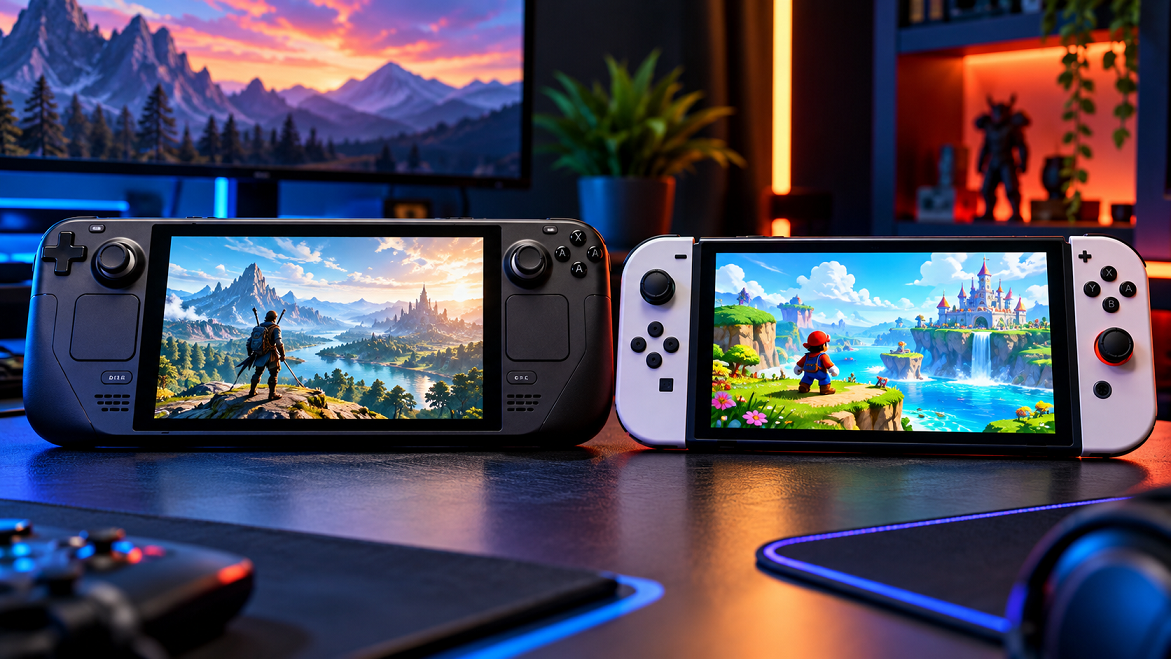
Handheld gaming has changed dramatically. What was once a choice between traditional portable consoles is now a competition between full PC gaming and Nintendo’s distinctive hybrid-console ecosystem. In 2026, two of the most recognizable options are Valve’s Steam Deck OLED and Nintendo Switch 2.
They approach portable gaming from very different directions. The Steam Deck OLED is essentially a compact gaming PC built around SteamOS, giving players access to a huge PC game library and extensive customization. Switch 2, meanwhile, combines portable gaming with Nintendo’s first-party ecosystem, detachable Joy-Con 2 controllers, and a more conventional console experience.
So, which one wins? There isn’t a universal answer. The better choice depends heavily on the games you play, how you use your device, and whether you value PC flexibility or Nintendo’s console ecosystem.
Steam Deck OLED vs. Switch 2 at a Glance
| Feature | Steam Deck OLED | Nintendo Switch 2 |
| Display | 7.4-inch HDR OLED | 7.9-inch LCD, HDR10 |
| Resolution | 1280 × 800 | 1920 × 1080 |
| Refresh rate | Up to 90Hz | Up to 120Hz with supported software |
| Processor | AMD Zen 2/RDNA 2 APU | Custom NVIDIA processor |
| Memory | 16GB LPDDR5 | 12GB LPDDR5X |
| Storage | 512GB or 1TB NVMe SSD | 256GB UFS |
| Storage expansion | microSD | microSD Express |
| Operating system | SteamOS | Nintendo’s proprietary system software |
| Handheld weight | Approx. 640g | Approx. 534g with Joy-Con 2 |
| TV output | Up to 4K/120Hz via compatible setup | Up to 4K/60fps in TV mode |
| Key strength | PC gaming flexibility | Nintendo ecosystem and hybrid design |
The manufacturers’ official specifications confirm these fundamental hardware differences.
1. Design and Portability
Steam Deck OLED
The Steam Deck OLED is a substantial handheld. Its wider body provides room for large controls, dual track pads, rear grip buttons, and full-size analog sticks.
That size is beneficial during long gaming sessions because the controls are positioned more like a traditional game pad. The trade-off is portability: it occupies more space in a bag than the Switch 2.
The OLED model weighs approximately 640 grams and measures 298 × 117 × 49 mm.
Nintendo Switch 2
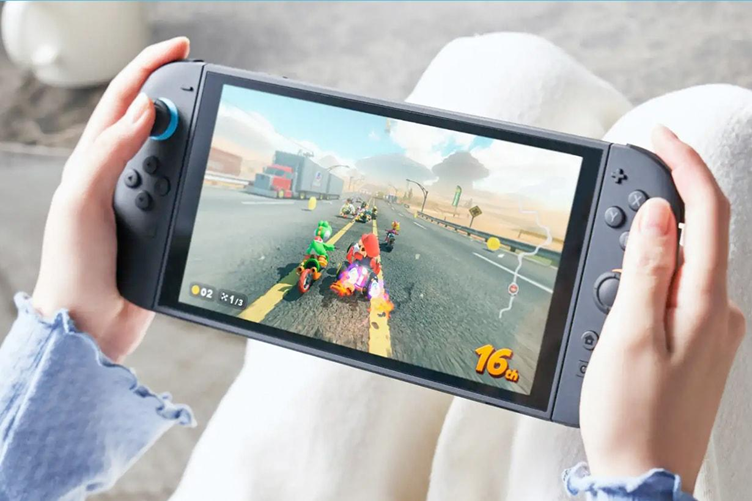
Switch 2 takes a slimmer, more traditional hybrid-console approach. Its Joy-Con 2 controllers can be detached, allowing tabletop play and multiplayer without requiring a separate conventional controller.
With Joy-Con 2 attached, Nintendo lists its weight at approximately 534 grams.
Practical difference: If you frequently switch between handheld, tabletop, and television gaming, Switch 2’s design is particularly useful. If you primarily sit down for long handheld sessions, the Steam Deck’s larger control layout can be more comfortable for many players.
2. Display: OLED Quality vs. Resolution
This is one of the most interesting differences.
The Steam Deck OLED uses a 7.4-inch HDR OLED panel with a 1280 × 800 resolution, up to 90Hz refresh rate, 600-nit SDR brightness, and up to 1,000 nits peak HDR brightness.
Switch 2 uses a larger 7.9-inch 1920 × 1080 LCD with HDR10 and VRR support up to 120Hz.
This creates two different advantages.
Steam Deck OLED: OLED technology provides deep blacks, extremely high contrast, and vibrant colors. Games with dark environments can look particularly impressive.
Switch 2: Its higher 1080p native resolution provides greater pixel density and sharper image presentation, while supported games can take advantage of higher refresh rates.
For someone who prioritizes display contrast and HDR presentation, Steam Deck OLED remains extremely attractive. For someone who values resolution and Nintendo’s newer display technology, Switch 2 has a strong argument.
3. Performance and Graphics
Directly comparing specifications can be misleading because these consoles use different hardware architectures and operating environments.
Steam Deck OLED uses an AMD 6nm APU with a Zen 2 four-core/eight-thread CPU and RDNA 2 graphics with eight compute units. It has 16GB of LPDDR5 memory.
Nintendo uses a custom NVIDIA processor in the Switch 2 and pairs it with 12GB of LPDDR5X memory. Its system can output up to 4K resolution at 60fps in TV mode, while 1080p and 1440p modes can support 120fps where software allows it.
The important point is that hardware specifications alone don’t determine gaming performance.
Nintendo controls the hardware and software environment much more tightly. Developers can optimize games specifically for Switch 2.
Steam Deck, on the other hand, operates like a portable PC. Game performance varies considerably depending on the title, graphics settings, Proton compatibility, and optimization.
4. Game Library: The Biggest Difference
For many buyers, this is more important than hardware.
Steam Deck’s PC ecosystem
Steam Deck gives players access to a huge PC library through Steam. Valve also provides its Steam Deck Verified compatibility system, which categorizes games based on how well they work on the device.
That doesn’t mean every PC game works perfectly.
Some games may require configuration changes, while others may have compatibility issues because of anti-cheat software, launchers, or other PC-specific requirements.
The benefit is enormous flexibility: your Steam library can travel with you, and PC games frequently receive discounts through Steam sales.
Switch 2’s Nintendo ecosystem
Switch 2’s biggest software advantage is Nintendo’s first-party catalog.
Games and franchises associated with Nintendo—including Mario, Zelda, Pokemon, Kirby and Animal Crossing—remain an important reason people choose Nintendo hardware.
Switch 2 is also compatible with many original Nintendo Switch games, although Nintendo notes that compatibility can vary by title and that some games receive specific updates or upgrades for Switch 2.
This creates a simple distinction:
Steam Deck: enormous PC ecosystem and customization.
Switch 2: highly curated console ecosystem and Nintendo exclusives.
5. Battery Life
Battery performance is complicated because actual runtime depends heavily on the game, brightness, refresh rate, and power settings.
Valve officially rates the Steam Deck OLED for approximately 3–12 hours of game play.
Nintendo’s official Switch 2 specifications list approximately 2–6.5 hours, although real-world results vary considerably by software and settings.
Independent testing also demonstrates why published battery ranges should not be treated as guarantees. Tom’s Guide conducted a controlled comparison using the same game and reported different results between the two devices, while also noting that battery testing can be highly sensitive to methodology.
For travel, therefore, consider battery capacity as one factor rather than assuming a single published number represents every gaming scenario.
6. Controls and User Experience
Steam Deck has several features that distinguish it from conventional consoles:
- Dual track pads
- Four programmable rear buttons
- Gyroscope
- Full-size analog sticks
- SteamOS desktop mode
- Extensive controller customization
These features can be especially useful for PC games originally designed around keyboard and mouse controls.
Switch 2 takes a simpler console-oriented approach. Joy-Con 2 controllers include motion controls and a mouse sensor, while the detachable design provides additional flexibility.
For someone who wants to customize controls extensively, Steam Deck is particularly compelling.
For someone who wants to pick up a controller and start playing with minimal configuration, Switch 2’s console-first approach is attractive.
7. TV and Multiplayer Gaming
This is where Switch 2’s hybrid philosophy becomes particularly important.
The system is designed to transition between handheld, tabletop, and TV modes. Its dock supports wired LAN and TV output up to 4K/60fps, with higher frame-rate modes available at lower resolutions where supported.
Steam Deck can also be connected to external displays and accessories. Valve’s dock supports DisplayPort and HDMI output, including up to 4K at 60Hz under supported configurations.
However, Switch 2’s detachable controllers make spontaneous local multiplayer much more natural.
Imagine taking a console to a friend’s house: with Switch 2, you can remove the Joy-Con 2 controllers and immediately set up a multiplayer session.
With Steam Deck, multiplayer is possible, but the setup can involve additional controllers and accessories.
8. Software Flexibility
This is arguably Steam Deck’s biggest technical advantage.
SteamOS is built on Linux and gives the device a PC-like environment. Users can access desktop applications, modify settings, and experiment with different configurations.
That flexibility is excellent for technically inclined gamer.
But flexibility also creates complexity.
Switch 2 deliberately hides much of that complexity. Nintendo controls the platform, operating system, and hardware ecosystem, so users generally encounter a more traditional console experience.
For parents, casual gamer, or people who simply want gaming without troubleshooting, this distinction can matter more than raw specifications.
9. Which Handheld Is Better for Different Gamer?
Choose Steam Deck OLED if you:
- Already have a large Steam library.
- Prefer PC gaming.
- Want extensive customization.
- Play indie and older PC games.
- Want an OLED display.
- Enjoy tweaking graphics and performance.
- Want desktop-PC functionality in a handheld.
Choose Switch 2 if you:
- Want Nintendo exclusives.
- Frequently play multiplayer locally.
- Prefer a traditional console experience.
- Want detachable controllers.
- Use handheld and TV modes regularly.
- Value a lighter hybrid design.
- Want games specifically optimized for Nintendo hardware.
10. What About Long-Term Value?
Long-term value isn’t simply about technical specifications.
A Steam Deck can become part of an existing PC gaming ecosystem. Your Steam purchases can potentially be used across your desktop, laptop, and handheld.
Nintendo’s value proposition is different. Its first-party software and distinctive hardware features are closely tied to its platform.
There is also an important consideration for buyers: game prices and availability vary between platforms. PC storefront sales can frequently make older Steam games inexpensive, while Nintendo’s first-party titles often maintain their value longer.
So your existing game collection should factor into the decision.
Steam Deck vs. Switch 2: The Bottom Line
The Steam Deck OLED and Nintendo Switch 2 aren’t really trying to solve the same problem.
Steam Deck is fundamentally a portable PC gaming platform. Its OLED display, Steam library, customization options, and PC flexibility make it particularly appealing to players who want control over their gaming environment.
Switch 2 is a hybrid console built around Nintendo’s software ecosystem. Its higher-resolution 1080p handheld display, detachable Joy-Con 2 controllers, TV functionality, and Nintendo-exclusive games give it a distinctly different identity.
Independent comparisons reinforce this difference: hands-on testing has highlighted Steam Deck OLED’s ergonomics and PC library while emphasizing Switch 2’s hybrid design and Nintendo-exclusive software.
So rather than asking which console universally “wins,” the more useful question is:
Do you want a portable PC, or a Nintendo hybrid console?
If your gaming life revolves around Steam, PC titles, and customization, the Steam Deck OLED fits that philosophy exceptionally well. If Nintendo games, couch multiplayer, and seamless handheld-to-TV gaming are central to your experience, Switch 2 addresses those needs directly.
In 2026, both remain compelling precisely because they offer different visions of portable gaming rather than simply competing as identical pieces of hardware.

1 Comment
Pingback: Start Streaming on Twitch Without Showing Your Face