






Montessori education is often associated with beautifully crafted wooden materials, carefully designed learning tools, and minimalist classrooms. But a Montessori-inspired home does not require an expensive toy collection.
The heart of Montessori is the creation of an environment where children can explore, practice real-life skills, make choices, and gradually become more independent. The American Montessori Society emphasizes observation, an appropriately prepared environment, real-life skills, and opportunities for children to practice independently.
That makes cardboard boxes, bottle caps, fabric scraps, containers, kitchen utensils, paper tubes, and other safe household materials surprisingly useful. They can become simple activities for sorting, transferring, matching, opening and closing, threading, building, and practical-life practice.
The goal is not to make a homemade toy that looks exactly like an expensive Montessori material. Instead, the goal is to create simple, purposeful opportunities for hands-on learning.
What Makes an Activity Montessori-Inspired?
Before making anything, it helps to understand the principles behind the activity.
1. Keep the activity purposeful
A good Montessori-inspired activity usually has a clear purpose. A child might transfer objects from one container to another, match shapes, practice fastening, or organize objects by size.
Montessori Practical Life activities are particularly important because they connect learning with everyday actions such as washing, sweeping, dressing, food preparation, and caring for the environment.
2. Encourage independence
The child should be able to understand what to do without constant adult intervention. Present one activity at a time, keep the materials organized, and demonstrate slowly when necessary.
3. Choose simplicity over entertainment
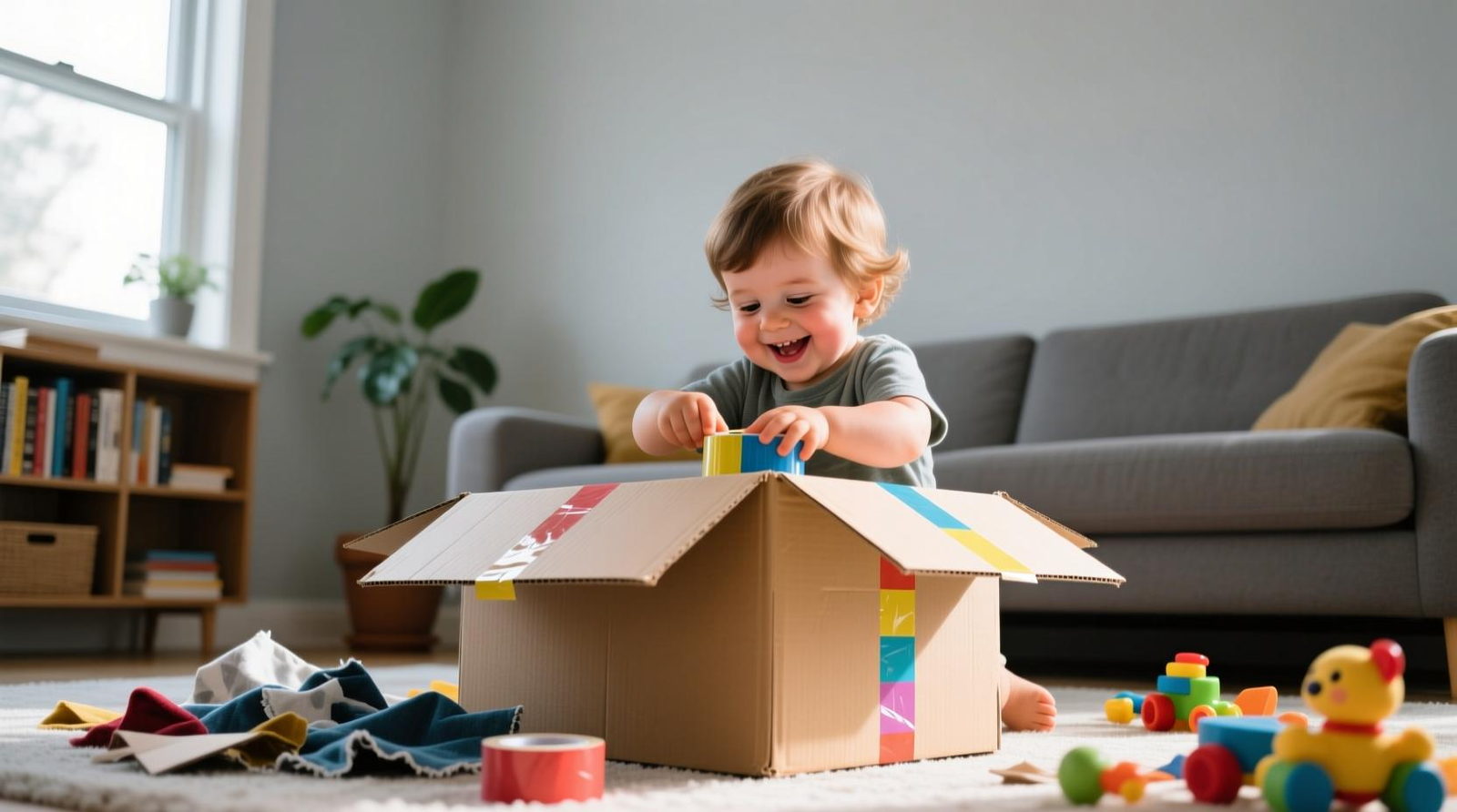
A cardboard box does not need lights, sounds, batteries, or complicated instructions. Open-ended materials can encourage children to experiment, manipulate objects, solve problems, and create their own uses for materials. NAEYC specifically highlights the value of inexpensive, open-ended household and natural materials for children’s learning.
4. Match the activity to the child’s abilities
A homemade activity should be appropriate for the child’s developmental stage. Something suitable for a preschooler may be unsafe or frustrating for a younger toddler.
10 Budget-Friendly Montessori-Inspired DIY Activities
1. Cardboard Shape-Matching Board
Materials:
- A sturdy cardboard box
- Paper or cardboard in several colors
- Scissors
- Glue or tape
- Marker
Cut several simple shapes—circles, squares, triangles, and rectangles—from cardboard. Draw corresponding outlines on a larger piece of cardboard.
The child places each shape over its matching outline.
Learning opportunities: shape recognition, visual discrimination, hand-eye coordination, concentration, and problem-solving.
For younger children, begin with only two or three shapes. Add more as the child becomes comfortable.
2. DIY Posting Box
A simple posting activity can be made from a clean cardboard box or food container.
Cut a slot into the top and provide large cardboard discs, cards, or other appropriately sized pieces that fit through the opening.
The child inserts each piece into the slot and eventually opens the container to retrieve them.
Learning opportunities: fine-motor control, coordination, object permanence, repetition, and concentration.
Avoid small pieces for children who still put objects in their mouths.
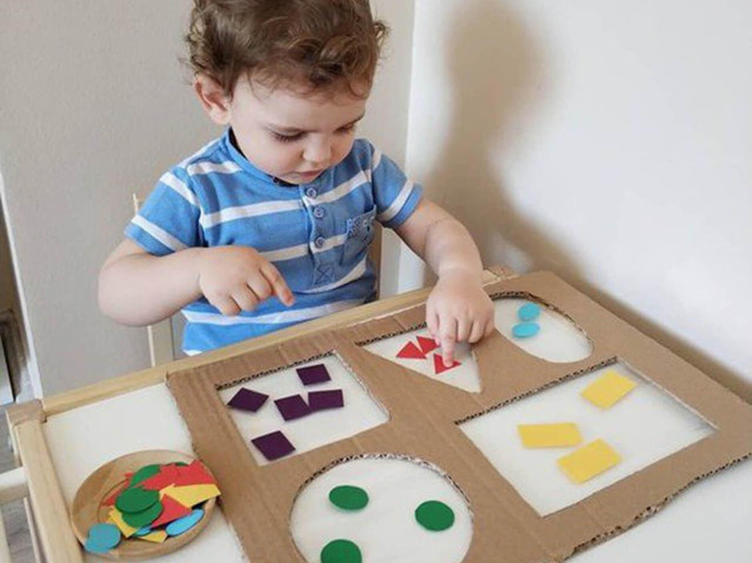
3. Cardboard Color-Sorting Game
Cut large circles or squares from colored cardboard. Create several matching sections on a cardboard tray.
For example:
- Red pieces → red section
- Blue pieces → blue section
- Yellow pieces → yellow section
Start with two colors before introducing additional choices.
This inexpensive activity can develop visual discrimination and classification skills while giving the child an opportunity to work independently.
4. Homemade Threading Activity
Use thick cardboard and large holes to create a simple lacing board.
Materials:
- Cardboard
- Hole punch
- Thick shoelace or cord
Punch holes around the edge of the cardboard and demonstrate how to thread the lace through them.
For safety, supervise closely and choose a cord appropriate for the child’s age.
Learning opportunities: hand-eye coordination, bilateral coordination, concentration, and preparation for dressing skills.
5. Practical-Life Fastening Board
Instead of purchasing a commercial dressing frame, an older child can practice fastening using pieces of old clothing attached securely to cardboard.
You can include:
- Large buttons
- Zippers
- Buckles
- Velcro
- Shoelaces
The American Montessori Society identifies fastening activities such as buttons, ties, zippers, laces, snaps, and Velcro as examples of small-motor Practical Life practice.
Introduce one fastening type at a time rather than putting everything on one board.
6. Kitchen Transfer Activity
You may already have everything needed for a simple transferring exercise.
Use:
- Two sturdy bowls
- A spoon or small scoop
- Large, safe objects
The child transfers objects from one bowl to another.
For developmentally ready children, you can eventually introduce dry foods such as large pasta pieces, always considering choking risks and supervision.
For toddlers, water transfer can also be introduced using a small amount of water, a sponge, and two containers in a controlled area.
The emphasis is on slow, purposeful movement rather than finishing quickly.
7. DIY Object-Matching Game
Collect several pairs of familiar household objects—for example, two wooden spoons, two matching containers, or two identical pieces of fabric.
Place one set in front of the child and ask them to find the corresponding pair.
As the activity develops, introduce objects with increasingly subtle differences.
This can encourage observation, comparison, visual discrimination, and vocabulary development.
8. Cardboard Building Blocks
Instead of throwing away sturdy packaging boxes, turn them into large building pieces.
Use boxes of different sizes and shapes. Cover sharp or damaged edges with strong tape and remove staples, plastic film, and loose pieces.
Children can stack, arrange, balance, and combine them into structures.
Unlike a toy with one predetermined purpose, cardboard can become a tower, garage, house, tunnel, or something entirely different. This aligns well with the broader educational value of open-ended materials described by NAEYC.

9. DIY Posting and Pulling Box
Create several large openings in a cardboard box and attach sturdy fabric strips or thick ribbons securely.
The child can pull, push, insert, and manipulate the materials.
This type of activity should be prepared specifically for the child’s age and inspected frequently. Loose strings, ribbons, small detachable parts, and anything that can wrap around the neck should not be accessible to young children without close supervision.
10. Household Practical-Life Station
Perhaps the most genuinely Montessori-inspired “toy” is not a toy at all.
Create a small, accessible station where your child can participate in everyday activities.
Depending on age and ability, this might include:
- A small cloth for wiping a table
- A child-sized dustpan
- A small watering container
- A basket for laundry
- Napkins for setting the table
- A safe spoon for food preparation
- A small container for sorting socks
Montessori’s Practical Life approach emphasizes meaningful participation in caring for oneself, others, and the environment.
How to Make DIY Montessori Materials More Effective
Present one activity at a time
A common mistake is putting too many homemade activities in front of a child. A small number of clearly organized choices can make it easier for children to focus.
The American Montessori Society recommends simplifying the home environment and keeping materials organized and accessible to encourage independence.
Demonstrate rather than over-explain
Show the child how the activity works using slow, deliberate movements. Then allow them to try.
If they make a mistake, give them time to discover what happened rather than immediately correcting them.
Let repetition happen
Children may perform the same activity dozens of times. That repetition is not necessarily boredom—it can be practice.
If a child repeatedly transfers objects, opens a box, or matches shapes, allow the repetition when the activity remains safe and purposeful.
Follow the child’s interests
Observe what attracts your child.
If they constantly open containers, create an opening-and-closing activity. If they enjoy sorting laundry, introduce a simple color or size-sorting activity. If they want to help in the kitchen, create a safe food-preparation task.
Following children’s interests while providing thoughtfully selected materials is also consistent with developmentally appropriate practice described by NAEYC.
Safety Comes Before the Montessori Label
DIY does not automatically mean safe.
Before giving a homemade activity to a child:
- Remove staples, sharp edges, loose tape, and damaged cardboard.
- Avoid small objects for children who may choke on them.
- Inspect materials regularly for deterioration.
- Avoid long loose cords, ribbons, or strings around young children.
- Use non-toxic, child-appropriate materials where relevant.
- Supervise activities involving water, food, tools, or detachable components.
- Consider the child’s developmental abilities rather than relying only on age labels.
NAEYC similarly recommends considering choking hazards and appropriate supervision when using household materials with young children.
A DIY activity should also be discarded or redesigned when it becomes damaged.
A Simple $0–$10 Montessori DIY Starter Kit
You do not need to buy a complete collection.
Start with materials you already have:
| Household Material | Possible Activity |
| Cardboard box | Posting box, puzzle, building blocks |
| Bottle caps | Sorting or counting |
| Old clothes | Buttoning and zipper practice |
| Bowls | Transferring and sorting |
| Shoelaces | Lacing activity |
| Paper | Folding, matching, drawing |
| Kitchen spoons | Scooping and transferring |
| Small basket | Practical-life organization |
| Fabric scraps | Texture and matching activities |
| Empty containers | Opening, closing, filling and emptying |
The Montessori Foundation likewise notes that parents do not need to duplicate a classroom or purchase specialized materials to bring Montessori principles into the home.
Conclusion
Montessori on a budget is less about finding the cheapest substitute for an expensive wooden toy and more about understanding why children learn through purposeful activity.
A cardboard box can become a puzzle. An old shirt can become a fastening exercise. Kitchen bowls can become tools for transferring and sorting. A basket and a small cloth can turn an everyday cleaning task into meaningful Practical Life work.
The most effective DIY Montessori activities are usually simple, safe, purposeful, appropriately challenging, and easy for the child to use independently. You do not need a dedicated Montessori room or a shelf full of expensive materials. Start with your child’s interests, observe what they can already do, make one small activity, and give them time to practice. In many homes, the most valuable Montessori materials are already sitting in the recycling bin, kitchen cupboard, laundry basket, or drawer.


