

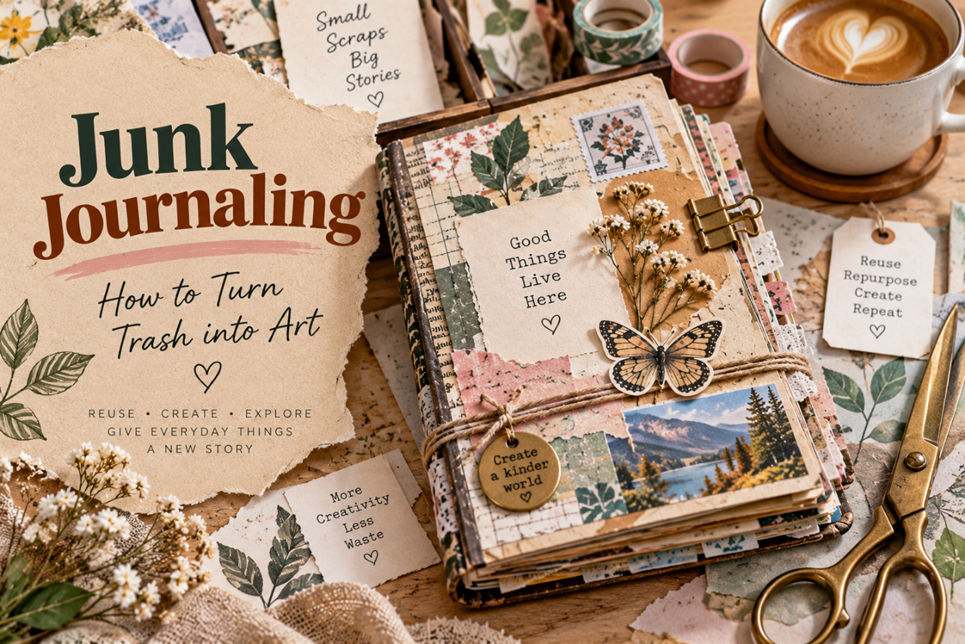
Junk journalism is a creative form of mixed-media journalism that turns everyday paper scraps, packaging, tickets, envelopes, receipts, fabric pieces, old book pages, and other ephemera into a handmade visual journal. Instead of buying everything new, the practice encourages you to look at ordinary discarded materials as potential art supplies.
The appeal is simple: a junk journal does not need to be perfect. Its charm comes from layers, textures, imperfections, handwritten notes, memories, and unexpected combinations. Recent guidance from Better Homes & Gardens describes junk journalism as a way to use everyday items such as receipts, tickets, stickers, and paper scraps to create personal memory collections.
Beyond creativity, junk journalism can also encourage thoughtful reuse. The U.S. Environmental Protection Agency places reuse ahead of recycling in its waste-management hierarchy, making re-purposing suitable materials a practical way to extend their useful life.
What Is Junk Journalism?
A junk journal is essentially a handmade journal assembled from a mixture of papers and found materials. Unlike a conventional diary, where blank pages are usually the starting point, a junk journal can begin with almost anything.
You might use:
- Old envelopes
- Magazine pages
- Receipts
- Product tags
- Paper bags
- Packaging
- Maps
- Greeting cards
- Book pages
- Calendar pages
- Newspaper clippings
- Fabric scraps
- Ribbons and thread
- Dried leaves or flowers
- Tickets and travel memorabilia
- Handwritten notes and sketches
The result can function as a diary, scrapbook, travel journal, art book, memory album, or simply a place to experiment with collage.
Why Turn “Trash” Into Art?
The most interesting part of junk journalism is changing the way you look at ordinary objects.
A coffee sleeve can become a pocket. A shipping label can become a background layer. An envelope can hold photographs or handwritten notes. A cereal box can become a sturdy journal cover.
This idea is closely related to up cycling, where an unwanted or discarded item is transformed into something useful or creatively valuable. Forbes has covered examples of artists and designers using discarded materials as the starting point for new creative work, illustrating how reuse can become part of the design process.
However, junk journalism should not be presented as a replacement for recycling in every situation. Some materials are better recycled than reused, particularly if they are dirty, contaminated, unsafe, or unsuitable for crafting.
How to Start a Junk Journal
You don’t need an expensive collection of craft supplies. A basic setup can be surprisingly simple.
1. Choose a Journal Base
Start with an inexpensive notebook, sketchbook, old book, or handmade collection of folded paper.
For beginners, a journal with relatively sturdy pages is useful because layering several materials can make individual pages heavier.
You can also make your own signature by folding several sheets of paper together and securing them with:
- Thread
- Staples
- Ribbon
- Washing tape
- Bookbinding stitches
2. Create a “Junk Box”
Instead of immediately throwing away interesting scraps, collect them in one container.
Try sorting materials into categories such as:
Paper: receipts, tickets, envelopes, packaging and magazines.
Textures: fabric, lace, tissue paper and corrugated cardboard.
Decorative pieces: labels, stamps, stickers, tags and ribbons.
Personal memories: photographs, notes, postcards and travel memorabilia.
A dedicated box prevents your craft materials from spreading throughout the house and makes it easier to find something when inspiration strikes.
3. Pick a Theme
A theme isn’t essential, but it can make the creative process easier.
Possible themes include:
- Travel memories
- Nature
- Coffee and everyday life
- Seasonal moments
- Family memories
- Books and reading
- Fashion
- Garden journalism
- Dreams and goals
- A particular color palette
For example, a travel journal could combine boarding passes, maps, restaurant receipts, photographs and handwritten observations from a trip.
The Art of Layering
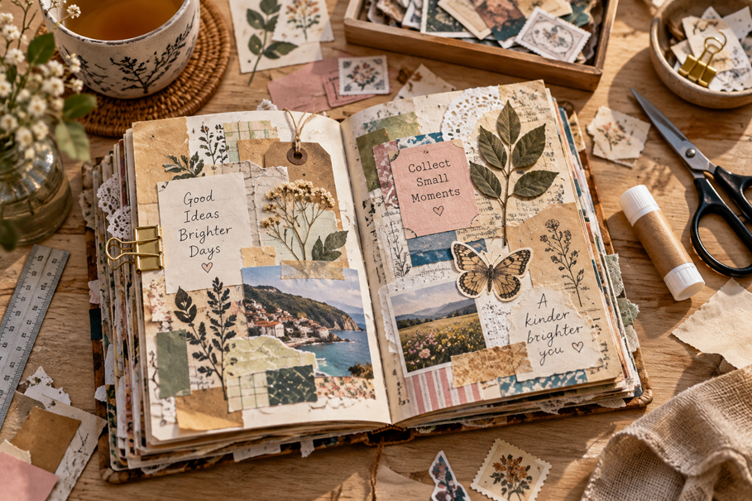
Layering is one of the defining visual characteristics of junk journalism.
Instead of placing one piece of paper neatly on a blank page, try building several layers.
A Simple Layering Formula
Start with a large background piece such as an old book page or paper bag.
Add a smaller piece of patterned paper.
Place a photograph, ticket, label or illustration on top.
Finally, add small details such as handwriting, thread, stamps, washi tape or a pressed botanical element.
The important principle is visual balance. If every element is equally large, bright and detailed, the page can become difficult to read.
Use a mixture of:
- Large and small elements
- Light and dark areas
- Rough and smooth textures
- Printed and handwritten material
- Empty space and decorated space
Practical Junk Journal Ideas
Turn Packaging Into Pockets
Small boxes, envelopes and folded packaging can become useful pockets.
Glue or stitch three sides of an envelope onto a journal page while leaving the opening accessible. You can then store photographs, notes, tickets or small keepsakes inside.
Make Tags From Cardboard
Shipping boxes and product packaging can be cut into tag shapes.
Punch a hole at the top and add:
- String
- Ribbon
- Twine
- Fabric
- A handwritten label
This is an easy way to turn ordinary cardboard into functional journal accessories.
Create a Memory Page From Receipts
Instead of keeping receipts loose in a drawer, use selected ones to document a particular day.
For example, a weekend page might include:
- A cafe receipt
- A photograph
- A handwritten description
- A product label
- A small illustration
Together, these ordinary objects can tell a much richer story than a photograph alone.
Use Old Magazines for Collage
Magazine photographs, typography and advertisements can provide ready-made visual elements.
Cut out interesting colors, shapes, people, landscapes or words and combine them into a themed composition.
Before throwing old magazines into recycling, consider whether selected pages can be reused creatively. Reuse and recycling serve different purposes, and the appropriate option depends on the material and your local recycling system.
How to Make a Junk Journal Page Step by Step
Here’s a beginner-friendly project you can complete in around 20–30 minutes.
Step 1: Select Five to Ten Materials
Choose pieces with different sizes and textures.
For example:
- One old book page
- One paper bag
- One magazine image
- One receipt
- One tag
- A piece of ribbon
- A handwritten note
Step 2: Establish the Background
Glue the largest paper element onto the page. Don’t worry if the edges aren’t perfectly straight.
Step 3: Build the Focal Point
Add the photograph, illustration or other item you want people to notice first.
Step 4: Add Supporting Layers
Place smaller pieces around the focal point. Slightly overlapping them can create depth.
Step 5: Add Texture
Introduce fabric, thread, lace, tissue paper or another tactile material.
Step 6: Personalize It
Write a date, quote, memory, observation or short story.
Step 7: Stop Before It Becomes Overcrowded
One common beginner mistake is continuing to add decorations simply because there is still empty space.
Empty space can help important elements stand out.
What Materials Should You Avoid?
Not everything belongs in a junk journal.
Avoid materials that are:
- Wet or moldy
- Contaminated with food
- Sharp or hazardous
- Chemically treated in an unknown way
- Extremely brittle
- Likely to stain other pages
- Difficult to store safely
Food packaging should be particularly clean before it is incorporated into a journal.
Some glossy, laminated or specially coated papers may also be unsuitable for local recycling, so don’t assume that every paper item belongs in the recycling bin either. The EPA recommends checking local recycling requirements because accepted materials vary between communities.
Junk Journalism and Sustainability
Junk journalism can support a reuse-first mindset, but it’s important to avoid overstating its environmental benefits.
Using a scrap that would otherwise be discarded can extend its useful life. The EPA specifically recommends reusing items such as scrap paper, envelopes, packaging and other materials for arts and crafts where appropriate.
At the same time, buying large quantities of new decorative supplies simply to create a “junk” journal can undermine the reuse concept.
A practical approach is:
Use what you already have → reuse suitable materials → buy only what you genuinely need → recycle what cannot be reused.
This keeps the creative process inexpensive while making the reuse aspect more meaningful.
Tips for Making Your Pages Look More Professional
Use a Consistent Color Palette
Choose three or four main colors and repeat them throughout a spread.
Create a Focal Point
Give each page one main visual element. Everything else should support it.
Mix Textures
Combining smooth paper with fabric, corrugated cardboard, thread or dried botanical material can make a page more visually interesting.
Don’t Chase Perfection
Torn edges, uneven handwriting and imperfect layers are part of the character of junk journalism.
Photograph Your Finished Pages
If you’re building a long-term journal, photograph completed spreads before adding more bulky elements. It creates a digital record and lets you share your work online.
Junk Journalism vs. Scrap booking
Although the two practices overlap, they are not identical.
Scrap booking often focuses on preserving photographs and memories using coordinated layouts and purpose-made materials.
Junk journalism tends to place greater emphasis on found materials, experimentation, layering and creative reuse.
There is no strict boundary, however. Many modern journals combine elements of both approaches.
Frequently Asked Questions
Is junk journaling expensive?
It doesn’t have to be. In fact, the concept works particularly well when you use materials already available at home.
Do I need artistic skills?
No. Junk journalism is accessible to beginners because there is no single correct artistic style. Cutting, arranging, writing and experimenting are enough to get started.
Can children make junk journals?
Yes, provided age-appropriate scissors, adhesives and materials are used under suitable supervision. It can also be a practical way to introduce children to reuse and creative design.
Can I use digital materials?
Absolutely. You can print photographs, quotes, illustrations, old documents or digital textures and combine them with physical materials.
Is junk journaling the same as a diary?
Not necessarily. A junk journal can contain diary entries, but it can also be purely visual or centered around memories, collections, travel, art or experimentation.
Final Thoughts
Junk journalism transforms the ordinary into something personal. A receipt becomes a memory, packaging becomes a pocket, an old magazine becomes collage material, and a forgotten scrap of paper can become part of a unique handmade story.
The best place to begin isn’t a craft store—it’s your recycling pile, desk drawer or collection of things you’ve been meaning to throw away. Select a few clean, safe materials, choose a simple theme and start layering.
There are no perfect pages and no required artistic style. The goal is to create something that has meaning to you while giving suitable discarded materials another purpose.
