







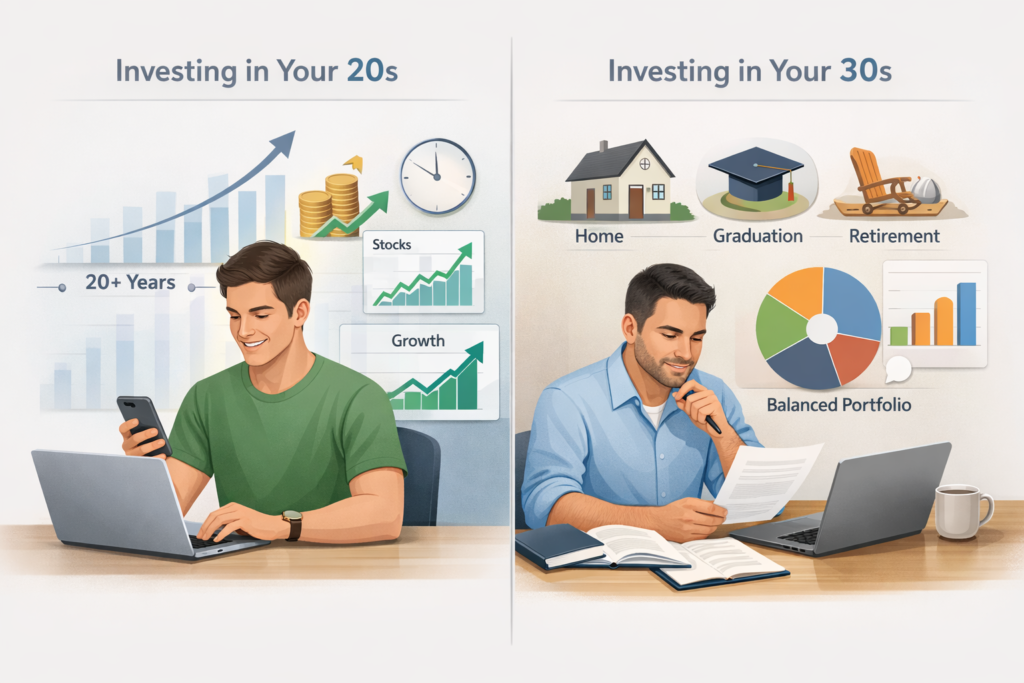
Investing is a lifelong journey, but the strategies that make sense in your 20s are not always the same ones that fit your 30s. Changes in income, responsibilities, risk tolerance, and financial goals naturally reshape how you should invest. Understanding what should change—and what should stay consistent—can help you make smarter, more confident decisions at each stage of life.
Why Age Matters in Investing
Your age influences three critical factors: time horizon, risk capacity, and financial priorities.
- In your 20s, time is your biggest advantage.
- In your 30s, stability and goal-based planning become more important.
The goal isn’t to abandon what worked before, but to refine your approach as your life evolves.
Investing in Your 20s: Building the Foundation
Focus on Growth and Learning
In your 20s, your primary asset is time. With decades ahead, you can afford short-term market volatility in exchange for long-term growth.
Key priorities:
- Start investing early, even with small amounts
- Learn how markets work
- Build disciplined habits
Example: Investing ₹5,000 per month at age 23 can potentially outperform investing ₹15,000 per month starting at 33, thanks to compounding.
Higher Risk Tolerance (Within Reason)
You generally have fewer financial obligations, making it easier to recover from market downturns.
Common choices include:
- Equity mutual funds or index funds
- Growth-oriented ETFs
- Limited exposure to high-risk assets (only after understanding them)
The emphasis should be on diversification, not speculation.
Prioritize Emergency Savings and Debt Control
Before aggressive investing:
- Build an emergency fund (3–6 months of expenses)
- Avoid high-interest debt
These steps protect your investments from being derailed by unexpected expenses.
Investing in Your 30s: Optimizing and Protecting Growth
Shift Toward Goal-Based Investing
By your 30s, goals become clearer and more concrete.
Common goals include:
- Buying a home
- Children’s education
- Retirement planning
- Business or career transitions
Your investments should now align with when you’ll need the money.
Example: Money needed for a house in 3–5 years should not be fully invested in volatile equity funds.
Balance Growth With Stability
While equities still play a major role, most investors in their 30s benefit from better asset allocation.
Typical adjustments:
- Introduce debt funds or bonds
- Rebalance portfolio annually
- Reduce unnecessary risk concentration
The focus shifts from “maximum growth” to sustainable, risk-adjusted returns.
Increase Investment Amounts Strategically
Income often peaks or stabilizes in your 30s. Lifestyle inflation can creep in, but disciplined investors do the opposite.
Best practices:
- Increase SIPs with salary hikes
- Automate investments
- Maintain consistency through market cycles
This is often the decade where wealth accelerates if discipline is maintained.
What Should Stay the Same in Both Decades
Long-Term Mindset
Market fluctuations are normal. Successful investors in both their 20s and 30s:
- Avoid emotional decisions
- Stay invested during downturns
- Focus on long-term trends, not short-term noise
Diversification and Low Costs
Regardless of age:
- Avoid putting all money in one asset or sector
- Prefer low-cost, transparent investment products
- Review—not constantly change—your portfolio
Continuous Learning
Markets evolve, regulations change, and personal circumstances shift. Staying informed is a lifelong advantage.
Common Mistakes to Avoid
- Delaying investing in your 20s due to “low income.”
- Taking excessive risk without understanding the downside
- Becoming too conservative too early in your 30s
- Ignoring insurance and emergency planning
Conclusion: Evolve, Don’t Restart
Investing in your 20s is about starting early, taking calculated risks, and learning. Investing in your 30s is about refinement, balance, and goal alignment. The most successful investors don’t overhaul their strategy every decade—they evolve it thoughtfully.


