







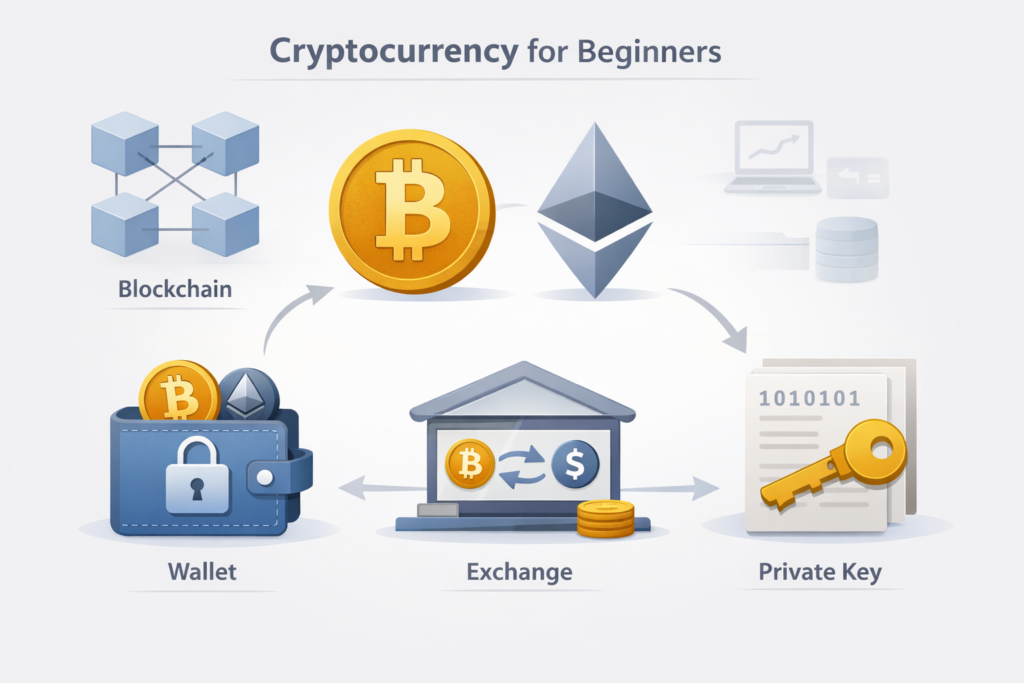
Cryptocurrency can feel intimidating at first. New investors are often confronted with unfamiliar jargon, fast-moving markets, and conflicting opinions. Understanding the basic terminology is the first and most important step toward making informed decisions. This beginner-friendly guide explains essential crypto terms in clear language, with practical examples, so you can confidently navigate the crypto ecosystem without prior technical knowledge.
What Is Cryptocurrency?
Cryptocurrency is a form of digital money that operates on decentralized networks, typically powered by blockchain technology. Unlike traditional currencies issued by governments, cryptocurrencies are not controlled by a central authority such as a bank.
Example: Bitcoin (BTC) can be sent directly from one person to another anywhere in the world without using a bank.
Blockchain Basics
Blockchain
A blockchain is a public, digital ledger that records all transactions securely and transparently. Once data is added, it cannot easily be changed.
Real-world analogy: Think of a shared Google Sheet that anyone can view, but no one can secretly edit.
Decentralization
Decentralization means control is distributed across many computers (nodes) rather than one central organization. This reduces the risk of manipulation or failure.
Common Crypto Assets
Bitcoin (BTC)
The first and most well-known cryptocurrency, often described as “digital gold” due to its limited supply and long-term store-of-value use case.
Altcoins
Altcoins are any cryptocurrencies other than Bitcoin, such as Ethereum (ETH), Solana (SOL), or Polygon (MATIC). Many are designed for specific applications like smart contracts or faster payments.
Stablecoins
Stablecoins are cryptocurrencies pegged to traditional currencies (usually the US dollar) to reduce price volatility.
Example: USDT and USDC aim to maintain a value close to $1.
Wallets and Security
Crypto Wallet
A crypto wallet stores your private keys and allows you to send, receive, and manage cryptocurrencies.
- Hot wallets: Connected to the internet (apps or web wallets)
- Cold wallets: Offline storage (hardware wallets), considered more secure for long-term holdings
Private Key
A private key is a secret code that proves ownership of your crypto. If you lose it, you lose access to your funds.
Best practice: Never share your private key or recovery phrase with anyone.
How Transactions Work
Address
A crypto address is like a bank account number. You share it to receive funds.
Transaction Fee (Gas Fee)
A transaction fee is paid to network validators or miners to process transactions.
Example: On Ethereum, fees fluctuate depending on network demand.
Trading and Market Terms
Exchange
A crypto exchange is a platform where users buy, sell, or trade cryptocurrencies.
- Centralized exchanges (CEXs): Operated by companies
- Decentralized exchanges (DEXs): Run by smart contracts without intermediaries
Market Cap
Market capitalization equals the price of a coin multiplied by its circulating supply. It helps compare the relative size of cryptocurrencies.
Volatility
Volatility refers to the degree to which prices change rapidly and significantly. Crypto markets are generally more volatile than traditional markets.
Advanced Concepts (Beginner-Friendly)
Smart Contracts
Smart contracts are self-executing programs on blockchains like Ethereum that automatically enforce agreements.
Real-world use: Decentralized lending platforms that release loans without a bank.
DeFi (Decentralized Finance)
DeFi refers to financial services (lending, borrowing, trading) built on blockchains without traditional intermediaries.
NFTs
Non-Fungible Tokens (NFTs) represent unique digital items such as art, collectibles, or access passes.
Risks Every Beginner Should Know
- Price risk: Crypto prices can rise or fall quickly
- Security risk: Hacks and scams exist
- Regulatory risk: Laws vary by country and may change
Understanding these risks is as important as learning the terminology.
Conclusion
Learning crypto doesn’t require a technical background—just a solid grasp of the fundamentals. By understanding key terms like blockchain, wallets, exchanges, and smart contracts, beginners can approach cryptocurrency with confidence and clarity. The cryptocurrency space is a rapidly evolving one, but informed users are better equipped to evaluate opportunities, manage risks, and participate responsibly. Start with education, move slowly, and prioritize security at every step.


