

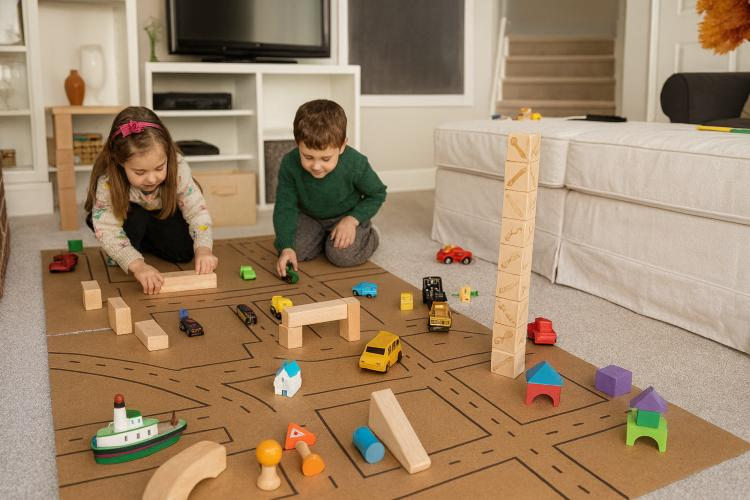
In a world filled with flashing lights, electronic sounds, screens, talking toys, and increasingly sophisticated children’s gadgets, a surprisingly simple idea is gaining attention: children may benefit from having less stimulation during play—not more.
A wooden block, cardboard box, set of crayons, toy animals, or a few kitchen-safe household objects may look boring compared with a toy that sings, talks, flashes, and responds to every button press. Yet simple toys can give children something highly valuable: the opportunity to decide what happens next.
This doesn’t mean electronic or interactive toys are inherently bad. Rather, child-development research consistently emphasizes the importance of play that allows children to explore, imagine, solve problems, communicate, and regulate their behavior. The American Academy of Pediatrics describes play as an important contributor to children’s cognitive, social-emotional, language, and self-regulation development.
The idea behind a low-stimulation childhood is therefore not about eliminating fun. It is about creating enough space for children to generate some of the fun themselves.
What Is a “Low-Stim” Childhood?
A low-stimulation childhood doesn’t mean removing every colorful toy, banning technology, or keeping children in a completely quiet environment.
Instead, it means deliberately creating opportunities for:
- Unstructured play
- Imagination
- Physical movement
- Outdoor exploration
- Reading
- Conversation
- Creative activities
- Boredom and independent discovery
- Toys that don’t constantly demand attention
The goal is to shift some of the entertainment workload from the toy to the child.
Consider the difference between a toy that automatically sings a song when a button is pressed and a collection of wooden blocks.
The first toy provides much of the experience. The second provides materials from which the child must create an experience.
That distinction matters.
Why “Boring” Toys Can Be Surprisingly Powerful
1. They Give Imagination More Room
A simple object doesn’t necessarily have a single purpose.
A cardboard box can become:
- A house
- A spaceship
- A car
- A shop
- A bed for a stuffed animal
- A hiding place
Similarly, a wooden block can become a building, telephone, food item, bridge, or anything else a child imagines.
This type of open-ended play gives children greater control over the story and rules of the activity.
Harvard’s Center on the Developing Child notes that play can help children practice executive-function skills such as attention, working memory, and self-control.
2. Children Practice Problem-Solving
Suppose a child wants to build a tower from ten blocks.
The tower falls.
What happens next?
The child might try:
- A wider base
- Different block arrangements
- Fewer blocks
- A different construction technique
There is no single button that solves the problem.
The child has to experiment.
That process—trying, failing, adjusting, and trying again—is an important part of learning.
3. Simple Toys Encourage Longer Exploration
A highly programmed toy often tells children what to do.
A simple toy asks children to decide what to do.
For example:
Electronic toy:
“Press this button to hear a sound.”
Blocks:
“What can you build?”
The second question is much bigger.
There isn’t necessarily a correct answer.
The Importance of Boredom
Parents sometimes feel uncomfortable when their child says:
“I’m bored.”
It’s tempting to immediately provide entertainment.
But boredom isn’t necessarily a problem that needs to be eliminated instantly.
When children aren’t being continuously entertained, they may begin searching for something to do. That search can lead to imaginative games, physical activity, drawing, storytelling, construction, pretend play, or interaction with siblings.
This doesn’t mean boredom automatically produces creativity every time. Children can also become frustrated or restless.
The point is that children need opportunities to initiate activities themselves, rather than constantly receiving entertainment from adults, devices, or toys.
Harvard’s developmental resources emphasize that play gives children opportunities to practice important executive-function and self-regulation skills.
Fewer Toys Can Sometimes Mean Deeper Play
Another important concept is toy quantity.
A playroom overflowing with toys can create a different experience from a small collection of carefully selected objects.
When everything is immediately available, children may move rapidly from one item to another.
By contrast, a smaller selection can make it easier to focus on what is already available.
This doesn’t mean parents need to throw away most of their children’s belongings. Instead, consider toy rotation.
Try a Simple Toy Rotation
Keep perhaps 8–15 toys or activities accessible at a time, depending on the child’s age and interests.
Store the rest away.
Every few weeks, replace some items with others.
A child who has stopped paying attention to a particular set of blocks may become interested again after those blocks disappear for several weeks.
The objective isn’t deprivation. It’s creating a calmer play environment.
What Makes a Good “Low-Stim” Toy?
A useful simple toy usually has several characteristics.
Open-ended
The toy can be used in multiple ways.
Examples include:
- Building blocks
- Wooden figures
- Dolls
- Toy animals
- Magnetic construction pieces
- Art materials
- Cardboard boxes
Child-directed
The child decides how the activity works rather than simply following the toy’s instructions.
Adaptable
The toy can remain useful as the child develops.
For example, blocks can start as simple stacking objects for a toddler and later become materials for complex buildings or imaginative worlds.
Social
Some toys encourage children and caregivers or siblings to play together.
A simple board game, pretend kitchen, ball, or construction set can create opportunities for conversation and cooperation.
What About Electronic and “Educational” Toys?
This is where balance is important.
The message isn’t that every electronic toy is harmful or that wooden toys are automatically superior.
A toy’s design and how it is used matter more than whether it is made from wood or contains batteries.
Some electronic toys can encourage interaction, problem-solving, or learning. However, a toy that does nearly everything for the child may leave fewer opportunities for the child to generate ideas independently.
The American Academy of Pediatrics recommends choosing toys that encourage caregivers and children to interact, explore, solve problems, and use imagination rather than focusing solely on expensive or highly sophisticated products.
So instead of asking:
“Is this toy educational?”
parents can ask:
“What will my child actually do with this toy?”
That’s often a much more useful question.
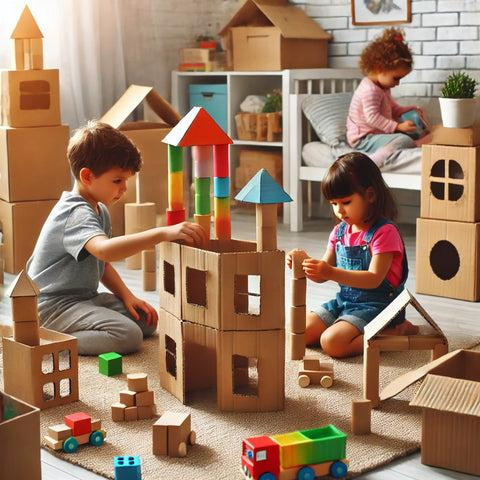
Real-World Example: The Cardboard Box
Imagine giving a four-year-old a sophisticated toy garage.
It has buttons, lights, sounds, ramps, and several automated features.
Now give the same child a large cardboard box.
The box might initially seem less exciting.
But within minutes, the child could draw windows on it, turn it into a garage, put toy cars inside, pretend to be a shopkeeper, or transform it into a spaceship.
The box doesn’t provide the story.
The child does.
That is the central idea behind low-stimulation play.
How Parents Can Create a Low-Stim Environment
You don’t need to redesign your entire home.
Start with a few practical changes.
Create a Simple Play Area
Keep a small selection of toys visible and accessible.
Consider:
- Blocks
- Books
- Art supplies
- Puzzles
- Pretend-play objects
- Balls
- Stuffed animals
Avoid making every toy available at the same time.
Introduce “Quiet Play” Periods
Set aside short periods when there are no screens or highly stimulating activities.
Tell your child:
“This is your play time. You can choose what you’d like to do.”
Initially, your child may complain about being bored.
That’s normal.
Give them time to adjust.
Don’t Immediately Solve Every Moment of Boredom
Instead of saying:
“You’re bored? Let’s watch something.”
Try:
“I wonder what you could make with these blocks.”
Then step back.
The goal is not to become your child’s entertainment director.
Get Involved—Then Step Back
Young children often benefit from adults joining their play.
Build something together.
Ask questions.
Pretend with them.
Then gradually allow the child to take over.
Harvard’s play resources specifically highlight how adults can participate with younger children and gradually step back as children become more capable of independent and peer play.
Don’t Turn “Low-Stim” Into Another Parenting Competition
There’s an important warning here.
Low-stimulation parenting should not become another source of pressure.
Your child doesn’t need a perfectly minimalist bedroom filled exclusively with handmade wooden toys.
Children are individuals.
One child may love blocks. Another may spend hours with toy cars. Another may prefer dolls, drawing, puzzles, music, or outdoor activities.
The objective is not to make childhood boring.
It’s to make room for children to become active participants in their own play.
A Simple Low-Stim Toy Checklist
Before buying another toy, ask:
- Can my child use it in different ways?
- Does it encourage imagination?
- Does my child have to actively participate?
- Can it grow with my child’s abilities?
- Can it encourage conversation or social play?
- Will it still be interesting without batteries?
- Does my child actually enjoy this type of activity?
If the answer to several of these questions is yes, the toy may have genuine long-term play value.
Conclusion: Sometimes Less Gives Children More
Modern childhood doesn’t need to be completely technology-free, and simple toys aren’t magical solutions to every developmental challenge.
But there is strong developmental reasoning behind giving children opportunities for unstructured, imaginative, child-directed play.
A block doesn’t tell a child what to build.
A cardboard box doesn’t explain what it is.
A blank sheet of paper doesn’t decide what the picture should look like.
And that’s precisely their strength.
The best toy isn’t always the one with the most features. Sometimes it is the one that leaves the most room for a child’s imagination.
A low-stimulation childhood isn’t about taking fun away.

1 Comment
Guter Überblick. Nützlich: Luna Lisa Alpha: . Luna Lisa Alpha