

Childcare remains one of the biggest financial decisions facing families in 2026. For working parents, the question is rarely just “How much does daycare cost?” The real calculation includes tuition, registration fees, meals, transportation, backup care, preschool expenses, and the potential financial impact of changing work schedules.
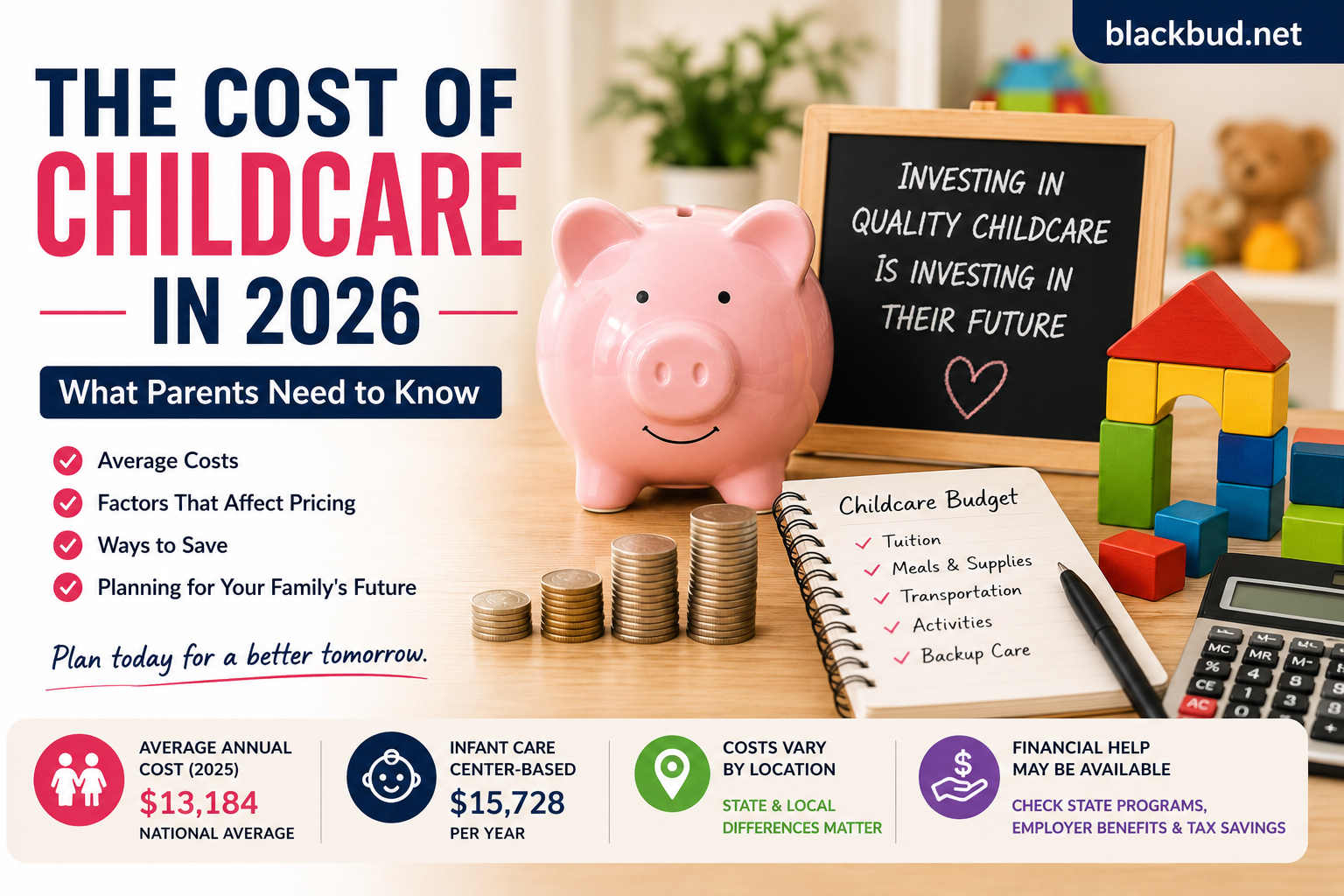
For families in the United States, the latest national data available in 2026 comes from Child Care Aware® of America’s Child Care in America: 2025 Price & Supply report, published in May 2026. It found that the national average annual price of child care was $13,184 in 2025. Prices vary substantially by state, child’s age, provider type, and local supply.
That makes national averages useful for understanding the broader picture—but not as a substitute for getting actual quotes from providers in your area.
How Much Does Childcare Cost in 2026?
The most recent national figures show that childcare can consume a significant share of household income.
Child Care Aware of America reported a national average annual childcare price of $13,184, equivalent to roughly $1,099 per month when divided across 12 months. The organization also found that the average price represented about 10% of median income for married-couple families with children and approximately 33% for single-parent families.
These figures are averages, not fixed national rates. A family living in a high-cost metropolitan area may pay considerably more, while families in lower-cost areas may find cheaper options.
Infant Care Usually Costs More
Infant care tends to be particularly expensive because younger children generally require more intensive supervision and lower child-to-caregiver ratios.
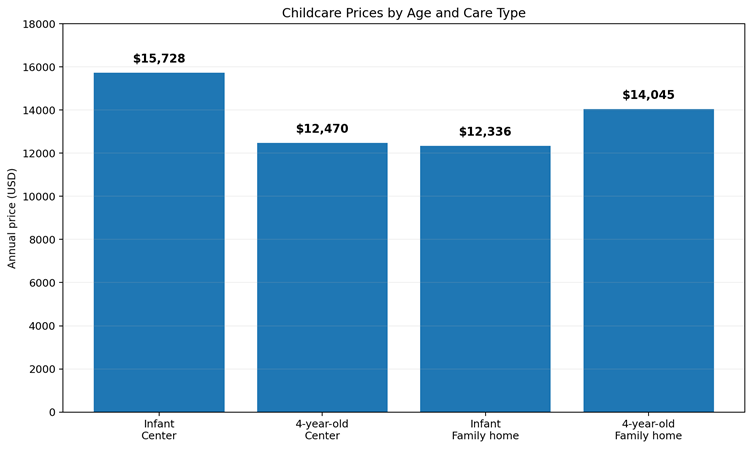
The 2025 national data showed the following average prices:
- Infant, center-based care: $15,728 per year
- 4-year-old, center-based care: $12,470 per year
- Infant, family childcare home: $12,336 per year
- 4-year-old, family childcare home: $14,045 per year
The numbers demonstrate why parents should compare childcare by both age and provider type, rather than assuming one average price applies to every family.
Why Childcare Is So Expensive
Childcare is a labor-intensive service. Unlike many consumer products, providers cannot easily reduce costs through automation because safe supervision requires qualified adults to be physically present.
Staffing Is a Major Expense
Childcare providers must pay teachers and caregivers, maintain appropriate staffing levels, provide training, and comply with licensing requirements. Rent, insurance, utilities, food, cleaning, supplies, administrative expenses, and professional development also contribute to operating costs.
This creates an important distinction between the price parents pay and the actual cost of providing quality care. A high tuition price does not automatically mean a provider is making a large profit.
Child Care Aware of America’s 2026 research on childcare costs found that in many states, public subsidy rates are below both market prices and the actual cost of providing care. This highlights the financial pressure experienced by providers as well as families.
The Hidden Costs Parents Often Miss
The advertised weekly or monthly tuition is only part of the childcare budget.
Before enrolling, parents should ask about:
Registration and Enrollment Fees
Some centers charge an initial registration or enrollment fee. It may be nonrefundable and may need to be paid again annually.
Meals and Supplies
Ask whether meals, snacks, diapers, wipes, formula, sunscreen, or classroom supplies are included. If they are not, calculate the additional monthly expense.
Extended-Hours Charges
Early drop-off and late pickup can create high additional costs, particularly for parents with long commutes or irregular working hours.
Holiday and Closure Policies
Some providers charge tuition during holidays, professional-development days, or scheduled closures even when children are not attending.
Backup Care
A childcare plan should also account for unexpected provider closures, sick days, school holidays, and caregiver emergencies. Backup care can become particularly expensive when parents need short-notice help.
Daycare vs. Family Childcare
Parents generally encounter several childcare models, including childcare centers, family childcare homes, nanny care, preschool programs, and informal in-home arrangements.
Childcare Centers
Centers typically operate in dedicated facilities with multiple caregivers and groups organized by age.
Advantages may include:
- Structured daily schedules
- Multiple staff members
- Established policies and procedures
- Opportunities for group activities
- Potentially longer operating hours
Potential disadvantages include:
- Less individualized care
- Fixed schedules
- Registration or wait-list requirements
- Additional fees
Family Childcare Homes
Family childcare homes operate from a provider’s residence and generally serve smaller groups.
They may offer a more home-like environment and sometimes greater flexibility. However, parents should carefully verify licensing status, caregiver qualifications, safety procedures, backup arrangements, and the program’s policies.
The U.S. government’s ChildCare.gov recommends that families understand available childcare options, check licensing and monitoring information, compare costs, and visit programs before making a decision.
How to Create a Realistic Childcare Budget
Instead of budgeting around tuition alone, calculate the total annual cost.
For example, imagine a family receives a quote of $1,200 per month for full-time childcare.
Annual tuition:
$1,200 × 12 = $14,400
Now add:
- $400 in annual registration fees
- $600 in supplies and miscellaneous expenses
- $500 in occasional backup care
- $300 in transportation-related costs
The family’s realistic annual childcare budget becomes approximately $16,200.
That is the figure parents should compare against household income—not simply the $1,200 monthly tuition.
Ways Families Can Reduce Childcare Costs
Lowering childcare expenses does not necessarily mean choosing the cheapest provider. The goal is to find an arrangement that balances cost, safety, quality, reliability, and work requirements.
Compare Multiple Providers
Get written quotes from several licensed providers. Ask every provider the same questions so you can make an accurate comparison.
Check for Financial Assistance
Eligible families may have access to state childcare subsidies, Head Start or Early Head Start, state-funded prekindergarten, local scholarships, or provider discounts.
ChildCare.gov provides state-specific information about financial assistance programs and childcare resources.
Ask About Employer Benefits
Some employers offer dependent-care benefits or a Dependent Care Flexible Spending Account (FSA). An FSA can allow eligible employees to set aside qualifying income for dependent-care expenses on a tax-advantaged basis.
Because tax rules and eligibility can change, families should verify current requirements with their employer or a qualified tax professional.
Look for Sibling Discounts
If two children attend the same provider, ask whether the center offers a sibling discount. Even a modest reduction can make a meaningful difference over a full year.
Consider Schedule Flexibility
If your employer offers remote work, compressed hours, or flexible schedules, calculate whether you genuinely need full-time childcare five days a week. In some circumstances, adjusting working hours may reduce the amount of paid care required.
However, parents should also consider the value of reliable childcare and avoid creating an unsustainable arrangement simply to save money.
Childcare Cost vs. Leaving the Workforce
For some families, childcare expenses can make employment appear financially unattractive, particularly when one parent has a relatively low income or when multiple children require care.
But the calculation should extend beyond today’s paycheck.
Parents should consider:
- Health insurance and other employee benefits
- Retirement contributions and employer matches
- Future salary increases
- Career progression
- Social Security earnings
- Professional experience
- The cost of re-entering the workforce later
A short-term childcare expense can therefore have long-term financial implications.
What Parents Should Ask Before Signing a Contract
Before paying a deposit, ask the provider:
- What is the complete monthly or weekly tuition?
- Are registration or annual fees charged?
- Are meals and supplies included?
- What happens when the center closes?
- Do families pay during holidays or vacations?
- What are the late-pickup fees?
- Is there a sibling discount?
- What is the refund or withdrawal policy?
- Does the provider accept childcare subsidies?
- What happens if my child is sick?
- How are staff absences handled?
- What are the program’s licensing and safety requirements?
Getting these answers in writing can prevent unpleasant financial surprises later.
Is Childcare Becoming More Affordable in 2026?
The national picture remains challenging.
Child Care Aware of America reported that childcare prices increased from 2024 to 2025, reaching the $13,184 national average. From 2021 through 2025, childcare prices increased approximately 23%, a rate broadly similar to overall inflation during that period.
At the same time, childcare availability varies considerably between communities. A lower advertised price does not help much if there are no available spaces, the provider’s hours do not match a parent’s work schedule, or the location creates an impractical commute.
Affordability is therefore about more than price. Availability, reliability, quality, location, hours, and household income all matter.
A Smarter Way to Think About the Cost
The most useful approach is to treat childcare as part of the family’s overall financial plan rather than as an isolated bill.
Start with the provider’s complete annual cost. Then subtract any subsidies, employer benefits, eligible tax advantages, or discounts. Finally, compare the remaining amount with the income and benefits associated with working.
For example:
Annual childcare cost: $16,000
Employer/FSA or other eligible savings: $2,000
Net childcare expense: $14,000
The family can then compare that net expense with the financial and career benefits of maintaining employment.
This approach produces a much more useful picture than simply asking whether daycare is “expensive.”
Conclusion
The cost of childcare in 2026 remains a significant challenge for many American families. The latest national data puts average annual childcare prices at $13,184, but individual families can pay substantially more or less depending on location, age, provider type, schedule, and available assistance.
The smartest strategy is not necessarily to choose the lowest-priced provider. Instead, parents should calculate the complete cost, compare several licensed options, investigate financial assistance, understand employer benefits, and consider how childcare fits into their broader household finances.
Quality childcare is both a family expense and an essential support for parents who work, study, or pursue professional goals. With careful planning and accurate information, families can make a childcare decision that is financially realistic while still prioritizing their child’s safety, development, and well-being.
