

In a world dominated by keyboards, smartphones, and rapid digital communication, handwriting can feel almost old-fashioned. Yet slowing down to form letters by hand can turn an ordinary writing exercise into a focused creative activity. Calligraphy—the art of creating visually deliberate and expressive letter forms—combines controlled hand movements, concentration, rhythm, and creativity.
Calligraphy itself should not be described as a treatment for anxiety, depression, or other mental-health conditions. However, handwriting and expressive writing have been studied in psychological research, and handwriting can provide a structured opportunity for reflection and focused attention. Research on expressive writing, for example, suggests that putting stressful experiences into words can sometimes help people process them, although outcomes vary by person and by the way writing is used.
The goal, therefore, is not perfect handwriting. It is to create a slower, intentional practice that can support concentration, creativity, and self-reflection.
What Is Calligraphy?
Calligraphy is more than simply having attractive handwriting. It is a visual art based on the deliberate design and execution of letters or characters.
Different cultures have developed distinctive calligraphic traditions. The Metropolitan Museum of Art notes that calligraphy has historically held an especially important position in Chinese visual culture, where the movement of the brush itself contributes to the expressive quality of the work.
Modern beginners can approach calligraphy much more simply. You do not need expensive equipment or years of artistic training. A smooth pen, suitable paper, and a few minutes of consistent practice are enough to begin.
How Handwriting and Calligraphy Can Support Well-Being
1. They Encourage Focused Attention
Writing by hand requires continuous coordination between visual attention and controlled movement. Unlike typing, where pressing keys produces letters almost automatically, handwriting requires you to physically create each character.
Research using EEG recordings has found more elaborate patterns of brain connectivity during handwriting than during keyboard typing in a group of university students. The researchers linked the visual and motor demands of handwriting with brain activity involved in learning and memory.
This does not prove that calligraphy treats mental-health conditions. It does suggest that handwriting is a cognitively active process that can provide a useful break from highly automated digital interaction.
2. Repetition Can Create a Calm Routine
Calligraphy naturally involves repetition: down strokes, curves, loops, spacing, and repeated letter forms.
A beginner might spend five minutes practicing:
- Straight lines
- Ovals
- Lowercase loops
- Consistent spacing
- Light and heavy strokes
- Individual letters
- Short words
The predictable nature of these exercises can make them useful as a focused personal routine. The experience is similar to other activities where attention is deliberately placed on a simple physical task.
Mindfulness research generally defines mindfulness as moment-to-moment awareness without judgment. Evidence reviewed by the American Psychological Association suggests that mindfulness-based practices can help with stress and psychological distress, although the research concerns mindfulness practices generally rather than calligraphy specifically.
3. Writing Can Create Space for Reflection
Calligraphy and journaling can be combined particularly well.
Instead of simply practicing letters, you could write a short reflection such as:
“What went well today?”
or:
“What is one thing I want to handle differently tomorrow?”
The physical act of writing slows the process down and gives you an opportunity to organize thoughts.
Research into expressive writing has found that writing about stressful experiences can sometimes help people process them. Importantly, the APA notes that simply repeatedly describing distress is not necessarily beneficial; meaning-making and reflection appear to matter.
That distinction is important. A healthy handwriting routine should not become an exercise in repeatedly dwelling on upsetting experiences.
Improving Your Handwriting Through Calligraphy
Better handwriting does not happen overnight. The most useful approach is deliberate, manageable practice.
Start With Basic Strokes
Before attempting elaborate alphabets, practice the movements behind the letters.
Try:
- Ten slow vertical strokes.
- Ten upward curves.
- Ten downward curves.
- Ten small ovals.
- Ten connected loops.
Focus on keeping your movements consistent rather than trying to write quickly.
Work on Letter Spacing
Uneven spacing can make handwriting look messy even when individual letters are attractive.
Write a simple sentence such as:
“Slow writing creates beautiful letters.”
Pay attention to the space between letters and words.
Practice Lowercase Letters First
Lowercase letters appear frequently in everyday writing, making them particularly useful for improving practical handwriting.
Practice groups with similar movements:
a, c, e, o
then:
i, l, t
and:
m, n, u
Once the basic movements become comfortable, connect them into words.
Slow Down Before Trying to Speed Up
One of the most common beginner mistakes is attempting to reproduce a sophisticated calligraphic style too quickly.
Instead:
- Write slowly.
- Maintain relaxed shoulders.
- Avoid gripping the pen excessively.
- Keep your wrist comfortable.
- Concentrate on consistent movement.
- Take short breaks.
Speed can gradually develop after control improves.
A 10-Minute Mindful Calligraphy Routine
You don’t need an hour-long practice session. A simple 10-minute routine can be enough to establish consistency.
Minute 1–2: Prepare
Put your phone aside and sit comfortably. Place your notebook on a stable surface.
Take a few natural breaths and notice the physical sensation of holding the pen.
Minute 3–5: Basic Strokes
Practice lines, curves, loops, and ovals.
Don’t judge the results. Simply observe how the pen moves across the paper.
Minute 6–8: Letter Practice
Choose three letters and write each one repeatedly.
For example:
a a a a a
m m m m m
s s s s s
Try to make each repetition slightly more consistent.
Minute 9–10: Reflective Writing
Finish with one or two sentences about your day.
For example:
“Today I completed something I had been postponing.”
The objective is not literary quality. It is simply to put a thought into words.
Turn Handwriting Practice Into a Personal Ritual
A successful routine should be enjoyable enough to repeat.
Consider creating a dedicated writing space with:
- A comfortable notebook
- One reliable pen
- A desk lamp
- A calligraphy guide sheet
- A small collection of inspirational quotations
- A folder for completed practice pages
You can also create a monthly handwriting project. For example, choose one quotation and rewrite it every day for 30 days. At the end of the month, compare the pages.
The changes may reveal improvements in spacing, consistency, letter proportions, and confidence.
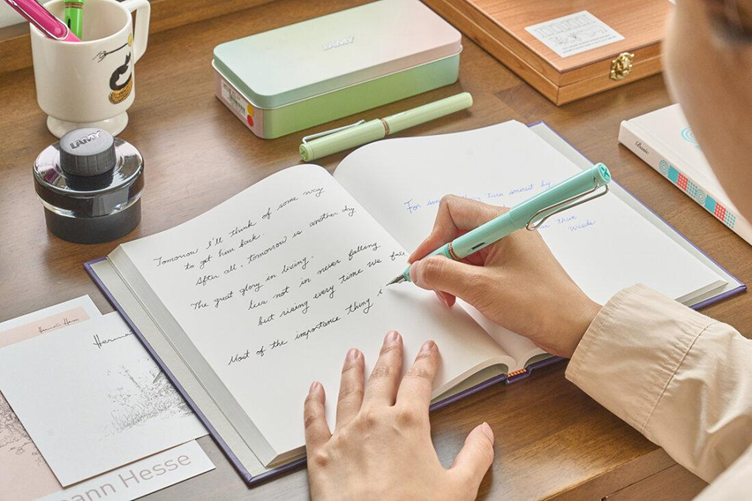
Calligraphy, Journaling, and Emotional Expression
Calligraphy can become especially interesting when combined with different forms of journaling.
Gratitude Journaling
Write three things you appreciated during the day.
Future-Self Letters
Write a short letter describing something you hope to accomplish over the next six months.
Stream-of-Consciousness Writing
Set a timer for five minutes and write continuously without worrying about grammar or handwriting quality.
Positive Affirmation Practice
Choose a realistic statement such as:
“I can take one step at a time.”
Write it slowly several times.
The emphasis should remain on reflection rather than treating handwriting as a substitute for professional psychological care.
The Connection Between Creativity and Mental Well-Being
Creative activities can provide opportunities for concentration, self-expression, and meaningful leisure. Calligraphy has an advantage in this context because it combines creativity with a clearly defined physical skill.
There is also an important psychological benefit to separating practice from performance.
Your handwriting doesn’t need to be Instagram-worthy.
A crooked line isn’t a failure. An uneven letter isn’t a problem. Beginners improve precisely because their early attempts are imperfect.
This mindset can make practice more sustainable: the objective becomes learning rather than producing flawless pages.
Choosing the Right Tools
You can start with almost anything that feels comfortable.
For Beginners
A smooth gel pen or ballpoint pen is inexpensive and easy to control.
For Traditional Calligraphy
A fountain pen, dip pen, brush pen, or specialized calligraphy nib can introduce different line characteristics.
For Paper
Choose paper that doesn’t cause excessive ink bleeding. Smooth paper is generally easier for controlled lettering.
The best equipment is ultimately the equipment that encourages you to practice regularly.
What the Evidence Actually Says
It is important to distinguish between handwriting research, expressive-writing research, mindfulness research, and calligraphy research.
There is evidence that handwriting involves complex visual and motor processes and can support learning-related cognitive activity.
There is also psychological research into expressive writing and its potential effects on stress and emotional processing.
Mindfulness-based interventions have their own research literature, including evidence concerning stress and certain mental-health applications.
However, these findings should not be combined into the claim that “calligraphy cures anxiety or depression.” There is not enough evidence to make that broad conclusion.
For someone experiencing persistent anxiety, depression, trauma symptoms, or significant emotional distress, calligraphy can be considered a personal creative activity—not a replacement for appropriate professional support.
Practical Applications Beyond Mental Wellness
Improving handwriting can also have everyday advantages.
You may find it useful for:
- Writing personal letters
- Creating handwritten cards
- Taking handwritten notes
- Designing invitations
- Making journals
- Creating art projects
- Developing personalized signatures
- Decorating planners
- Producing handmade gifts
The Metropolitan Museum of Art’s collections demonstrate how writing can become an artistic medium in its own right, with historical traditions ranging from Chinese brush writing to Islamic calligraphy.
Conclusion
Calligraphy offers a simple way to reconnect with the physical act of writing. Its value isn’t necessarily found in producing perfect letters. Instead, the practice can encourage slower movement, sustained attention, creativity, and personal reflection.
A useful approach is to begin with just 10 minutes a day. Practice a few basic strokes, work on several letters, and finish with a short handwritten reflection. Over time, your handwriting may become more controlled and expressive, while the routine itself can become a welcome screen-free pause in a busy day.
Most importantly, approach calligraphy without perfectionism. Your handwriting doesn’t have to look like professional calligraphy to be meaningful. The real art may be learning to slow down, pay attention, and give yourself a few quiet minutes with a pen and a blank page.
