






Skincare has spent years getting more complicated. Cleansers, toners, essences, exfoliants, serums, ampoules, eye creams, masks, moisturizers and facial oils can easily turn a simple morning routine into a 10-step ritual.
Now, a more practical approach is gaining attention: skinimalism—the idea of using fewer, more purposeful products rather than layering everything available on the bathroom shelf.
The goal isn’t to stop caring for your skin. It is to identify what your skin actually needs and build a routine you can follow consistently. Dermatologists also emphasize that more products do not automatically mean better results. The American Academy of Dermatology, for example, recommends a simple foundation of gentle cleansing, moisturizing and daily broad-spectrum sun protection.
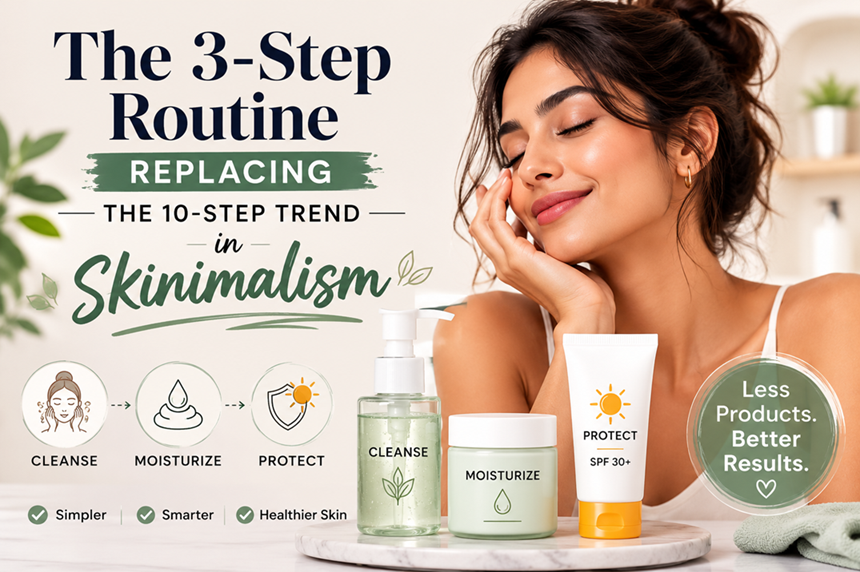
The modern three-step approach can be summarized as:
Cleanse → Moisturize → Protect
For some people, one targeted treatment can be added when there is a specific concern, but it doesn’t need to become another complicated collection of products.
What Is Skinimalism?
Skinimalism is a minimalist approach to skincare that prioritizes simplicity, consistency and purposeful product selection.
The concept isn’t entirely new. Forbes highlighted the move toward minimalist skincare as consumers began moving away from elaborate routines and focusing on products that perform useful functions.
More recently, the conversation has shifted from simply owning fewer products to choosing products based on skin type, skin concerns and evidence.
This matters because skincare is highly individual. A product that works beautifully for one person may cause dryness, irritation or breakouts in another.
Cleveland Clinic dermatologists similarly recommend tailoring skincare to individual skin type and goals rather than assuming everyone needs the same collection of products.
Why the 10-Step Routine Is Losing Its Appeal
A 10-step routine isn’t automatically bad. Some people enjoy it, and certain products can have legitimate purposes. The problem is assuming that every skin type needs every step.
More Products Can Mean More Irritation
Every new product introduces additional ingredients to the skin. Using multiple exfoliating acids, retinoids, fragranced products or other active ingredients simultaneously can make it difficult to identify what is causing irritation.
The American Academy of Dermatology advises focusing on one primary anti-aging concern at a time because introducing several anti-aging products within a short period can irritate the skin.
Complexity Can Reduce Consistency
A routine may look impressive on social media, but if it takes 20 minutes and requires remembering ten different steps, it may be difficult to maintain.
A simpler routine has a practical advantage: you are more likely to use it consistently.
Your Skin Does Not Need a New Product for Every Concern
Dark spots, dryness, dullness and occasional breakouts may require different strategies, but that doesn’t mean every concern needs its own bottle.
The better question is:
What is the most important thing my skin needs right now?
That question is at the heart of skinimalism.
The Three-Step Skinimalist Routine
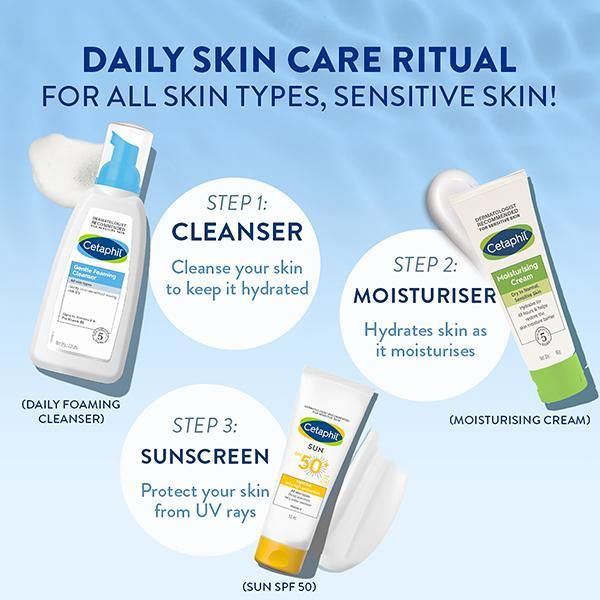
Step 1: Cleanse
The first step is straightforward: remove dirt, excess oil, sunscreen and makeup without unnecessarily stripping the skin.
A gentle cleanser is usually sufficient for everyday use. The American Academy of Dermatology recommends a gentle, non-abrasive cleanser and advises limiting face washing to twice daily and after sweating to reduce irritation.
How to Choose a Cleanser
Look for a cleanser appropriate for your skin type.
Dry or sensitive skin:
Choose a gentle, fragrance-free formula that doesn’t leave the face feeling tight or squeaky.
Oily skin:
A lightweight foaming or gel cleanser may be more comfortable, particularly when excess oil is a concern.
Combination skin:
A balanced cleanser can help clean oily areas without excessively drying the cheeks.
Acne-prone skin:
Some people may benefit from cleansers containing ingredients such as salicylic acid or benzoyl peroxide, but these should be introduced carefully if irritation occurs.
Don’t Confuse “Squeaky Clean” With Healthy Skin
A tight feeling immediately after cleansing isn’t necessarily evidence that a cleanser is working better.
If your face feels uncomfortable, dry or irritated after washing, the product may simply be too harsh for your skin.

Step 2: Moisturize
The second step is hydration and barrier support.
Moisturizers help reduce water loss from the skin and can make the skin feel softer and more comfortable. They are useful even for people with oily skin; the key is choosing an appropriate texture.
The American Academy of Dermatology notes that ingredients such as ceramides and hyaluronic acid can be useful in moisturizers, while fragrance may irritate some people with dry or sensitive skin.
Choose Texture Based on Your Skin
Oily skin:
Try a lightweight gel or lotion.
Combination skin:
A medium-weight moisturizer may work well, with slightly more product on drier areas.
Dry skin:
A richer cream containing barrier-supportive ingredients can be more comfortable.
Sensitive skin:
Keep the formula simple and consider fragrance-free products.
One useful skinimalist principle is to look for multifunctional products. For example, a moisturizer that provides effective hydration and contains barrier-supportive ingredients may eliminate the need for several separate hydration-focused products.
Step 3: Protect With Sunscreen
If there is one step that should not disappear when simplifying your routine, it is sun protection.
The American Academy of Dermatology recommends broad-spectrum sunscreen with SPF 30 or higher, along with other sun-protective measures such as seeking shade and wearing protective clothing.
Cleveland Clinic also recommends sunscreen as a key part of a basic morning skincare routine.
Why Sunscreen Matters
Daily UV exposure contributes to premature skin aging and can contribute to pigmentation changes and skin cancer.
That means an expensive collection of brightening or anti-aging products makes little sense if daily sun protection is neglected.
What to Look For
Choose a sunscreen that offers:
- Broad-spectrum protection
- SPF 30 or higher
- Water resistance when appropriate for outdoor activities
- A texture you are comfortable applying generously and consistently
If you spend extended time outdoors, sunscreen should be reapplied as directed. The AAD recommends reapplication every two hours while outdoors and after swimming or sweating.
Where Does Serum Fit Into Skinimalism?
This is where the three-step routine becomes flexible.
A serum is optional, not automatically essential.
If your skin has a specific concern—such as persistent acne, pigmentation or signs of photoaging—you may choose one targeted treatment rather than adding several.
For example:
Concern: uneven pigmentation
A dermatologist-approved treatment may be considered after establishing a basic routine.
Concern: acne
An appropriate acne treatment may be more useful than multiple cosmetic serums.
Concern: signs of aging
Ingredients such as retinoids may have a role, but they can cause irritation and should be introduced gradually.
Cleveland Clinic’s dermatology guidance similarly emphasizes simple routines and evidence-supported ingredients rather than judging effectiveness by the number of products used.
The key principle is one concern, one targeted solution.

Morning vs. Night: Keep It Simple
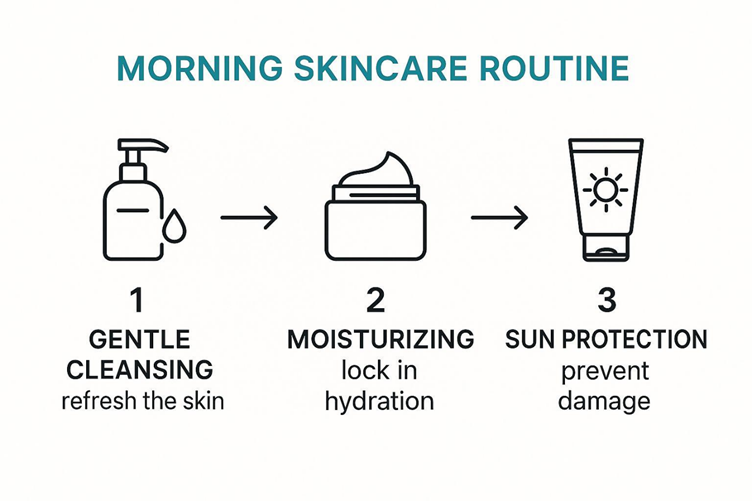
A practical skinimalist schedule could look like this:
Morning
- Gentle cleanser
- Moisturizer, if needed
- Broad-spectrum SPF 30+ sunscreen
Evening
- Gentle cleanser
- Targeted treatment, if needed
- Moisturizer
If your sunscreen or makeup needs additional removal, cleansing can be adapted accordingly. People who wear heavy makeup or water-resistant sunscreen may need a more thorough evening cleansing strategy.
The important point is that “minimalist” does not mean rigid. Your routine should respond to your skin and lifestyle.
Who Can Benefit From Skinimalism?
Skinimalism can be particularly appealing to people who:
- Have accumulated too many skincare products
- Frequently experience irritation after adding new products
- Want a faster morning routine
- Prefer a smaller beauty budget
- Are new to skincare
- Have difficulty maintaining complicated routines
It can also be a useful reset after experimenting with too many active ingredients.
However, minimalist skincare shouldn’t replace professional care when a medical skin condition requires treatment.
Common Skinimalism Mistakes
Mistake 1: Removing Everything Overnight
If you have a routine that includes medically recommended treatments, don’t automatically discontinue them simply because minimalism is trending.
Simplification should be thoughtful rather than extreme.
Mistake 2: Treating “Natural” as Automatically Better
Natural ingredients can still cause irritation or allergic reactions. Product selection should be based on formulation, skin compatibility and evidence—not simply whether an ingredient is described as natural.
Mistake 3: Skipping Sunscreen
A shorter routine should never mean skipping sun protection.
Mistake 4: Adding Five “Minimalist” Products
Skinimalism becomes meaningless if a three-step philosophy turns into three cleansers, four serums and two moisturizers.
The objective is fewer unnecessary steps, not simply buying a different set of products.
Mistake 5: Expecting Overnight Results
Most skincare changes require time and consistency. Constantly switching products makes it harder to determine what is actually helping.
A Real-World Example
Imagine someone currently using:
- Oil cleanser
- Foaming cleanser
- Toner
- Essence
- Vitamin C serum
- Exfoliating acid
- Acne serum
- Eye cream
- Moisturizer
- Facial oil
- Sunscreen
Instead of using everything every day, they could simplify to:
Morning:
Cleanser → Moisturizer → Sunscreen
Evening:
Cleanser → One appropriate treatment → Moisturizer
The result is not necessarily “less skincare.” It is more intentional skincare.
If a dermatologist has recommended a particular medication or treatment, that should remain part of the plan even if it makes the routine longer.
How to Build Your Own 3-Step Routine
Start by asking three questions:
1. What Is My Skin Type?
Is your skin generally oily, dry, combination or sensitive?
2. What Is My Main Concern?
Choose the most important issue rather than attempting to solve everything simultaneously.
3. Which Products Have a Clear Purpose?
If you cannot explain why a product is in your routine, it may be worth reconsidering whether you need it.
The best minimalist routine is not necessarily identical to someone else’s. It is the smallest routine that effectively addresses your skin’s basic needs and any specific concerns.
Conclusion: Skinimalism Is About Doing More With Less
The move from 10-step skincare to a three-step routine isn’t about declaring every additional skincare product useless. It is about changing the way we think about skincare.
Cleanse. Moisturize. Protect.
Those three fundamentals provide a practical foundation. If you have a specific concern, add one targeted treatment based on your skin’s needs rather than automatically adding another layer.
Ultimately, the best skincare routine isn’t the longest one on your shelf. It is the one that is appropriate for your skin, supported by sound evidence, easy to maintain and consistent enough to become a habit.
Skinimalism, at its best, isn’t about doing less for your skin. It’s about removing the unnecessary so the important things get the attention they deserve.


