





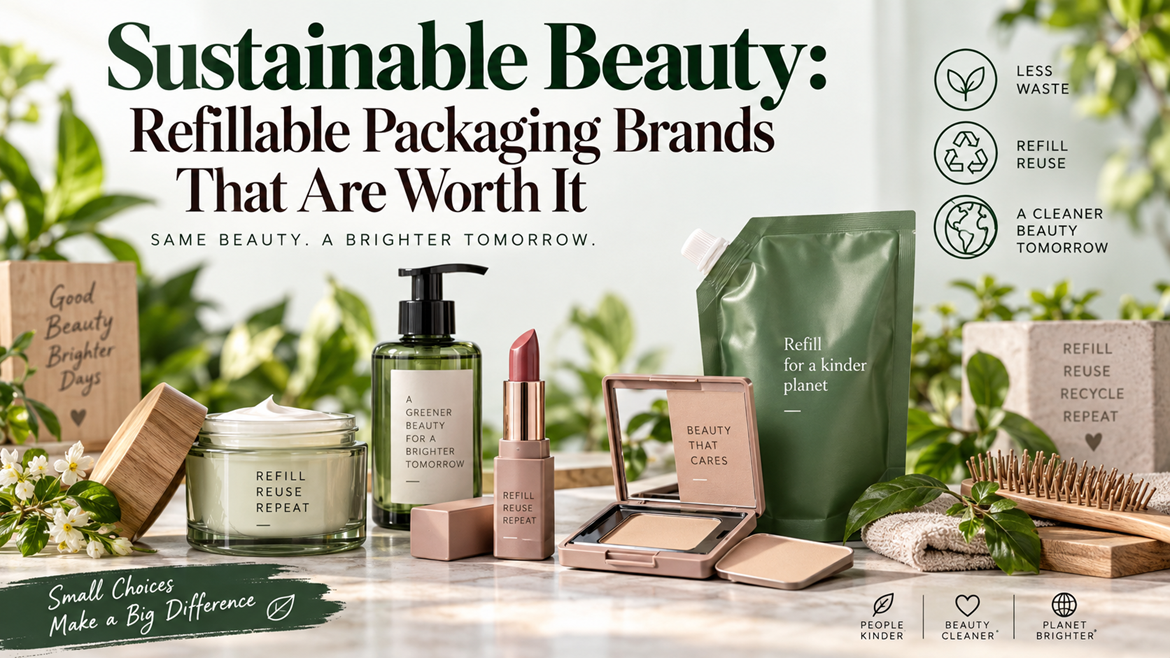
The beauty industry has made major progress in moving away from single-use packaging, but choosing a product simply because it says “econ-friendly” is not enough. A genuinely useful refill system should make it practical to keep the original container, buy replacement product, and avoid unnecessary packaging over multiple purchase cycles.
Refillable beauty is becoming increasingly common across skincare, hair care, makeup, fragrance, and body care. In 2026, L’Oreal’s global refill campaign includes 18 brands and 28 products across four divisions, while brands such as Kjaer Weiss and L’Occitane have built refill systems into significant parts of their product ranges.
The important question is not simply “Is this packaging refillable?” but rather “Does the refill system actually reduce material use while remaining convenient and hygienic?”
Here are several refillable beauty brands and systems worth knowing about, along with practical criteria for choosing them.
Why Refillable Beauty Packaging Matters
Traditional beauty packaging often combines several materials: glass or plastic containers, pumps, caps, labels, cartons, inner components, and protective packaging. Small components can be particularly difficult to recycle.
The Ellen MacArthur Foundation has identified reuse and refill systems as important approaches for moving packaging away from single-use consumption. Its cosmetics research also shows that the sector continues to face significant challenges with non-recyclable packaging, particularly small-format products and components.
A refill system can change that model:
Buy the durable container → use the product → purchase a refill → reuse the container.
Instead of replacing the complete package every time, the consumer keeps the component designed for repeated use.
However, refillable doesn’t automatically mean environmentally superior. The entire system matters, including the materials used for the refill, transportation, cleaning requirements, number of times the container is reused, and whether the refill is actually used.
What Makes a Refillable Beauty Brand Worth Considering?
Before purchasing, look for these characteristics.
1. A durable primary container
A good refill system should have a container designed for repeated use. Metal compacts, sturdy glass bottles, reusable aluminum dispensers, and durable cases can all work depending on the product.
2. Easily available refills
A beautiful reusable container is less useful if replacement inserts or refills are difficult to find.
Check whether refills are:
- Available online
- Available locally
- Offered in multiple shades or formulas where applicable
- Sold separately from the original container
- Compatible with the original packaging
3. Less material per refill
The refill should generally use less packaging than purchasing a completely new container.
This is where measurable information is more useful than vague claims such as “green” or “planet friendly.”
4. A realistic reuse system
Consider how easy the product is to refill. A system requiring complicated cleaning or specialized equipment may be less practical for everyday consumers.
5. Clear disposal instructions
Even refill systems eventually create waste. Look for brands that clearly explain what to do with empty refills, pumps, caps, pans, and other components.
Refillable Beauty Brands Worth Knowing
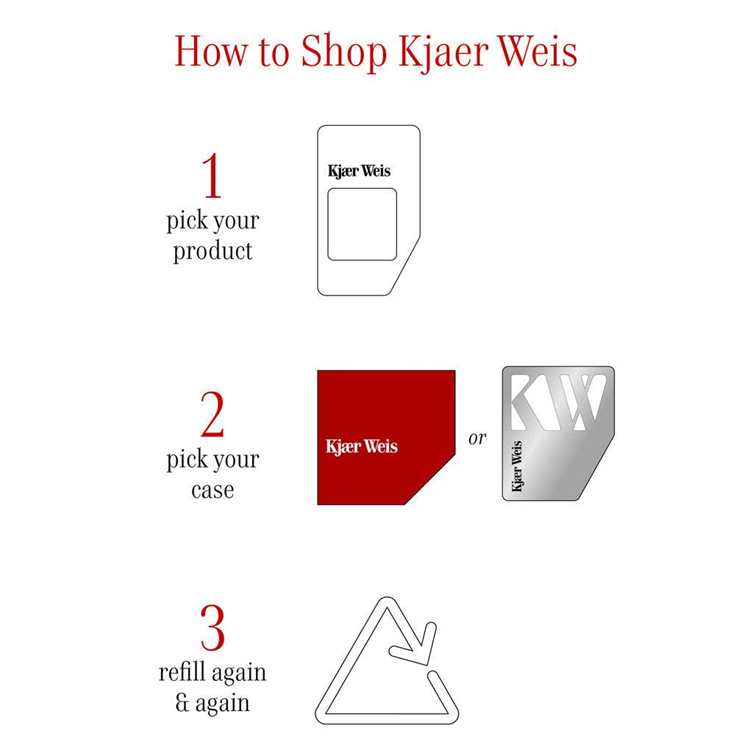
1. Kjaer Weiss: Refillable Makeup Designed for Long-Term Use
Kjaer Weiss is one of the most established names in refillable makeup.
The brand says it introduced refillable packaging when it launched in 2010. Its system uses reusable cases for products such as cream blush, eye shadow, lip products, and other makeup.
Its Intelligent Refill System allows consumers to replace the product inside the case rather than purchasing an entirely new outer package. The company says its refills are packaged in recycled paper and that empty makeup pans can be recycled.
Why it is interesting
Kjaer Weiss demonstrates one of the most straightforward refill concepts in beauty:
Keep the case → replace the makeup insert.
This is particularly suitable for people who repeatedly purchase the same type of makeup.
2. L’Occitane: Practical Refills for Hair care and Body Care
L’Occitane en Provence has developed refill options across several categories, including hair care, body care, hand care, and skincare.
Its Indian website currently lists refill products such as shampoo, conditioner, shower oil, body cream, hand wash, deodorant, and selected skincare products.
For example, L’Occitane states that some of its Eco-Refills use 69% to 90% less plastic compared with its regular packaging.
The brand also operates recycling programs in some markets, giving consumers options for hard-to-recycle beauty packaging.
Why it is practical
Hair care and body-care products are particularly well suited to refill systems because consumers tend to use them frequently.
A refill pouch or pack can replace the need for a new rigid bottle every time.
For Indian consumers, L’Occitane’s India website currently provides a dedicated selection of refill products, making it one of the easier examples to investigate locally.
3. L’Oreal: Refills Moving Into the Mainstream
L’Oreal is taking refillable packaging beyond specialist sustainable-beauty brands.
As of June 2026, L’Oreal reported that its refill movement covered 18 brands and 28 products across skincare, fragrance, makeup, and hair care. Participating brands include Lance, Prada Beauty, Yves Saint Laurent Beauty, Garner, Metastases, La Rose-posy, Vichy, and CeraVe.
The company also provides product-specific material reduction figures. For example, it says buying a Lance Absolute refill instead of purchasing the standard jar again reduces the use of glass, metal, plastic, and cardboard by specified amounts.
That type of product-level measurement is useful because it gives consumers something more concrete than a general sustainability slogan.
4. Tatar Harper: Refill-Oriented Luxury Skincare
Tatar Harper is another example of a premium skincare brand that has incorporated refill formats.
Vogue has highlighted the brand’s Water-Lock Moisturizer refill pod, which was designed to work with its existing packaging.
The broader advantage of a system like this is straightforward: consumers retain the main container while replacing only the product component.
For expensive skincare, that can make particular sense when the same product is purchased repeatedly.
5. Refillable Fragrance: An Important Category to Watch
Fragrance has become one of the most visible areas for refillable luxury beauty.
L’Oreal, for example, has expanded refill options across several fragrance brands. Its Armani beauty division says its refillable bottle system was introduced in 2020, allowing consumers to retain the original bottle and purchase refills.
Vogue has also reported on refillable fragrance systems from major luxury brands and noted that fragrance can be particularly compatible with refill models because consumers often value the appearance and longevity of the original bottle.
This creates a useful model:
Keep the beautiful bottle as the permanent object; replace only the fragrance.
Refillable Does Not Always Mean Perfect
It is important to avoid treating refillable packaging as an automatic solution to beauty’s environmental challenges.
Vogue Business has highlighted several practical problems, including complicated refill processes, packaging components that can be difficult to recycle, and consumer reluctance to change established purchasing habits.
For example, pumps can contain multiple materials and mechanical components that complicate recycling. A refill system may reduce the amount of packaging used while still leaving certain components that require specialized disposal.
The Ellen MacArthur Foundation similarly reports that cosmetics companies have made progress on reusable and recyclable packaging, but that significant amounts of cosmetic plastic packaging remain non-recyclable.
Therefore, refill ability should be considered one part of a packaging strategy—not proof that a product has zero environmental impact.
How to Choose the Right Refillable Beauty Product
Check the Refill-to-Original Ratio
Compare the refill packaging with the original container.
Ask:
- How much material is saved?
- Is the refill substantially lighter?
- Does the refill eliminate glass, metal, plastic, or cardboard?
- Can the outer container realistically be reused many times?
Consider Your Consumption Habits
Refillable packaging works best when you regularly finish and repurchase a product.
For example, if you use the same moisturizer every few months, a durable refillable jar may make more sense than repeatedly buying completely new packaging.
On the other hand, purchasing a reusable container for a product you rarely use may not provide the same practical benefit.
Look at the Full Product System
Sustainability is broader than packaging.
Consider:
Formula + ingredients + manufacturing + packaging + transportation + use + end-of-life
A refill is useful, but it is only one part of the product’s overall environmental footprint.

A Simple Refillable Beauty Routine
You don’t need to replace your entire beauty collection.
Start with products you purchase regularly.
Step 1: Choose one frequently used product
A shampoo, body wash, moisturizer, fragrance, or makeup product can be a good starting point.
Step 2: Buy the durable container once
Choose packaging designed specifically for repeated use.
Step 3: Purchase compatible refills
Make sure the refill is officially designed for your container.
Step 4: Follow the manufacturer’s hygiene instructions
Don’t transfer products into random containers, particularly skincare, eye-area products, or water-based formulas. Use the manufacturer’s recommended refill method.
Step 5: Dispose of the refill correctly
Check local recycling rules and the brand’s instructions rather than assuming every component belongs in household recycling.
The Future of Sustainable Beauty Packaging
The beauty industry’s shift toward refillable packaging is part of a larger movement from single-use consumption toward reuse and circular design.
The most promising systems are likely to be those that combine three things:
Durable packaging + convenient refills + measurable material reduction.
Industry research already shows that brands are experimenting with refill-at-home systems, in-store refill stations, reusable containers, recycled materials, and redesigned packaging.
But consumer participation remains critical. A refill system only delivers its intended benefits when customers actually keep and reuse the primary container rather than treating the refill as another disposable product.
Conclusion
Refillable beauty packaging is becoming a meaningful alternative to traditional single-use cosmetics packaging. Brands such as Kjaer Weiss, L’Occitane, L’Oreal, and Tatar Harper demonstrate different approaches, from refillable makeup cases to hair care pouches, skincare pods, and refillable fragrance bottles.
The smartest approach is not to assume that every refillable product is automatically sustainable. Instead, look for durable packaging, genuinely lower-material refills, convenient reuse, transparent disposal instructions, and credible evidence behind environmental claims.
For consumers, the most practical starting point is simple: choose products you already repurchase frequently and switch those products to a well-designed refill system. Over time, that small change can make a more meaningful difference than buying an entire collection of products simply because they carry a sustainability label.


