








What Is Active Recall?
Active recall is a learning method in which you deliberately try to retrieve information from memory instead of simply reading it again. Imagine your memory as a path through a forest. Reading the same chapter repeatedly is like looking at a map of the path, while active recall is actually walking along it. Each time you attempt to remember an idea without looking at your notes, you strengthen your ability to find that information later. That is why active recall is particularly useful for exams, professional training, language learning, and any subject where you need to produce an answer rather than simply recognize one. Research on memory consistently distinguishes between studying information and successfully retrieving it, and recent research continues to examine how retrieval and testing influence later memory.
The important point is that active recall is not the same thing as taking notes. You can write beautiful handwritten notes for three hours and still use very little active recall if you spend the entire session copying information from a textbook. Likewise, you can type notes on a laptop and create an excellent retrieval practice system if you turn those notes into questions and regularly answer them without looking. The real question, therefore, is not simply whether pen and paper are better than a keyboard. It is whether the way you use either tool forces your brain to select, organize, retrieve, and explain information. Once you understand that distinction, the handwriting-versus-typing debate becomes much easier to solve.
Why Retrieval Matters More Than Note-Taking
Think about the difference between recognizing an answer and producing it yourself. When you reread a paragraph, the information looks familiar, which can create the comforting feeling that you understand it. However, familiarity is not necessarily the same as recall. If someone closes the book and asks, “Explain this concept in your own words,” you may suddenly discover that your understanding is much weaker than it felt during reading. Active recall removes that illusion because it requires you to generate the answer before checking whether you were correct.
This is where your notes can become either a powerful learning tool or a storage system you rarely use. If your notebook contains pages of polished sentences that you simply reread before an exam, handwriting alone will not magically create strong memory. Instead, you want to transform notes into retrieval prompts. For example, rather than writing, “Photosynthesis is the process by which plants convert light energy into chemical energy,” write a question such as, “How do plants convert light energy into chemical energy?” Then close the notebook and answer it from memory. The writing method becomes secondary because the important cognitive event is the attempt to retrieve the answer.
Handwriting vs. Typing for Learning
There is a reason handwriting has remained part of education even as laptops and tablets have become common. Writing by hand is generally slower than typing, and that limitation can actually influence how you take notes. When you cannot record every sentence, you have to make choices. You listen, identify important information, shorten explanations, connect ideas, and decide what deserves space on the page. That process can encourage deeper processing because you are not simply acting as a human recording device.
A well-known 2014 study by Pam Mueller and Daniel Oppenheimer compared laptop and longhand note-taking and reported that students taking notes by hand performed better on conceptual questions in their experiments. The researchers argued that laptop note-takers were more likely to transcribe information verbatim, while longhand note-takers were more likely to process and reframe information. However, the story is not quite as simple as “handwriting always wins.” A later direct replication and mini meta-analysis found that laptop participants did not perform worse than longhand participants on the quiz, challenging the idea that handwriting automatically produces superior immediate learning.
How Handwriting Changes the Way You Process Information
Handwriting introduces a physical component that typing does not reproduce in exactly the same way. Your hand has to form letters, words, shapes, arrows, diagrams, and spatial relationships. You also have to decide where something belongs on the page. A heading might sit at the top, an example might be placed underneath it, and an arrow might connect one idea to another. The page can become a visual representation of how you understand the material.
Research published in Frontiers in Psychology in 2024 examined handwriting and typing using high-density EEG recordings. The researchers reported more elaborate connectivity between brain regions during handwriting than during typewriting in their sample of 36 university students. They suggested that this pattern may be relevant to learning and memory formation.
That finding is interesting, but it should not be turned into the claim that handwriting has been proven to make everyone learn better. The study examined neural activity during writing and typing rather than directly proving that students using handwritten notes will achieve better long-term academic outcomes. A later commentary also raised concerns about the study’s methodology and argued that the evidence for a direct learning benefit was weaker than some interpretations suggested. In other words, handwriting appears to engage the brain differently, but different brain activity is not automatically proof of better exam performance.
Why Typing Can Encourage Passive Note-Taking
Typing has one obvious advantage: speed. If a lecturer speaks quickly, you can usually type substantially more words than you can write by hand. That can be useful when the material is dense, when you need an accurate transcript, or when you are attending a meeting where missing details matters. The problem begins when speed changes your strategy from understanding to copying.
Imagine a teacher explaining a difficult idea. With a keyboard, you may type almost every sentence because you physically can. Your fingers keep moving, so you feel productive. Yet your attention can become focused on capturing words rather than understanding relationships between ideas. The original Mueller and Oppenheimer research specifically highlighted this potential problem, finding that laptop note-takers tended to produce more verbatim notes and that verbatim transcription was associated with poorer conceptual performance in their original experiments.
Typing itself, however, is not the enemy. Mindless transcription is the problem. If you type only the essential concepts, rewrite explanations in your own words, add questions, and test yourself afterward, a laptop can become an excellent active recall system. In fact, digital notes offer features that paper cannot easily match, such as search, tagging, backlinks, rapid editing, flashcard integration, and cloud synchronization.
What Research Says About Handwritten Notes
The research landscape is more nuanced than many productivity posts suggest. Earlier work gave handwriting a strong advantage in certain learning situations, especially when students were tempted to transcribe lectures word for word. Mueller and Oppenheimer’s 2014 experiments found an advantage for longhand note-taking on conceptual questions. Their explanation was not that paper has magical memory properties, but that the slower process of handwriting may push learners toward generative processing.
Then came research that complicated the picture. A 2021 preregistered direct replication of one of Mueller and Oppenheimer’s studies found that laptop participants took more notes and more verbatim notes but did not perform worse than longhand participants on the immediate quiz. The authors also conducted mini meta-analyses across similar studies and concluded that the evidence did not support a simple claim that longhand note-taking improves immediate learning through better encoding.
That distinction matters enormously if you are writing an SEO article or giving study advice. It would be inaccurate to tell readers that science has conclusively proven handwritten notes are always superior. The more defensible conclusion is that handwriting can encourage deeper processing in some situations, especially when it prevents verbatim transcription, but learning outcomes depend heavily on what the learner actually does with the information.
The Mueller and Oppenheimer Study
The 2014 study remains influential because it directly addressed a common modern learning behavior: taking lecture notes on a laptop. Across three studies, the researchers found that students using laptops performed worse on conceptual questions than students taking notes by hand. They also found that laptop users tended to transcribe more of the lecture verbatim.
The interesting lesson is not simply “use paper.” Consider what happens when you try to handwrite a complicated explanation at normal speaking speed. You cannot capture everything. Therefore, you might write, “Cause → effect → example,” instead of copying an entire paragraph. That tiny constraint forces you to interpret what you hear. Interpretation is valuable because it gives the information meaning and connects it with existing knowledge.
Yet the later replication is an important counterweight. It found that laptop users did not suffer the predicted learning disadvantage on the quiz, and its broader analysis did not provide strong support for the claim that longhand automatically improves immediate learning. This is why the best study strategy should focus on how you process and retrieve information, rather than treating handwriting as a magical shortcut.
What Newer Research Says
More recent research has added another piece to the puzzle by examining what happens in the brain during handwriting. The 2024 high-density EEG study found broader connectivity patterns during handwriting than during typewriting among the young adults tested. The researchers linked this activity to processes that are relevant to memory formation and learning.
At the same time, researchers and commentators have emphasized that neural connectivity should not be confused with a direct demonstration of improved learning. The study’s participants were performing controlled writing and typing tasks, not sitting through months of coursework and taking final examinations.
There is also a broader lesson here. Learning science rarely gives us one universal winner. The effectiveness of a method depends on the task, learner, environment, material, and what happens after the initial exposure. Handwriting may be especially useful for processing and organizing information, while typing may be more efficient for capturing large amounts of material and managing digital resources.
Is Handwriting Actually Better for Active Recall?
If the question is specifically about active recall, handwriting has an advantage in one important way: it can make the act of recalling information slower and more deliberate. Suppose you read a chapter about the human heart. Instead of copying definitions, you close the book and write everything you remember about blood flow. You draw the chambers, label the valves, explain the direction of circulation, and mark the parts you cannot remember. That is active recall.
Now imagine doing exactly the same exercise on a laptop. You close the textbook and type the explanation from memory. That is also active recall. The retrieval process is happening because you are generating information without looking at the source. The fact that your fingers are pressing keys rather than moving a pen does not eliminate the retrieval attempt.
This leads to the most useful answer: handwriting may be better for some forms of encoding, but active recall itself is more important than the physical medium. If handwriting encourages you to think, summarize, draw connections, and retrieve information, it is an excellent choice. If typing helps you create more questions, test yourself more often, and review your mistakes efficiently, typing may be the better option for you.
Handwriting as an Encoding Tool
Handwritten notes can work particularly well during the first encounter with difficult material. Because writing is slower, you have less incentive to record every sentence. You can create shorthand, symbols, diagrams, and personal explanations. For example, instead of copying a textbook definition of inflation, you might write, “Prices ↑ → purchasing power ↓,” followed by a simple example from everyday life. The act of translating the concept into your own structure can make the material more meaningful.
This is especially useful for subjects that involve relationships rather than isolated facts. Biology, history, economics, mathematics, and science often require you to understand why something happens, not merely memorize what it is called. A handwritten page can become a mental map. You might draw arrows between causes and effects, circle key terms, and write questions in the margins.
Still, do not confuse handwritten notes with active recall. If your notebook becomes a beautifully decorated textbook reproduction, you may be spending a lot of time on presentation without challenging your memory. The strongest approach is to write less during learning and retrieve more afterward.
Why Recall Practice Still Matters More
Imagine two students. Student A spends two hours making handwritten notes and then rereads them four times. Student B spends 45 minutes making simple typed notes and then spends another hour answering questions from memory. Which student is likely to have stronger retrieval ability?
There is no guarantee in every individual case, but Student B is using the more direct memory practice. Active recall requires the brain to produce information when the answer is not immediately visible. That is exactly what happens during an exam, interview, presentation, or real-world task.
For this reason, your study system should have a clear transition:
Learn → close the source → retrieve → check → correct → retrieve again.
Your notebook or laptop is simply the tool that supports that cycle. If your note-taking method takes up almost all your study time, it may be time to change the balance.
When Typing Notes May Be Better
Typing can be the better choice when speed, organization, accessibility, or volume matters. If you are attending a fast lecture containing many technical details, typing may allow you to capture enough information to review later. It is also useful when you need searchable records, large collections of notes, or easy collaboration with classmates and colleagues.
Digital notes can also support active recall in powerful ways. You can convert headings into questions, link related concepts, create digital flashcards, hide answers, and use spaced-repetition software. You can quickly search for a topic and then test yourself on it. For students managing several courses, this flexibility can save considerable time.
Typing also removes some practical barriers. Not everyone writes comfortably by hand for long periods, and some people have handwriting that becomes difficult to read when they write quickly. A keyboard can make editing and reorganizing information far easier. The best learning system is one you can use consistently without unnecessary friction.
The key is to prevent your keyboard from becoming a transcription machine. Do not try to capture every spoken word unless you genuinely need a transcript. Instead, listen first, identify the main idea, and record the concept in your own language. Then convert that concept into a question that you can answer later.
How to Combine Handwriting and Typing for Better Recall

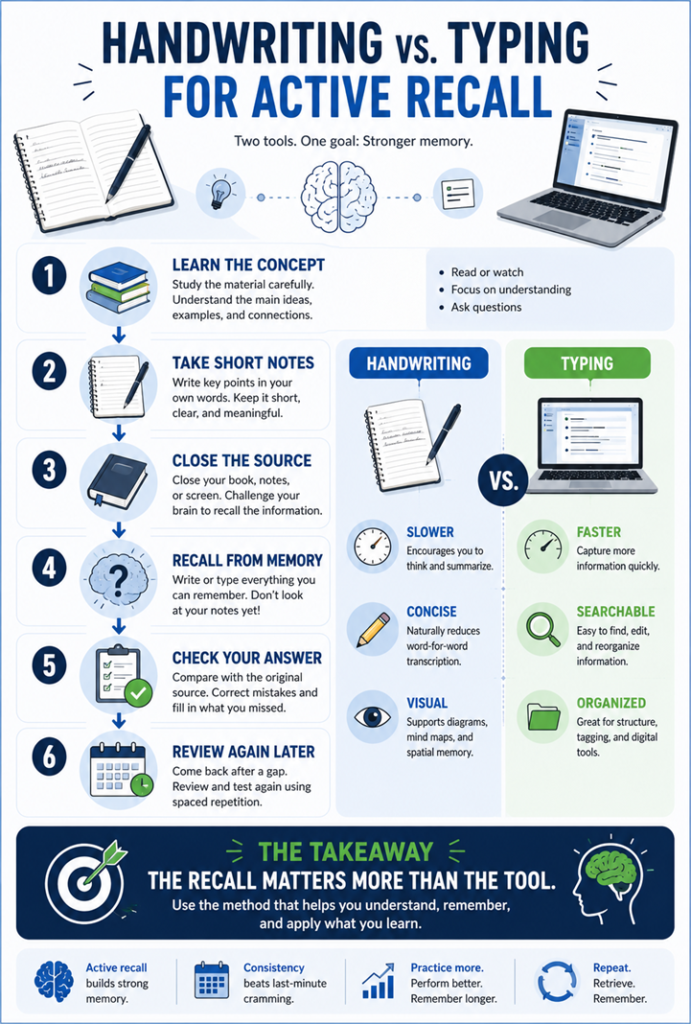
You do not have to choose one method forever. A hybrid approach can give you the strengths of both. You might use handwriting when learning difficult concepts and digital tools when organizing, searching, and reviewing your material. This works particularly well because different stages of learning have different demands.
For example, imagine you are studying a chapter on the nervous system. During the first study session, you could use paper to draw the major structures and explain the pathway of a nerve impulse. Later, you could type the key concepts into a digital document and turn each one into a question. During revision, you would hide the answers and retrieve them from memory. Finally, you could write a short explanation by hand to identify gaps in your understanding.
A Simple Active Recall Workflow
Try this five-step process:
- Study a small section. Read or watch the material carefully instead of rushing through an entire chapter.
- Close the source. Put the textbook, video, or lecture slides away.
- Recall from memory. Write or type everything you can remember.
- Check your answer. Compare your response with the original material and identify missing or incorrect information.
- Repeat later. Return to the questions after a gap and retrieve the information again.
The fourth step is easy to skip, but it matters. You need feedback because active recall is not about confidently producing wrong answers. You want to discover what your memory can retrieve and where it breaks down.
You can also use a simple rule: notes should support recall, not replace it. If you spend 80% of your study session making notes and only 20% testing yourself, consider reversing that ratio. Your goal is not to create the world’s most beautiful notebook. Your goal is to make your brain capable of producing the information when the source is gone.
Common Note-Taking Mistakes That Hurt Memory
One of the biggest mistakes is copying instead of processing. This can happen with both handwriting and typing. A student may carefully rewrite every definition, underline every sentence, and color-code every heading. The final notes look impressive, but the student may still struggle to explain the topic without them.
Another mistake is reviewing only by rereading. Rereading feels comfortable because the information is visible. Active recall feels harder because you have to search your memory. That difficulty can actually be useful. When you cannot immediately remember an answer, your brain has to work to retrieve it, and checking the correct answer then exposes the gap.
A third mistake is waiting until the night before an exam to test yourself. Retrieval practice works best as part of a repeated learning cycle. Instead of creating 100 questions the evening before a test, create a few questions after each study session and revisit them over time.
Finally, avoid turning note-taking into an artistic project unless design genuinely helps you learn. A clean page is useful. A page that takes 45 minutes to decorate but contains little retrievable information is not. Clarity beats decoration, and retrieval beats rereading.
Handwriting vs. Typing: Quick Comparison
| Factor | Handwriting | Typing |
| Speed | Slower | Faster |
| Encourages summarizing | Often yes | Depends on how you type |
| Risk of verbatim copying | Lower | Higher |
| Digital organization | Limited | Excellent |
| Searchability | Low | Excellent |
| Diagrams and spatial notes | Excellent | Good with digital tools |
| Editing | More difficult | Very easy |
| Active recall potential | High | High |
| Best use | Deep processing and visual organization | Fast capture, organization, and digital review |
The table shows why there is no universal winner. Both methods can support excellent learning when used deliberately. The biggest difference is often learner behavior, not the tool itself.
Final Verdict: Which Method Should You Use?
So, is writing notes by hand better than typing for active recall? The most accurate answer is: not necessarily, but handwriting can encourage behaviors that support better learning. Research has found advantages for longhand note-taking in some experiments, especially regarding conceptual questions, while later replication work has challenged the strength and consistency of that advantage. More recent neuroscience research also suggests that handwriting and typing engage the brain differently, but those findings should not be interpreted as definitive proof that handwriting always produces better academic outcomes.
If your main goal is active recall, choose the method that helps you retrieve information without looking at the answer. If writing by hand makes you slow down, summarize, draw connections, and think deeply, use it. If typing helps you organize a large amount of material and turn it into effective questions and flashcards, use it.
For many learners, the best solution is a combination. Handwrite difficult concepts, type and organize your question bank, and use both for retrieval practice. The pen does not have magical memory powers, and the keyboard does not automatically make learning passive. Your learning strategy matters more than the device in your hand.
Conclusion
Handwriting can be a powerful learning tool because it naturally slows you down and may encourage you to process information instead of copying it word for word. Research has provided evidence that longhand note-taking can support conceptual learning in certain circumstances, while newer work shows that the advantage is not universal. Research examining brain activity also suggests that handwriting produces different connectivity patterns from typing, although those findings should be interpreted carefully rather than treated as proof of superior learning.
For active recall, the winning strategy is simpler: study the material, hide it, retrieve what you remember, check your mistakes, and repeat the process later. You can do that with a pen, keyboard, tablet, or flashcard app. If handwriting helps you think more deeply, keep using it. If typing makes your study system faster and easier to maintain, use it without guilt. The real goal is not to produce perfect notes; it is to build a memory that can retrieve the right information when you need it.
FAQs
1. Is handwriting better than typing for memory?
Handwriting may encourage deeper processing because it is slower and often requires you to summarize rather than copy. Some research has found learning advantages for handwritten notes, but later replication research has produced more mixed results.
2. Does typing reduce active recall?
No. Typing does not automatically reduce active recall. If you close your notes and answer questions from memory on a keyboard, you are still practicing active recall. The bigger problem is passive transcription, where you type information without thinking about or processing it.
3. Should I write handwritten notes before making flashcards?
That can be an effective approach, especially for difficult subjects. You can first handwrite simplified concepts or diagrams and then turn the most important ideas into digital flashcards or questions for repeated retrieval practice.
4. How can I make handwritten notes more useful for active recall?
Write questions, leave space for answers, summarize concepts in your own words, and draw diagrams where appropriate. After studying, close the book and try to recreate the important ideas from memory. Then compare your response with the original notes and correct the gaps.
5. What is the best note-taking method for students?
There is no single method that works best for every student. Handwriting can be useful for deep processing and diagrams, while typing is excellent for speed, organization, search, and digital review. The strongest approach is usually the one that helps you spend more time retrieving and explaining information rather than simply recording or rereading it.


2 Comments
Solid write-up — learned a lot. Worth trying SaveYT — for quick offline YouTube downloads.. SaveYT
Praktisch. Schau dir Pixwit an: . Pixwit