

You can spend hundreds on serums containing hyaluronic acid, vitamin C, peptides, retinoids, or other sophisticated ingredients and still feel as though your skincare routine is doing very little. Your skin may remain tight, flaky, red, rough, unusually sensitive, or prone to stinging.
The problem may not be that your serum is ineffective. In many cases, the missing piece is the skin barrier.
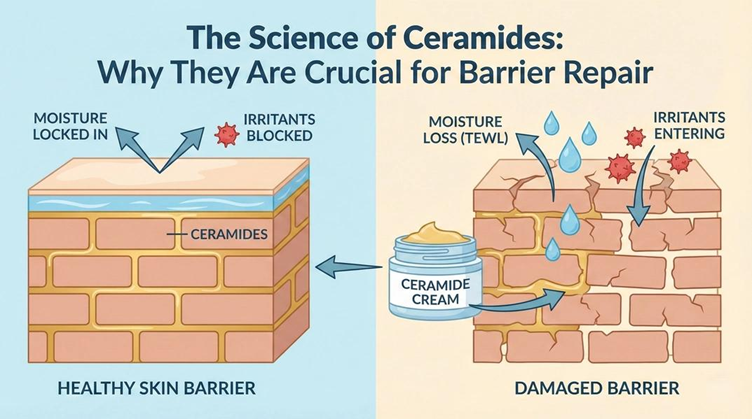
The skin barrier is primarily associated with the outermost portion of the epidermis, particularly the stratum corneum. It helps regulate water loss and protects the body from environmental irritants. Its structure is often compared with a brick wall: corneocytes form the “bricks,” while lipids—including ceramides, cholesterol, and fatty acids—help form the “mortar” between them.
When this barrier is compromised, adding more active products can sometimes make a skincare routine less comfortable rather than more effective. The smarter approach is often to restore basic barrier support before asking your skin to tolerate a complicated routine.
What Exactly Is the Skin Barrier?
Your skin is not simply a surface that absorbs skincare products. It is a sophisticated protective organ.
The stratum corneum helps keep water inside the skin while limiting the penetration of unwanted substances. Its lipid matrix contains ceramides, cholesterol, and fatty acids arranged in highly organized structures that contribute to barrier function.
Think of it this way:
- Corneocytes: the structural “bricks”
- Ceramides: important lipid components of the “mortar”
- Cholesterol and fatty acids: additional structural lipids
- Humectants: help attract and hold water
- Emollients: help smooth and soften the skin
- Occlusives: help reduce water loss from the surface
A healthy barrier does not necessarily mean flawless skin. It means the skin is better able to maintain hydration and tolerate everyday environmental exposure and skincare.
Signs Your Skin Barrier May Be Compromised
A damaged or weakened barrier can present differently from person to person. Common signs include:
1. Persistent Tightness
Your face feels tight shortly after cleansing, even when you have applied moisturizer.
2. Stinging or Burning
Products that previously felt comfortable suddenly sting when applied. This can be particularly noticeable with acids, retinoids, vitamin C products, or fragranced skincare.
3. Dryness and Flaking
The skin may look rough, flaky, or unusually dull because the outer layer is struggling to maintain appropriate hydration.
4. Increased Sensitivity
Your skin seems to react to products, temperature changes, or environmental conditions more easily than before.
5. Redness and Irritation
Inflammation and irritation can accompany impaired barrier function. However, persistent redness or irritation can also have other causes, so it should not automatically be diagnosed as “barrier damage.”
Why Your Expensive Serums May Not Be Giving Results
The Problem Isn’t Necessarily the Serum
A high-priced serum can contain well-studied ingredients and still fail to deliver the result you expect.
One reason is that skincare results depend on more than the ingredient list. Your skin’s condition, formulation, frequency of use, concentration, compatibility with other products, and consistency all matter.
For example, imagine someone using:
Morning: vitamin C serum → exfoliating toner → moisturizer → sunscreen
Night: retinoid → exfoliating acid → peptide serum → moisturizer
On paper, this looks sophisticated. But if the person develops persistent dryness, burning, or irritation, adding another serum may be the wrong solution.
The better question becomes: Is the skin currently tolerating the routine?
More Actives Can Mean More Irritation
Retinoids and exfoliating acids can be valuable skincare ingredients when appropriately selected and used. But excessive exfoliation, harsh cleansing, or overly frequent use of irritating products can compromise the skin barrier. Forbes Health similarly identifies over-exfoliation, harsh products, hot showers, dry air, and environmental exposure among factors that can contribute to barrier problems.
This creates a frustrating cycle:
More irritation → more dryness → more products → more irritation.
Breaking that cycle can be more productive than purchasing another expensive treatment serum.
The Ingredients That Matter for Barrier Support
Ceramides
Ceramides are naturally occurring lipids found in the stratum corneum and are important components of the skin’s intercellular lipid matrix.
The American Academy of Dermatology recommends looking for moisturizers containing ingredients such as ceramides and hyaluronic acid when managing dry skin.
Humectants
Humectants such as glycerin and hyaluronic acid help attract and retain water in the outer layers of skin.
But hydration alone isn’t the entire story. If water is added to the skin without adequate moisture retention, the result may not feel sufficiently comfortable or long-lasting.
Emollients
Emollients help smooth the skin by filling spaces between surface cells and improving the feel of rough, dry skin.
Occlusives
Occlusive ingredients help reduce water loss from the skin surface. Petrolatum is a well-established example. Harvard Health notes that moisturizers generally work through combinations of humectant, emollient, and occlusive mechanisms.
Barrier Repair Doesn’t Have to Be Expensive
One of the biggest misconceptions in modern skincare is that an effective barrier routine needs to contain numerous luxury products.
It doesn’t.
A relatively simple routine can provide the foundation your skin needs:
Morning
- Use a gentle cleanser if cleansing is necessary.
- Apply a straightforward moisturizer suited to your skin.
- Finish with broad-spectrum sunscreen, ideally SPF 30 or higher.
Evening
- Cleanse gently.
- Apply moisturizer while the skin is slightly damp.
- If your skin is particularly dry, consider a more occlusive moisturizer or suitable barrier-supporting product.
Harvard Health recommends moisturizing after cleansing while the skin is still damp, while the AAD emphasizes selecting moisturizers appropriate to an individual’s skin needs.
What to Pause During a Barrier Reset
A “barrier reset” doesn’t have to mean abandoning skincare indefinitely. It means temporarily removing unnecessary sources of irritation.
Consider reducing or pausing:
- Physical scrubs
- Frequent exfoliating acids
- Multiple exfoliating products
- Strong retinoid use if it is causing significant irritation
- Highly fragranced products
- Very hot water
- Aggressive cleansing
- Constantly introducing new products
Once the skin feels comfortable and stable again, active ingredients can be reintroduced gradually rather than all at once.
Cleveland Clinic specifically recommends avoiding over-cleansing and maintaining moisturization, with ceramides, fatty acids, and lipids among the ingredients worth considering for barrier support.
A Real-World Example
Consider two skincare routines.
Routine A:
- Foaming cleanser
- Exfoliating toner
- Vitamin C serum
- Retinoid
- Peptide serum
- Multiple masks
- Lightweight moisturizer
Routine B:
- Gentle cleanser
- Ceramide-containing moisturizer
- Sunscreen
- One carefully selected active introduced gradually
If Routine A leaves the skin persistently irritated while Routine B keeps it comfortable, the simpler routine may be the more productive starting point.
This doesn’t mean every active ingredient is harmful. It means skin tolerance and barrier condition should influence how aggressively you build a routine.
How Long Does Barrier Repair Take?
There is no universal number of days required for barrier recovery.
The timeline depends on what caused the problem, how severe the irritation is, your underlying skin condition, and whether you remove the triggering factors.
Consistency matters more than constantly changing products.
If your skin repeatedly becomes inflamed despite simplifying your routine, don’t assume you simply need a stronger moisturizer. Conditions such as eczema, psoriasis, contact dermatitis, acne-related irritation, or other dermatological problems can resemble ordinary “barrier damage.” The AAD notes that persistent excessive dryness may require evaluation and treatment of an underlying skin condition.
When You Should See a Dermatologist
Consider professional evaluation if you experience:
- Persistent burning or pain
- Significant swelling
- Cracking, oozing, or bleeding
- Severe or worsening redness
- Recurrent rashes
- Persistent itching
- Symptoms that do not improve after simplifying your routine
- Suspected eczema, dermatitis, or another skin condition
Barrier care is useful, but it shouldn’t replace diagnosis when a medical skin condition may be involved.
Conclusion
Expensive serums aren’t automatically bad investments—but they aren’t a substitute for healthy skin fundamentals.
When the barrier is compromised, the priority should often shift from adding more active ingredients to improving tolerance, hydration, and protection. Gentle cleansing, an appropriate moisturizer, barrier-supporting ingredients such as ceramides, and daily sun protection can provide a much stronger foundation than a crowded routine.
The most effective skincare routine isn’t necessarily the one with the highest price tag or the longest ingredient list. It is the one your skin can tolerate consistently while addressing your actual needs.
Before buying another serum, take a step back and ask a simpler question:
Is my skin healthy enough to benefit from everything I’m putting on it?
Sometimes, better skincare begins with doing less—but doing it consistently.
