
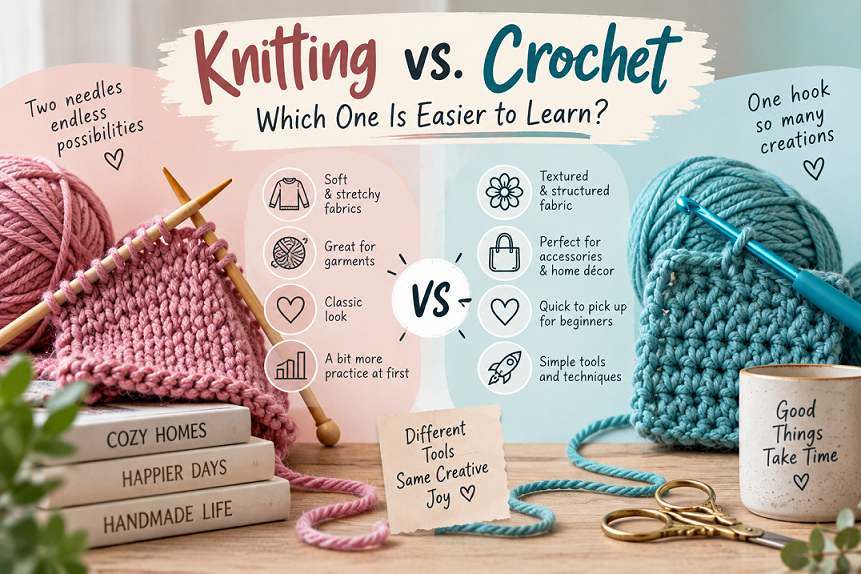
If you want to start a yarn-based craft, one of the first questions you may ask is: Is knitting or crochet easier to learn? Both crafts use yarn to create everything from scarves and blankets to sweaters, bags, toys, and home decor. However, they use different tools, hand movements, and construction techniques, so the learning experience can feel quite different.
For many complete beginners, crochet tends to have a gentler initial learning curve because it uses one hook and generally keeps fewer active loops under control at once. Knitting, meanwhile, requires two needles and involves transferring stitches between them. That doesn’t mean knitting is difficult—it simply requires a different type of coordination.
The right choice ultimately depends on the type of projects you want to make, how you prefer to learn, and which movements feel most natural to you.
Knitting vs. Crochet: What’s the Difference?
The biggest difference is the way stitches are formed and held.
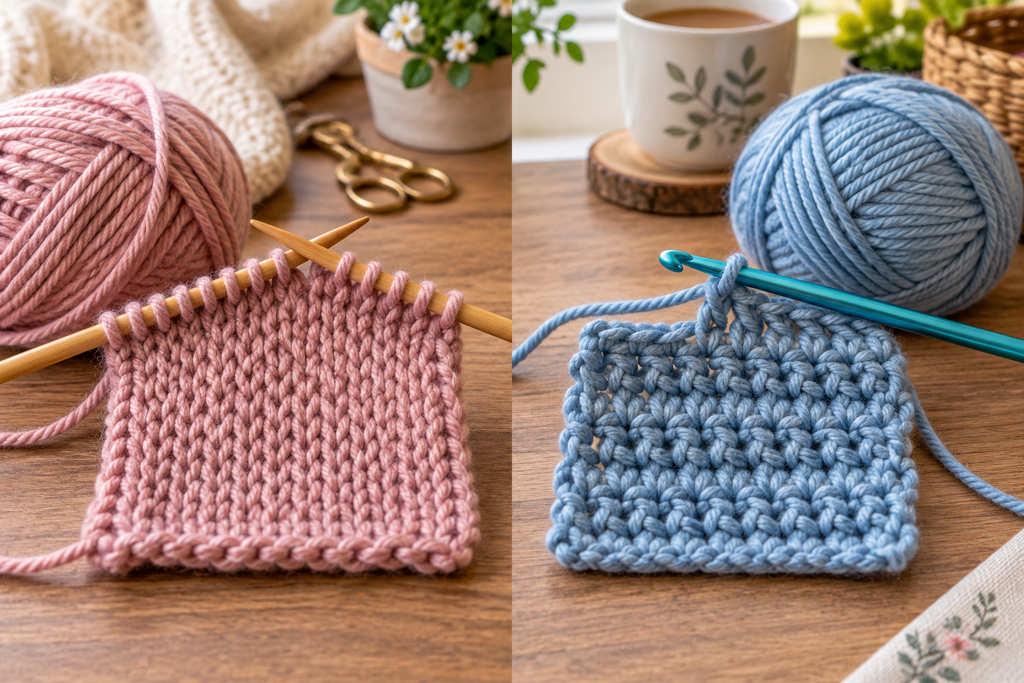
Knitting normally uses two needles. Stitches remain on the needles as you work, and you create new stitches by manipulating loops from one needle to the other. Basic knitting starts with techniques such as casting on, knitting, purling, and casting off.
Crochet uses one hook. Rather than keeping a whole row of active stitches on needles, you generally work through individual loops with the hook. Basic crochet commonly begins with a slip knot, chain stitches, and foundational stitches such as single and double crochet.
This fundamental difference is why many newcomers find crochet easier to understand initially.
Is Crochet Easier for Beginners?
For many people, yes.
Crochet has a relatively straightforward basic setup: one hook, one working loop, and yarn. Once you understand how to hold the hook, maintain tension, and make a chain, you can begin learning basic stitches.
A beginner might progress through:
- Slip knot
- Chain stitch
- Single crochet
- Double crochet
- Turning
- Increasing and decreasing
- Working in the round
Because crochet typically involves one active working loop, mistakes can also feel less intimidating. If you make an error several rows below, you may be able to remove stitches back to the problem area and continue.
Martha Stewart’s beginner crochet guide similarly emphasizes starting with a few basic stitches and practicing until the hand movements become familiar.
Why Crochet Can Feel Easier
Crochet has several beginner-friendly characteristics:
- Only one hook is required.
- Basic stitches can be learned individually.
- Projects can be relatively easy to pause and resume.
- Individual stitches can often be undone without managing a large number of live stitches.
- The technique works well for flat pieces and projects made in the round.
For example, a beginner could start with a small crochet coaster or granny square rather than committing immediately to a large blanket.
Is Knitting Harder to Learn?
Knitting can require a little more coordination at the beginning, particularly because you are managing two needles and multiple live stitches.
The first skills usually include:
- Making a slip knot
- Casting on
- Holding the needles correctly
- Making knit stitches
- Learning the purl stitch
- Maintaining consistent tension
- Casting off
The basic knit stitch itself is not particularly complicated. The challenge comes from coordinating both needles, controlling the yarn, and keeping stitches from accidentally slipping off.
Once those movements become automatic, knitting can become highly rhythmic.
A beginner-friendly knitted scarf, for example, can be made almost entirely with the knit stitch. Martha Stewart recommends simple projects such as beginner scarves and small accessories as ways to build confidence.
Knitting vs. Crochet: A Beginner Comparison
| Feature | Knitting | Crochet |
| Main tool | Two needles | One hook |
| Beginner coordination | Usually more complex | Usually simpler |
| Basic starting skills | Cast on, knit, purl | Slip knot, chain, basic stitches |
| Active stitches | Multiple stitches held on needles | Usually one active loop |
| Fixing mistakes | Can require more care | Often relatively straightforward |
| Common beginner projects | Scarves, dishcloths, hats | Granny squares, scarves, coasters |
| Fabric appearance | Often smooth and flexible | Often more textured and structured |
| Garment construction | Excellent for fitted garments | Excellent for textured garments and accessories |
| Portability | Good, but needles can be awkward | Very portable |
| Learning curve | Gradual | Often quicker initially |
Neither craft is objectively “better.” The important distinction is that the first few learning steps can feel easier in crochet, while knitting offers its own advantages once you become comfortable with needle control.
Which Is Easier to Fix When You Make a Mistake?
Mistakes are part of learning either craft.
In knitting, a dropped stitch can potentially cause a vertical ladder of unraveling stitches. Fortunately, dropped stitches can often be recovered using a crochet hook, but beginners may find the process confusing initially.
Crochet mistakes can also require unraveling, but because you generally work with one active loop, many beginners find it easier to identify where they went wrong.
This doesn’t mean crochet is mistake-proof. Common beginner problems include:
- Losing or adding stitches
- Crocheting into the wrong part of a stitch
- Uneven tension
- Forgetting turning chains
- Accidentally changing stitch counts
Good tension and counting are important in both crafts.
Which One Is Easier for Making Clothes?
This depends heavily on the type of clothing you want to create.
Knitting for Clothing
Knitting produces a fabric with considerable stretch and drape, making it particularly useful for garments such as:
- Sweaters
- Cardigans
- Socks
- Beanies
- Gloves
- Scarves
The traditional V-shaped appearance of knitted stitches also creates a fabric that many people associate with classic sweaters and winter accessories.
Crochet for Clothing
Crochet is particularly useful when you want:
- Strong texture
- Decorative patterns
- Openwork
- Granny-square designs
- Bags
- Hats
- Shawls
- Lightweight decorative garments
Crochet can also be used for sweaters and other garments, although its fabric structure differs from conventional knitted fabric.
So if your goal is specifically to make a traditional stretchy sweater, knitting may be worth learning even if crochet seems easier at first.
Which One Is Faster to Learn?
There is no universal timetable because learning speed depends on practice, previous craft experience, hand coordination, and the complexity of the project.
However, beginners can often make a recognizable crochet fabric relatively quickly because the basic technique requires only a hook and a small number of foundational stitches.
Knitting may take longer to feel comfortable because beginners have to coordinate two needles while maintaining several stitches.
The important distinction is between learning the basics and becoming highly skilled. Crochet may be quicker to start, but both crafts become increasingly sophisticated as you move into advanced patterns, shaping, color work, cables, lace, garment construction, and pattern reading.
Which Craft Requires More Equipment?
Crochet has a relatively simple equipment list.
A beginner can start with:
- One crochet hook
- Suitable yarn
- Scissors
- A yarn needle
Knitting can require:
- Knitting needles
- Yarn
- Scissors
- A yarn needle
- Stitch markers
- Potentially circular or double-pointed needles for certain projects
Knitting needles also come in different types and sizes, including straight, circular, and double-pointed needles.
That doesn’t mean you need a huge collection when starting. One appropriate needle size and beginner-friendly yarn can be enough for your first project.
What Should a Complete Beginner Start With?
If you’ve never worked with yarn before, start small.
If You Choose Crochet
Try a:
- Granny square
- Simple coaster
- Small scarf
- Dishcloth
- Basic beanie
A small square is particularly useful because you can repeatedly practice the same stitch without worrying about complicated shaping.
If You Choose Knitting
Try a:
- Garter-stitch scarf
- Headband
- Simple dishcloth
- Basic rectangular panel
- Small shawl
A simple garter-stitch project lets you concentrate on your knit stitch, yarn tension, and needle control.
Martha Stewart’s beginner knitting resources similarly recommend approachable projects that allow newcomers to practice fundamental techniques before moving to more complicated designs.
Practical Tips for Learning Faster
1. Start With Medium-Weight Yarn
Avoid extremely thin yarn when learning. A medium-weight yarn makes individual stitches easier to see.
2. Choose Light-Colored Yarn
Very dark yarn can make it difficult to distinguish individual stitches. A lighter, solid color is generally easier for beginners.
3. Don’t Start With a Sweater
A sweater can involve hundreds or thousands of stitches, shaping, sizing, gauge calculations, and pattern instructions.
Your first project should teach you the technique—not test your patience.
4. Practice Tension
Beginners frequently pull the yarn too tightly. Try to maintain a comfortable, consistent tension rather than forcing every stitch to be extremely tight.
5. Repeat One Stitch
Instead of learning five stitches simultaneously, practice one stitch repeatedly until the movement becomes natural.
6. Learn to Read Your Stitches
Eventually, being able to recognize a knit stitch, purl stitch, chain, or crochet stitch visually will make pattern reading much easier.
Can You Learn Both?
Absolutely.
In fact, learning one can make the other less intimidating. Crochet hooks can also be useful to knitters for recovering dropped stitches, while many crafters enjoy combining knitted and crocheted elements in the same project.
You don’t have to treat them as competing hobbies. Many experienced fiber artists use both techniques depending on the desired fabric, construction method, texture, or decorative effect.
Knitting vs. Crochet: Which Should You Choose?
If your priority is the easiest introduction to yarn crafts, crochet is often the more approachable starting point because of its single-hook construction and relatively simple initial setup.
If you are particularly interested in knitted sweaters, socks, traditional ribbed fabrics, or the appearance and stretch of knitted textiles, learning knitting from the beginning may make more sense.
The best choice is ultimately the one that matches the projects you genuinely want to make. Motivation matters: practicing a craft becomes much easier when you’re excited about the finished object.
Frequently Asked Questions
Is crochet easier than knitting?
For many beginners, yes. Crochet generally involves one hook and one active working loop, which can make the basic mechanics easier to grasp. However, individual learning experiences vary.
Is knitting more difficult than crochet?
The initial coordination can be more demanding because knitting normally involves two needles and multiple live stitches. With practice, however, the basic movements become repetitive and predictable.
Can I learn knitting and crochet at the same time?
You can, but beginners may find it easier to learn one technique first. Once you understand basic yarn tension and stitch structure, learning the second craft can become easier.
Which is better for beginners: knitting or crochet?
There is no universal answer. Crochet often provides a simpler starting point, while knitting may be more appropriate if your primary goal is making traditional knitted garments.
Can crochet replace knitting?
Not completely. Although both can produce many similar objects, they create different fabric structures and behave differently. Some projects are particularly well suited to one technique.
Conclusion
Crochet is often easier for a complete beginner to learn, particularly because it uses one hook and requires fewer tools to get started. Knitting has a somewhat more involved initial coordination, but its fundamental stitches are also accessible with consistent practice.
Rather than choosing based solely on which craft is “easier,” consider what you want to make. Choose crochet if you want a straightforward introduction, textured projects, granny squares, accessories, or highly portable crafting. Choose knitting if you’re drawn to stretchy fabrics, sweaters, socks, classic knitted textures, or the rhythm of working with two needles.
Most importantly, don’t judge your ability by your first crooked row. Uneven tension, missed stitches, and imperfect edges are normal parts of learning. Start with a small project, use suitable yarn, practice regularly, and let your hands gradually learn the movements.
The easiest craft is ultimately the one you’re motivated to practice.
