






Mobile connectivity is something we hardly think about—until it changes. The shift from 4G to 5G isn’t just a buzzword in tech marketing; it’s a significant evolution in how wireless networks work and what they can do for everyday users, businesses, and entire industries. This article breaks down the differences in a clear way, explains how you benefit (or not) right now, and grounds everything in real-world terms.
For technical grounding and a deeper background on standards and capabilities, you can explore the official 5G overview on Wikipedia and a detailed industry comparison of 4G and 5G networks.
Understanding the Generations: What 4G and 5G Mean
4G (Fourth Generation) was the first cellular standard designed for fast mobile internet—enabling reliable streaming, social media, and app-based experiences on your phone. 5G (Fifth Generation) builds on this foundation but is engineered for much more: ultra-fast speeds, minimal delay (latency), and support for vastly more connected devices.
In simple terms:
- 4G focuses on mobile broadband performance. It brought us high-definition video streaming, navigation apps, and real-time communication.
- 5G expands on that with a smarter, more versatile network capable of supporting real-time systems, automation, and massive device connectivity.
Faster Speeds: What You’ll Notice
Beyond Just “Faster Downloads”
One of the most visible differences between 4G and 5G is speed.
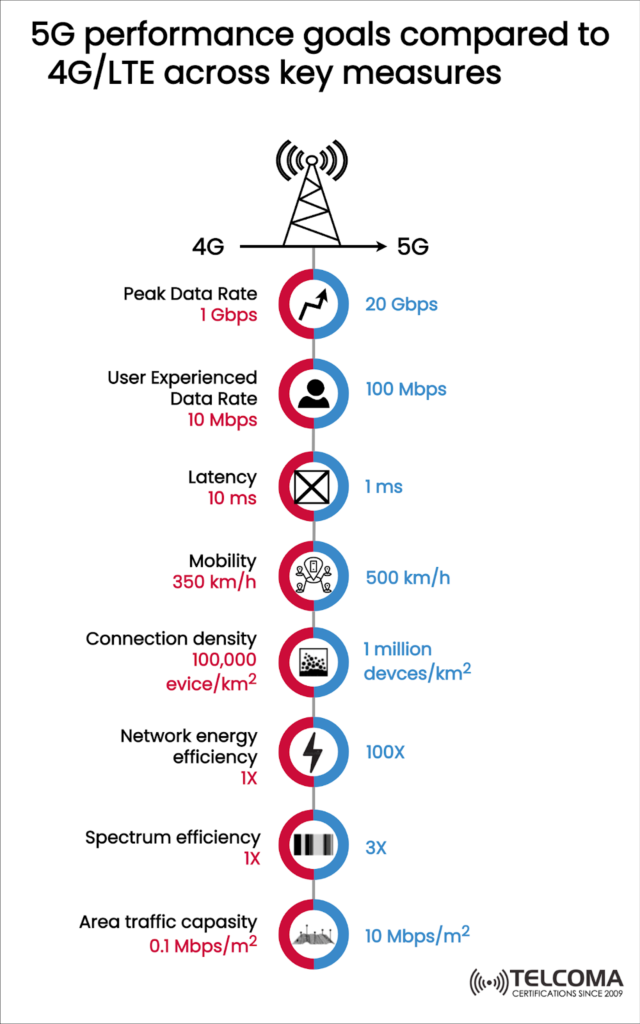
- 4G typically delivers peak download speeds up to ~1 Gbps in ideal conditions.
- 5G aims for download speeds up to 10–20 Gbps in optimal setups, though real-world speeds are commonly in the multi-Gbps range—still multiples higher than 4G.
What that means for you:
- Large files, such as movies or software updates, download significantly faster.
- High-resolution video (4K and beyond) streams smoothly, even on multiple devices.
- Cloud-based apps launch and sync with virtually no delay.
You won’t see maximum theoretical speeds all the time—coverage, device capability, and network load all affect performance—but the average user experience is already faster and more consistent where 5G is available.

Latency: Faster Response Times for Real-Time Experiences
Latency describes the time it takes for data to make a round-trip over the network. Lower latency means more responsive services.
- 4G latency typically sits around 20–40 milliseconds.
- 5G latency can drop below 5 milliseconds.
That’s not just a technical metric—it changes how software feels and behaves. For example:
- Multiplayer gaming is more responsive, with less lag.
- Video calls feel closer to real life.
- Emerging applications like remote robotics or augmented reality truly benefit from the near-instant communication possible on 5G.
More Devices, Less Congestion
Modern life increasingly relies on connected gadgets: watches, smart appliances, security cameras, and sensors. Here’s where 5G stands out.
5G networks are engineered to support vastly more devices in the same area than 4G, up to ten times or more.
Practically speaking, this means:
- Fewer slowdowns in crowded areas like stadiums or concerts.
- Smart home and IoT devices can coexist without degrading your phone’s performance.
- Businesses can deploy dense sensor networks for automation, inventory, or environmental monitoring.
Real-World Uses: Today and Tomorrow
Everyday Improvements
- Streaming: 5G gives consistently smoother, high-quality video—even in busy urban centers.
- Remote Work: Cloud apps load faster and stay more responsive, even with many people online.
- Gaming & AR/VR: Reduced lag makes cloud gaming and augmented reality experiences more enjoyable.
Advanced and Emerging Applications
Some use cases stretch beyond what 4G can comfortably support:
- Connected transportation systems and vehicle-to-vehicle communications rely on low latency and high reliability.
- Industry automation, where machines and sensors coordinate tasks in real time.
- Smart cities manage lighting, traffic, and utilities with low-power sensors and dense connectivity.
These scenarios are still evolving and depend on broader 5G adoption, but they illustrate the long-term potential.
Coverage and Compatibility: The Current Reality
Despite its advantages, 5G isn’t universally available yet. Coverage varies by region, and devices must support 5G radios to benefit from it. In areas without 5G, phones often revert to 4G, ensuring continuity of service.
In short:
- 4G remains essential. It’s still the backbone of mobile connectivity in many places.
- 5G is rolling out progressively, becoming more widespread as infrastructure and device support grow.
Conclusion: What Changes for You
The transition from 4G to 5G is more than a simple upgrade. It enhances everyday experiences with faster speeds and smoother performance, especially where multiple devices are in use. It also lays the groundwork for real-time, data-intensive applications that will define future technologies—from smart infrastructure to advanced automation.
While 4G will remain relevant for many years, 5G unlocks new capabilities that go well beyond mobile broadband. Whether you’re a casual user, remote worker, or technology enthusiast, the shift to 5G is already shaping how we connect and interact with digital services.


1 Comment
Pingback: Smart TV Connected to Wi-Fi but No Internet?