

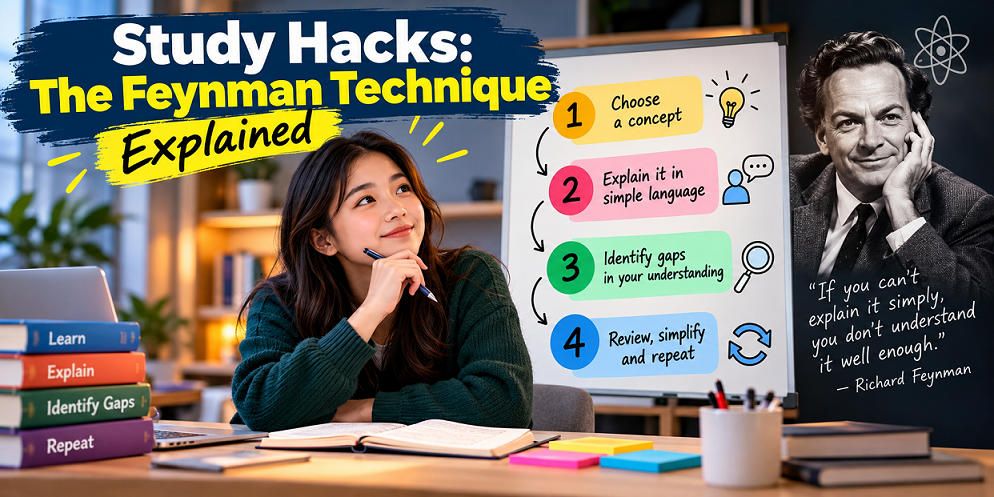
Studying harder does not always mean studying better. Spending hours rereading textbooks, highlighting pages, or memorizing definitions can create the feeling that you understand a subject without actually being able to explain or apply it.
The Feynman Technique offers a different approach: instead of simply reviewing information, you actively try to explain a concept in simple language. When your explanation breaks down, that weakness becomes a signal showing you exactly what you need to study again.
The method is associated with physicist Richard P. Feynman, who was known for his ability to communicate complicated scientific ideas clearly. Feynman taught at Cal tech and received the 1965 Nobel Prize in Physics. Cal tech’s historical material also documents his emphasis on explaining difficult ideas to students.
Although the modern “Feynman Technique” is not a formal scientific learning protocol created by Feynman himself, its core practices—retrieving information, explaining it, identifying gaps, and refining understanding—fit well with evidence-based approaches to learning.
What Is the Feynman Technique?
The Feynman Technique is a structured way to test whether you genuinely understand a concept.
The basic process is:
- Choose a concept.
- Explain it in simple language.
- Identify gaps in your understanding.
- Review, simplify, and explain it again.
The important distinction is that you should attempt the explanation without simply copying your textbook or notes.
This turns studying from a passive activity into an active process.
For example, instead of reading a definition of photosynthesis several times, close the textbook and try to answer:
“What is photosynthesis, and how would I explain it to someone who has never studied biology?”
If you cannot explain what happens to sunlight, water, carbon dioxide, and glucose—or you rely heavily on scientific terminology without understanding it—you have discovered areas that require further study.
Why the Feynman Technique Can Be Effective
One reason the method is useful is that it encourages retrieval practice. Rather than looking at information and recognizing it, you attempt to bring the information back from memory.
Cornell University’s Learning Strategies Center describes retrieval practice as actively recalling information and notes that the process can reveal what you do and do not understand.
Practice testing works in a similar way. Instead of repeatedly reviewing an answer, you attempt to retrieve it yourself, which can strengthen later recall.
The Feynman Technique adds another layer: explanation.
When you explain something, you have to organize information logically. You may discover that you know individual facts but do not understand how those facts connect.
That distinction is particularly important for subjects that require reasoning rather than memorization.
The Four Steps of the Feynman Technique
1. Choose One Concept
Start with a specific topic rather than an entire subject.
For example:
- Instead of “biology,” choose cellular respiration.
- Instead of “economics,” choose inflation.
- Instead of “mathematics,” choose quadratic equations.
- Instead of “computer science,” choose how a database index works.
Write the topic at the top of a blank page.
Then ask yourself:
“What do I already know about this?”
Write down everything you can remember without consulting your notes.
This first attempt is valuable because it gives you a baseline.
2. Explain It in Simple Language
Now pretend that you are teaching the concept to someone who has no background knowledge.
Avoid unnecessary jargon.
For example, instead of saying:
“Inflation represents a sustained increase in the general price level.”
You could begin with:
“Inflation means that, on average, the same amount of money buys fewer goods and services than before.”
Then continue explaining why it happens, what influences it, and what consequences it can have.
The goal isn’t to make every subject childish or oversimplified. The goal is to make your explanation clear enough that another person can follow your reasoning.
Feynman’s teaching legacy is closely connected with this emphasis on making difficult concepts understandable. Cal tech’s historical account of his teaching describes his efforts to explain profound ideas to beginning students.
3. Identify Your Knowledge Gaps
This is arguably the most useful part of the technique.
Pay attention to moments when you:
- Stop because you do not know what comes next
- Use a technical word without being able to define it
- Give an incomplete explanation
- Contradict yourself
- Skip an important step
- Think, “I know this, but I can’t explain it”
Mark those areas.
For example, while explaining how an electric circuit works, you may understand that current flows through a circuit but struggle to explain the difference between voltage, current, and resistance.
That is a specific knowledge gap.
Instead of rereading an entire chapter, you can now focus your attention on those particular concepts.
This targeted approach complements retrieval practice because attempting to recall information exposes areas that need additional work. Cornell specifically recommends retrieval activities because they help learners identify topics requiring further review.
4. Review, Simplify, and Repeat
Return to your textbook, lecture notes, trusted educational resources, or other authoritative sources.
Focus primarily on the gaps you identified.
Then close your resources and explain the concept again.
Your second explanation should ideally be:
- Clearer
- More logical
- More complete
- Less dependent on jargon
- Supported by examples
Repeat the process until you can explain the concept confidently and accurately.
The goal is not to remove necessary technical vocabulary. Instead, make sure you understand the vocabulary before using it.

A Practical Example: Learning Gravity
Suppose you are studying gravity.
First attempt
You might write:
“Gravity is a force caused by mass that attracts objects.”
That is a useful beginning, but it may not demonstrate complete understanding.
Ask deeper questions
- Why does gravity exist?
- Why does an object fall toward Earth?
- Why do objects have different weights?
- How does gravity affect planets?
- What is the difference between mass and weight?
You may discover that you understand the basic definition but struggle with the relationship between mass and gravitational acceleration.
Return to the source
You review the relevant material, clarify the distinction, and try again.
Simplified explanation
“Mass describes how much matter an object contains, while weight describes the gravitational force acting on that mass. On Earth, gravity causes objects to accelerate toward the ground.”
The explanation is now more precise because the process exposed and repaired a specific gap.
How to Use the Feynman Technique for Exams
The technique can be particularly useful during revision.
Try this simple study session:
Step 1: Pick a topic
Choose one concept from your syllabus.
Step 2: Study briefly
Review your textbook or class materials.
Step 3: Close your notes
Use a blank sheet of paper.
Step 4: Explain from memory
Write or speak through the concept as though teaching someone.
Step 5: Find the gaps
Circle anything you cannot explain confidently.
Step 6: Check your sources
Return to your study material and correct those weaknesses.
Step 7: Test yourself again
Explain the concept from memory a second time.
This approach can be combined with other evidence-supported strategies such as spaced practice, retrieval practice, and practice testing. Cornell’s study guidance recommends these approaches for longer-term learning rather than relying exclusively on cramming.
Feynman Technique vs. Rereading
Rereading has its place, particularly when you are encountering unfamiliar material for the first time. However, rereading alone can make information feel familiar without proving that you can retrieve or apply it.
The Feynman Technique asks you to demonstrate your understanding.
| Approach | What You Do | What It Reveals |
| Rereading | Review the same material | Familiarity |
| Highlighting | Mark important passages | What appears important |
| Flashcards | Retrieve information | Recall ability |
| Practice questions | Solve problems | Application |
| Feynman Technique | Explain the concept | Understanding and gaps |
These methods do not have to compete with one another. A strong study session can combine them.
For example, you might learn a topic, use the Feynman Technique to explain it, complete practice questions, and revisit the material later using spaced practice.
Common Mistakes to Avoid
Trying to Explain Everything at Once
Don’t start with an entire textbook chapter. Break large subjects into manageable concepts.
Looking at Your Notes While Explaining
If your goal is to test understanding, attempt the first explanation from memory.
Using Jargon as a Substitute for Understanding
Knowing terminology is not the same as understanding a concept.
If you say, “mitochondria produce ATP through oxidative phosphorylation,” you should also be able to explain what that means in ordinary language.
Oversimplifying to the Point of Being Wrong
Simple does not mean inaccurate.
A good explanation should remove unnecessary complexity while preserving the essential facts.
Ignoring Application
Understanding a definition is only part of learning. Where appropriate, solve a problem, analyze an example, or apply the concept to a real situation.
How Students Can Make the Technique More Powerful
The Feynman Technique becomes more useful when combined with a broader study system.
Combine It With Spaced Practice
Do not explain a concept only once.
Return to it after a day, several days, and later again. Spaced practice distributes learning over time and is recommended as an effective study strategy by Cornell’s Learning Strategies Center.
Add Practice Questions
After explaining a concept, solve problems related to it.
For mathematics or science, this helps determine whether you can apply the knowledge rather than merely describe it.
Use Real-World Examples
If you’re studying supply and demand, explain it using a familiar product.
If you’re learning programming, explain the concept and then write a small program using it.
If you’re studying biology, connect the concept to an everyday biological process.
Teach Another Person
Explaining a concept to a friend, classmate, colleague, or even an imaginary student can make weaknesses in your explanation easier to notice.
Feynman’s own teaching history demonstrates the importance he placed on discussion, thinking, and working through ideas rather than simply listening to lectures.
When the Feynman Technique Is Most Useful
The method works particularly well when you need to understand conceptual material.
It can be applied to:
- Science
- Mathematics
- History
- Economics
- Programming
- Business
- Languages
- Professional certifications
- Technical subjects
It is less useful as a standalone method for tasks that require extensive repetition or physical practice. For example, learning a musical instrument, athletic technique, or laboratory procedure requires actual practice in addition to explanation.
The technique is best viewed as one component of a broader learning strategy, not a magic shortcut.
A Simple 15-Minute Feynman Study Routine
Short on time? Try this routine:
Minutes 1–3: Choose a concept and recall what you know.
Minutes 4–7: Explain it in simple language without notes.
Minutes 8–10: Identify gaps and confusing points.
Minutes 11–13: Check reliable sources and repair those gaps.
Minutes 14–15: Explain the concept again from memory.
You can then schedule another retrieval session later.
Final Thoughts
The Feynman Technique is fundamentally about replacing the question “Have I read this?” with a more useful question:
“Can I explain this clearly and accurately without relying on my notes?”
That small change can transform the way you study.
By selecting a focused concept, explaining it simply, identifying gaps, returning to reliable sources, and repeating the explanation, you create a practical feedback loop for learning.
The technique should not replace practice questions, spaced study, or hands-on application. Instead, it works well alongside those strategies. Used thoughtfully, it can help students move beyond familiarity toward a clearer understanding of what they actually know—and what they still need to learn.
