

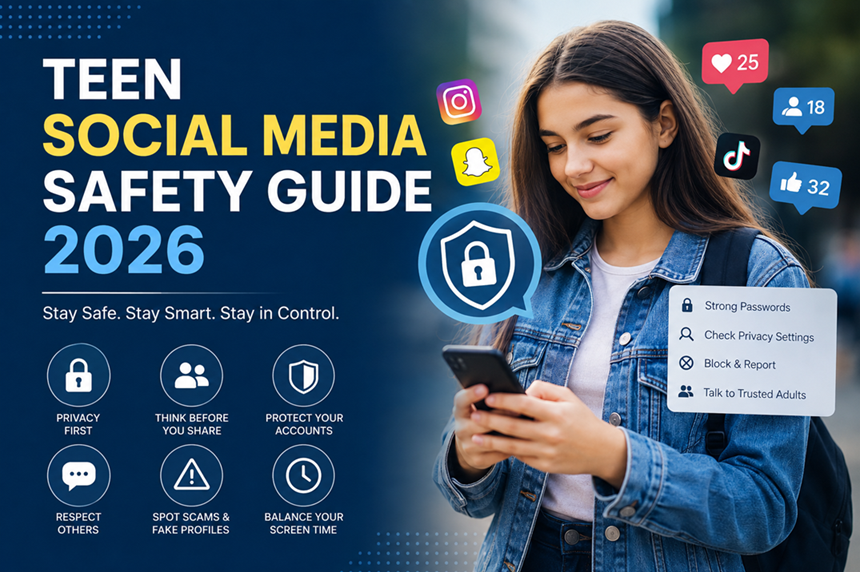
Social media is now a major part of teenage life. It can help teens stay connected with friends, discover educational content, express creativity, and find supportive communities. At the same time, social platforms can expose young people to privacy risks, cyberbullying, inappropriate content, scams, social pressure, and unhealthy patterns of use.
The goal of social media safety in 2026 should not simply be to ban technology. A more practical approach is to help teenagers develop the skills, judgment, and confidence they need to use digital platforms responsibly.
The American Psychological Association emphasizes that social media is not inherently beneficial or harmful; its effects can depend on the teenager, the content they encounter, platform features, and their wider social circumstances.
Why Teen Social Media Safety Matters in 2026
Social platforms continue to evolve quickly. Recommendation algorithms, disappearing messages, livestreaming, artificial intelligence, personalized feeds, and increasingly sophisticated scams can make the online environment difficult for teenagers and parents to navigate.
A teenager may start with a harmless video and quickly encounter content that is misleading, upsetting, commercial, or inappropriate. Likewise, a private conversation can potentially become a screenshot, forwarded message, or permanent digital record.
That is why social media safety needs to cover more than screen time. It should include:
- Privacy and account security
- Healthy communication
- Cyberbullying prevention
- Content awareness
- Digital footprints
- Scam and phishing awareness
- Password protection
- Location privacy
- Healthy screen habits
- Responsible use of AI-generated content
1. Make Every Social Media Account Private by Default
One of the simplest safety improvements is reviewing privacy settings when an account is created and whenever the platform changes its features.
Teens should understand who can:
- View their profile
- Follow them
- Send direct messages
- Comment on posts
- Tag or mention them
- See their location
- Download or share their content
The American Academy of Pediatrics recommends setting privacy controls at secure levels and creating family rules about who children can communicate with online.
A practical example
Instead of allowing anyone to send a teenager a direct message, configure the account so that only approved friends can contact them. If the platform provides separate controls for comments, tags, mentions, and messages, review each one individually.
Privacy settings are not a one-time task. Platforms can introduce new features or change existing controls, so families should periodically review them.
2. Teach Teens to Protect Personal Information
Teenagers should know that information that appears harmless can become valuable when combined with other details.
Avoid publicly sharing:
- Home addresses
- School schedules
- Personal phone numbers
- Passwords
- Real-time locations
- Travel plans while away from home
- Financial information
- Identification documents
- Private family information
Photos can also reveal more than intended. A picture outside a school, for example, may show a uniform, street sign, house number, or other identifying information.
Teach teens to pause before posting and ask:
“Would I be comfortable if this information were seen by a stranger?”
If the answer is no, it probably should not be posted publicly.
3. Use Strong Passwords and Two-Factor Authentication
A social media account can contain private conversations, photographs, contacts, and personal information. Protecting the account should therefore be treated like protecting a digital home.
Teens should use:
- Long, unique passwords
- A different password for each important account
- Two-factor authentication where available
- A reputable password manager when appropriate
- Updated recovery email and phone information
They should never share passwords with friends, even close friends.
If someone sends a message saying, “I need your login code,” treat it as suspicious. Verification codes should never be shared with another person simply because they request them.
4. Teach Teens How to Recognize Scams and Fake Accounts
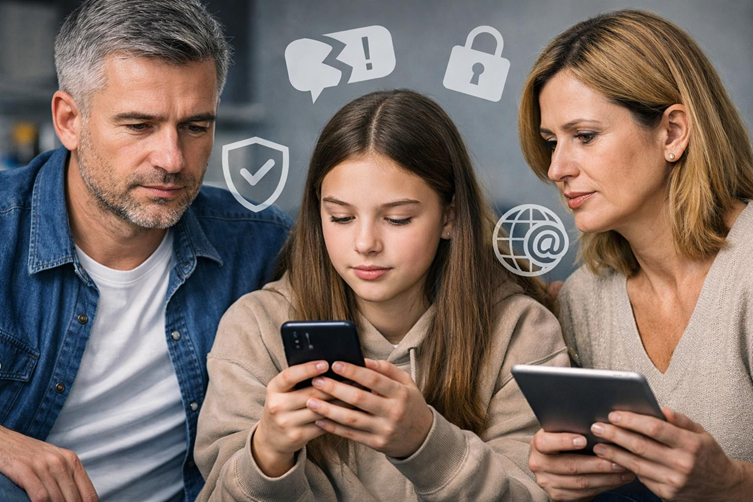
Online scams are increasingly designed to look like ordinary conversations.
Common warning signs include:
- “You won a prize” messages
- Requests for verification codes
- Fake giveaways
- Investment or money-making promises
- Suspicious links
- Accounts pretending to be celebrities or friends
- Urgent requests for money
- Messages asking users to move immediately to another platform
A useful family rule is:
Stop → Check → Think → Then respond.
If a message creates urgency or pressure, take a moment before clicking, replying, or sending information.
5. Explain the Reality of Cyberbullying
Cyberbullying can happen through comments, direct messages, group chats, gaming communities, videos, or shared images.
Parents should encourage teenagers to avoid retaliating publicly. Instead:
- Save evidence such as screenshots.
- Block or restrict the account when appropriate.
- Report abusive content through the platform.
- Tell a trusted adult.
- In serious situations, involve the school or appropriate authorities.
Most importantly, teens should know that asking for help is not “snitching.” It is a safety skill.
The American Academy of Pediatrics recommends keeping communication open and discussing online problems calmly rather than relying solely on punishment.
6. Think Before Posting Photos or Videos
A teenager may delete a post later, but that does not guarantee that the content has disappeared.
Someone may have:
- Taken a screenshot
- Downloaded the image
- Recorded the screen
- Shared it elsewhere
- Saved it privately
Before posting, teenagers can use the future-self test:
“Would I be comfortable with this being seen by a teacher, future employer, college admissions officer, relative, or someone I don’t know?”
If not, reconsider posting it.
7. Be Careful With Location Sharing
Location information deserves special attention.
Teens should understand the difference between:
- Sharing a location privately with trusted contacts
- Posting a location publicly
- Revealing a location through photographs
- Using live-location features
- Accidentally showing identifiable places in videos
Avoid publicly announcing that the family is away from home or revealing a regular daily route.
Review location permissions for social apps periodically and disable access when it is unnecessary.
8. Learn to Question the Content Algorithms Recommend
Social media feeds are personalized. What appears on one teenager’s screen may be completely different from what appears on another’s.
The APA notes that personalization, recommendations, likes, endless scrolling, and other platform features can influence adolescent experiences online.
Parents can help teens develop media literacy by asking:
- Who created this?
- What is the creator trying to make me believe or do?
- Is there evidence supporting the claim?
- Could the image or video be edited?
- Is this an advertisement?
- Does another reliable source report the same information?
This becomes particularly important as AI-generated images, videos, voices, and text become easier to create.
9. Discuss AI-Generated Content and Deepfakes
Teenagers should understand that seeing something online does not automatically mean it is authentic.
AI can be used to generate or manipulate:
- Images
- Videos
- Voices
- Messages
- Screenshots
- Social media profiles
A teenager should avoid immediately sharing shocking content. Instead, encourage them to verify unusual claims using reliable sources.
If someone creates or shares manipulated content involving a teenager, preserve evidence and report it rather than escalating the situation publicly.
10. Set Healthy Boundaries Around Social Media
Safety is not only about strangers and scams. Excessive or problematic use can also interfere with everyday life.
Warning signs may include:
- Social media interfering with schoolwork
- Regularly losing sleep because of social media
- Abandoning hobbies or offline friendships
- Feeling unable to stop using an app
- Becoming extremely distressed about likes, comments, or follower counts
- Repeatedly using social media longer than intended
The APA recommends paying attention to problematic social media use when it interferes with normal responsibilities, relationships, sleep, or other activities.
Create technology-free periods
Families can establish device-free:
- Mealtimes
- Family conversations
- Study periods
- Bedtime
- Certain weekend activities
The objective should be balance rather than an unrealistic expectation that teenagers will never use social media.
11. Parents Should Monitor Without Destroying Trust
Monitoring can be especially important for younger teenagers. However, effective supervision should involve communication and coaching rather than secret surveillance whenever possible.
The APA recommends ongoing adult monitoring for most young adolescents, while also recognizing the teenager’s developing need for privacy and autonomy.
Parents can ask:
- “What apps are you using most?”
- “Have you seen anything strange recently?”
- “Do people ever pressure you online?”
- “What would you do if someone asked for a private photo?”
- “What would you do if someone threatened you?”
These questions encourage problem-solving rather than simply checking whether rules have been broken.
12. Create a Family Social Media Safety Agreement
A written agreement can make expectations easier to understand.
It might include rules such as:
- We do not share passwords with friends.
- We do not meet online contacts alone.
- We do not share private family information publicly.
- We verify suspicious messages before responding.
- We tell an adult when something online feels unsafe.
- We do not participate in dangerous online challenges.
- We respect other people’s privacy.
- We keep devices away during agreed family times.
- Parents agree to listen before reacting when a teen reports an online problem.
The American Academy of Pediatrics recommends family media planning that includes age-appropriate limits, tech-free times, safety rules, and opportunities for children to provide feedback.
13. What to Do When Something Goes Wrong
Even well-prepared teenagers can encounter harmful content, bullying, scams, or inappropriate contact.
The first response should be calm.
If a teen receives a threatening message
Save the evidence, avoid engaging with the sender, block or restrict the account where appropriate, and report the behavior. If there is an immediate threat to safety, seek appropriate local emergency or professional assistance.
If a private image is shared without permission
Do not forward it further. Preserve relevant evidence, report the content through the platform, and involve a trusted adult. The teenager should not be blamed for asking for help.
If an account is hacked
Change the password from a trusted device, enable two-factor authentication, review account recovery information, and use the platform’s official account-recovery process.
Conclusion: Build Digital Skills, Not Just Digital Restrictions
Teen social media safety in 2026 is less about finding one perfect parental-control setting and more about developing practical digital judgment.
The safest approach combines strong privacy settings, secure passwords, thoughtful monitoring, media literacy, healthy boundaries, and open communication. Teens also need to understand that mistakes online do not have to become permanent disasters—and that asking a trusted adult for help is always an option.
Social media can be a valuable part of teenage life when it supports connection, creativity, learning, and healthy relationships. The long-term goal is to help young people become capable digital citizens who can recognize risks, protect their privacy, make informed decisions, and recover responsibly when something goes wrong.
