

Introduction
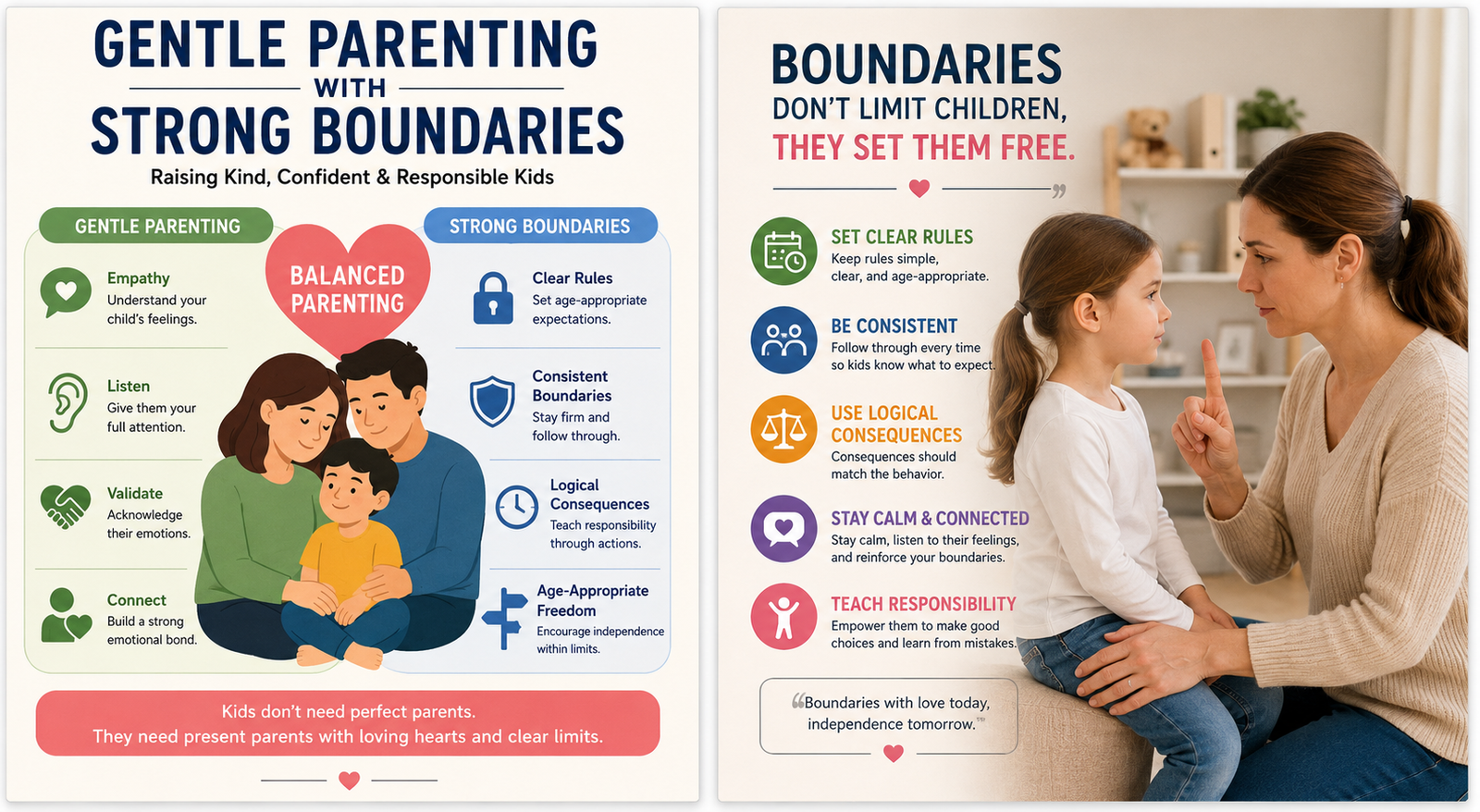
Parenting advice has changed dramatically over the past decade. Concepts such as emotional validation, respectful communication, connection before correction, and avoiding harsh punishment have become increasingly familiar to parents.
But in 2026, another idea is gaining attention: children can be emotionally understood while still being expected to follow reasonable rules.
This has led to renewed interest in boundaries, routines, consequences, and parental authority. However, describing this as the complete “decline of gentle parenting” would be too simplistic. There is no strong evidence that parents everywhere are abandoning gentle or positive parenting. Instead, the conversation appears to be shifting toward a more balanced question: How can parents be kind and emotionally responsive without becoming permissive?
That distinction matters because major child-development guidance already supports both sides. The American Academy of Pediatrics recommends positive discipline while also emphasizing clear, consistent limits and consequences.
Gentle Parenting Was Never Supposed to Mean “No Rules”
One of the biggest problems in the modern parenting debate is that gentle parenting and permissive parenting are sometimes treated as the same thing.
They are not.
Gentle or positive approaches generally emphasize understanding a child’s developmental stage, responding calmly, teaching appropriate behavior, and avoiding humiliating or physically harsh discipline.
Permissive parenting, by contrast, can involve few limits, inconsistent expectations, or allowing children to make decisions that are beyond their developmental capacity.
The American Academy of Pediatrics specifically recommends setting clear and consistent rules, explaining them in age-appropriate language, and calmly applying consequences when necessary.
So the emerging emphasis on boundaries does not necessarily represent a rejection of empathy. It may represent a correction of the idea that being emotionally supportive means avoiding parental authority.
Why Boundaries Are Getting More Attention in 2026
Parents Are Tired of Endless Negotiation
One practical complaint frequently heard in parenting discussions is that every request can become a lengthy negotiation.
“It’s time to turn off the tablet.”
“Five more minutes.”
“Please put your shoes on.”
“Why?”
“But I don’t want to.”
“Can we do it later?”
A parent can validate the child’s frustration without turning every household expectation into a debate.
A healthier response might be:
“I know you want to keep playing. Screen time is finished now. You can turn it off yourself, or I can help you.”
The child’s feelings are acknowledged, but the boundary remains.
Modern Family Life Requires Structure
Children live within systems of rules at home, school, sports activities, online spaces, and eventually workplaces.
The CDC explains that family rules provide structure and help children understand which behaviors are acceptable. It also emphasizes consistency, predictability, and follow-through.
For young children especially, predictable routines can make daily life easier because they reduce uncertainty about what happens next.
A bedtime routine, for example, might be:
Bath → pajamas → story → lights out.
The goal isn’t to control every minute of a child’s life. It is to create a predictable framework in which children can develop independence.
The Difference Between a Boundary and a Punishment
This distinction is crucial.
A boundary communicates what is acceptable and what the parent will do to maintain that limit.
A punishment is often focused on making a child suffer for wrongdoing.
For example:
Punitive:
“You were bad, so you can’t watch television for a week.”
Boundary-based:
“Throwing toys can hurt people. The toy will be put away for today.”
The second response connects the consequence more directly to the behavior.
The CDC describes consequences as what happens after a behavior and recommends clear expectations, warnings when appropriate, and consistent follow-through.
Healthy boundaries also do not require yelling, humiliation, threats, or physical punishment. The AAP recommends positive discipline approaches and advises against spanking, hitting, shaming, insulting, or humiliating children.
What Parents Are Actually Bringing Back
The renewed interest isn’t necessarily about returning to old-fashioned authoritarian parenting.
Instead, many families are rediscovering several basic parenting tools.
1. Clear Expectations
Instead of saying:
“Behave yourself.”
Say:
“Keep your hands to yourself while we’re in the store.”
Specific instructions are easier for children to understand.
2. Consistent Consequences
If a parent says, “If you throw the toy again, I’ll put it away,” the parent needs to follow through.
Otherwise, the child may learn that repeated negotiation eventually changes the rule.
The CDC specifically recommends consistent follow-through because predictable consequences help children understand expectations.
3. Fewer Rules, Applied Better
Children do not need dozens of household rules.
For younger children, the CDC suggests focusing on only a small number of important rules that they can understand and remember.
For example:
- We don’t hurt people.
Simple rules are easier to teach consistently.
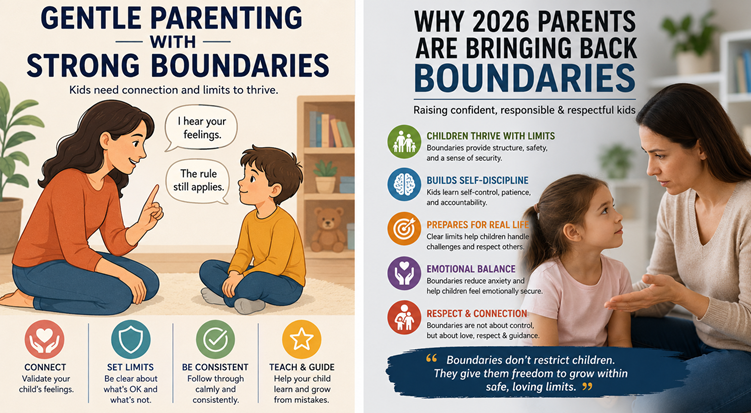
Boundaries and Emotional Validation Can Coexist
This may be the most important lesson from the current parenting debate.
A child can be angry and still have to follow the rule.
Consider a four-year-old who wants another cookie before dinner.
A parent could say:
“You’re really disappointed because you want another cookie. I understand. We’re not having another one before dinner.”
The child might cry.
That does not automatically mean the parent has handled the situation badly.
The parent can remain present, offer comfort, and allow the emotion to pass without changing the boundary.
This approach separates two things that are often confused:
Feelings are acceptable. Not every behavior is acceptable.
A child may be furious. Hitting someone is still not acceptable.
A child may be disappointed. Screaming at another person is still not acceptable.
A child may disagree. The family rule can remain.
The Role of Connection Still Matters
The return of boundaries should not mean returning to emotionally distant parenting.
Research from Harvard’s Center on the Developing Child emphasizes the importance of responsive, back-and-forth interactions between children and caring adults. These relationships support children’s developing social and emotional skills.
In practical terms, children need both:
“I understand you.”
and
“This is the limit.”
A parent can sit beside a crying child while maintaining the boundary.
That combination may be more sustainable than either extreme: harsh authoritarianism on one side or unlimited permissiveness on the other.
Real-World Examples of Balanced Parenting
Screen Time
Without a boundary:
“Okay, you can keep watching if you promise this is the last video.”
With a harsh approach:
“Turn it off now or you’re grounded for a month.”
Balanced approach:
“I know you want another video. Screen time is finished. You can choose whether to turn it off yourself or have me help.”
Hitting
Without a boundary:
“Don’t be angry. Tell me how you feel.”
With a harsh approach:
“Stop hitting, or you’re going to be punished.”
Balanced approach:
“You’re angry, and it’s okay to be angry. I won’t let you hit me. You can tell me what you’re upset about.”
Leaving the Playground
Instead of repeatedly negotiating:
“You have five minutes left. Then we’re leaving.”
When the time arrives:
“It’s time to go. You can walk to the car, or I can carry you.”
The child still has some choice, but the larger boundary remains.
Boundaries Should Change as Children Grow
A good boundary is not necessarily permanent.
A toddler may need a parent to physically prevent them from running into a road.
A school-age child may be expected to stop at the curb and look both ways.
A teenager may eventually be trusted to travel independently.
The objective is therefore not maximum control. It is gradually transferring responsibility as the child’s abilities develop.
The AAP similarly emphasizes routines, responsibilities, age-appropriate independence, and meaningful consequences when rules are broken.
What Parents Should Avoid
The renewed interest in boundaries can become unhealthy if it turns into excessive control.
Parents should be cautious about:
- Creating rules for every minor behavior
- Using fear to obtain obedience
- Humiliating children
- Threatening extreme punishments
- Demanding unquestioning obedience
- Treating normal developmental behavior as deliberate defiance
- Using physical punishment
- Changing rules constantly depending on parental mood
Firm does not mean frightening.
A strong parent can be calm, predictable, affectionate, and authoritative at the same time.
The Better Alternative: Warm but Firm Parenting
The debate doesn’t have to be gentle versus strict.
A more useful model is:
Warmth + Boundaries + Consistency + Age-appropriate Independence
Parents can listen without surrendering authority.
They can validate emotions without approving harmful behavior.
They can apologize when they make mistakes without eliminating expectations.
And they can say “no” without making a child feel unloved.
This is particularly important because children learn not only from what parents say but from how parents behave. Calmly enforcing a rule teaches emotional regulation in a way that shouting about emotional regulation never can.
Conclusion: Parenting Doesn’t Need to Choose Between Kindness and Authority
The conversation surrounding gentle parenting in 2026 is better understood as an evolution than a complete rejection.
Parents don’t have to choose between being compassionate and being firm. Children need emotional connection, but they also need structure. They need freedom, but they also need safety. They need to express their feelings, but they also need to learn that feelings don’t justify every action.
The most effective boundaries are not about winning a power struggle. They are about teaching children how the world works, helping them understand expectations, and gradually preparing them to regulate themselves.

2 Comments
À garder. Swift-image sur /. Swift-image
Harika yazı! MiniMax H3 AI video: MiniMax H3 Video Generator — /. MiniMax H3 Video Generator