
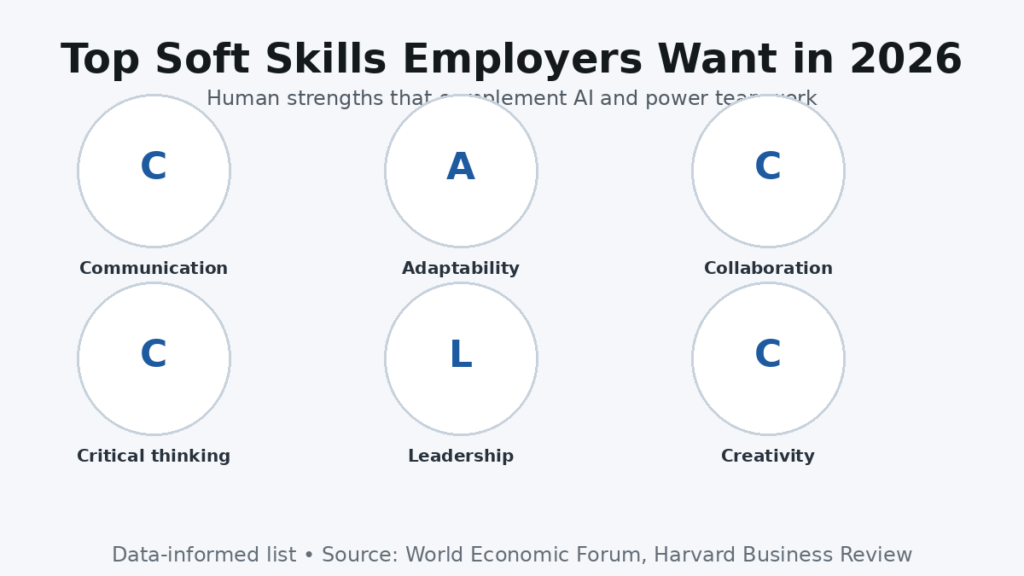
As workplaces evolve around AI, automation, and hybrid collaboration, employers still prize human strengths that technology can’t replace. In 2026, hiring decisions increasingly favor soft skills that drive problem-solving, team performance, and adaptability across changing business models. Below is a concise, evidence-based guide to the top soft skills hiring managers are seeking — with practical examples and ways to demonstrate each on the job or in interviews.
The core soft skills employers prioritize
1. Communication (verbal & written)
Clear communication remains the most-cited nontechnical skill. Employers want people who can explain complex ideas simply, write concise updates, and tailor messages to stakeholders (peers, managers, clients).
Practical example: lead standups that surface blockers in plain language and follow up with a one-paragraph email that lists decisions and owners. This reduces misalignment and speeds delivery.
2. Adaptability & resilience
Rapid change — new AI tools, shifting roadmaps, remote/hybrid arrangements — makes adaptability essential. Employers favor people who learn new tools fast, pivot priorities when required, and handle uncertainty without losing focus.
Practical example: volunteer to pilot a new collaboration tool, document a short playbook, and coach two teammates — that shows you learn and scale change across a team.
3. Collaboration & teamwork
Working across functions (product, design, engineering, sales) demands strong collaboration: active listening, constructive feedback, and shared ownership. Organizations report gaps in workforce proficiency here, so this skill stands out.
Practical example: when joining a cross-functional project, schedule a short kickoff to clarify success metrics, and run iteration retros that end with two concrete improvements.
4. Critical thinking & problem solving
Analytical reasoning paired with creative problem-solving helps people translate data and AI outputs into actionable decisions. Employers want staff who question assumptions and propose testable hypotheses.
Practical example: present an analysis with a clear problem statement, two alternative explanations, and a small experiment to validate which explanation is correct.
5. Leadership & social influence
Leadership here isn’t just managerial rank — it’s the ability to influence, mentor, and rally others around outcomes. Employers look for those who can drive initiatives, not just execute tasks.
Practical example: mentor a junior colleague, lead a lunch-and-learn on a practical topic, or own a small cross-team initiative to gain visibility and impact.
6. Creativity & design thinking
Creativity fuels product differentiation and process improvement. Employers reward people who can reframe problems and prototype new approaches.
Practical example: run a rapid 30-minute ideation session with stakeholders and produce three quick prototypes to test with users.
How employers evaluate soft skills in 2026
Behavioral interviews & structured examples
Hiring teams use behavioral interview techniques — “Tell me about a time when…” — to check for real examples instead of hypotheticals. Use the STAR method (Situation, Task, Action, Result) and quantify outcomes when possible.
Work samples & micro-projects
Many employers ask for short, real-world tasks that reveal collaboration, communication, and problem-solving under time or resource constraints. Treat these as the most direct way to show soft skills.
On-the-job signals
Performance reviews, peer feedback, and cross-team project outcomes (e.g., reduced cycle time, improved NPS) are strong indicators employers use to judge someone’s soft-skill impact over time.
Practical steps to strengthen and showcase these skills
- Document results — convert teamwork wins into concise case notes: problem, your role, outcome (numbers where possible).
- Ask for structured feedback — request two specific areas to improve after projects (communication clarity, decision speed).
- Practice public explaining — write short summaries of complicated topics (one-paragraph blog posts, internal notes).
- Own small cross-team efforts — leading a small, measurable initiative is the fastest path to proven leadership.
- Learn human-centered facilitation — running inclusive workshops improves collaboration and creativity.
Conclusion
In 2026, the most sought-after employees combine cognitive strengths (critical thinking, analytical ability) with human-centered soft skills — communication, adaptability, collaboration, leadership, and creativity. These strengths are what translate technical progress into organizational value. Focus on measurable examples, continuous practice, and structured feedback to make these skills visible and persuasive to employers.
