

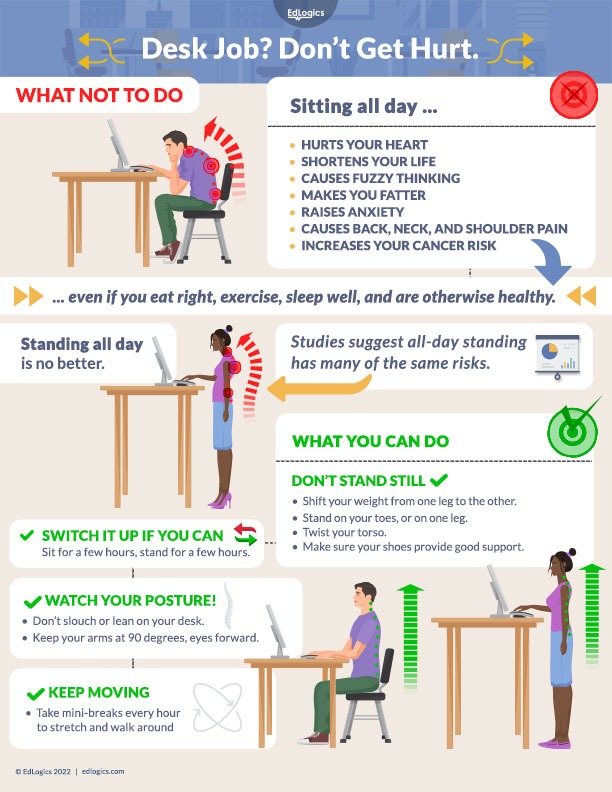
Bottom line up front: prolonged sedentary time is a real public-health issue — but the headline “sitting is the new smoking” oversimplifies things. Replacing long periods of sitting with movement (frequent walking breaks, short activity bursts) is what the evidence supports. Standing desks can help reduce sitting time and improve comfort for some people, but standing all day is not a cure-all and may carry its own risks if used incorrectly.
Why the comparison to smoking took off
The phrase “sitting is the new smoking” captured attention because large observational studies show that high amounts of sedentary time are associated with greater risks of cardiovascular disease, type-2 diabetes, some cancers, and earlier mortality. Public health bodies — including WHO — now explicitly recommend reducing sedentary behaviour and increasing physical activity across the day. But observational links aren’t the same as the direct causal harm of tobacco: the magnitude and mechanisms differ.
What the science actually shows (short evidence summary)
- Sedentary time correlates with worse health outcomes. People who sit much of the day have higher rates of cardiometabolic disease and mortality in large cohort studies. This is the core of the “new smoking” story.
- Guidelines focus on movement, not just posture. WHO’s 2020 guidelines advise limiting sedentary time and emphasise replacing it with any intensity of physical activity — light activity counts. They don’t advise standing as the only solution.
- Standing desks reduce sitting time, but the benefits are moderate. RCTs and workplace trials (including the SMArT trial) show sit-stand desks can lower total sitting and improve self-reported discomfort and energy, but objective health gains (e.g., big changes in blood pressure or long-term disease risk) remain limited or mixed.
- Standing all day isn’t harmless. Recent large analyses show prolonged standing may increase circulatory problems (varicose veins, venous disease) and doesn’t automatically cut heart disease risk — so balance and movement matter.
- Activity breaks and overall daily movement are key. Small, frequent bouts of walking or light activity appear more potent for metabolic health than simply swapping hours of sitting for standing. Think “sit less, move more” rather than “stand more.”
Practical, high-authority recommendations you can act on today
- Aim to interrupt sitting every 30–60 minutes. Short 2–5 minute walks or mobility breaks beat long unbroken sitting. (Tip: set a gentle timer.)
- If you buy a sit-stand desk, use it as part of a rotation. Start with short standing intervals (15–30 minutes) and alternate. Gradually increase standing as tolerated.
- Prioritise movement over posture. A brisk 10–15 minute walk has more metabolic benefit than several hours of passive standing. Schedule walking meetings, active commutes, or lunchtime walks.
- Use ergonomic supports if standing. Anti-fatigue mats, supportive shoes, and a monitor/keyboard setup at elbow height will reduce strain and circulatory issues. Don’t lock knees; shift weight and move feet.
Measure outputs that matter to you. Track energy, focus, musculoskeletal pain, and objective activity (phone step counts or a wearable). Productivity effects are individual; many report improved energy but not dramatic objective gains.
