

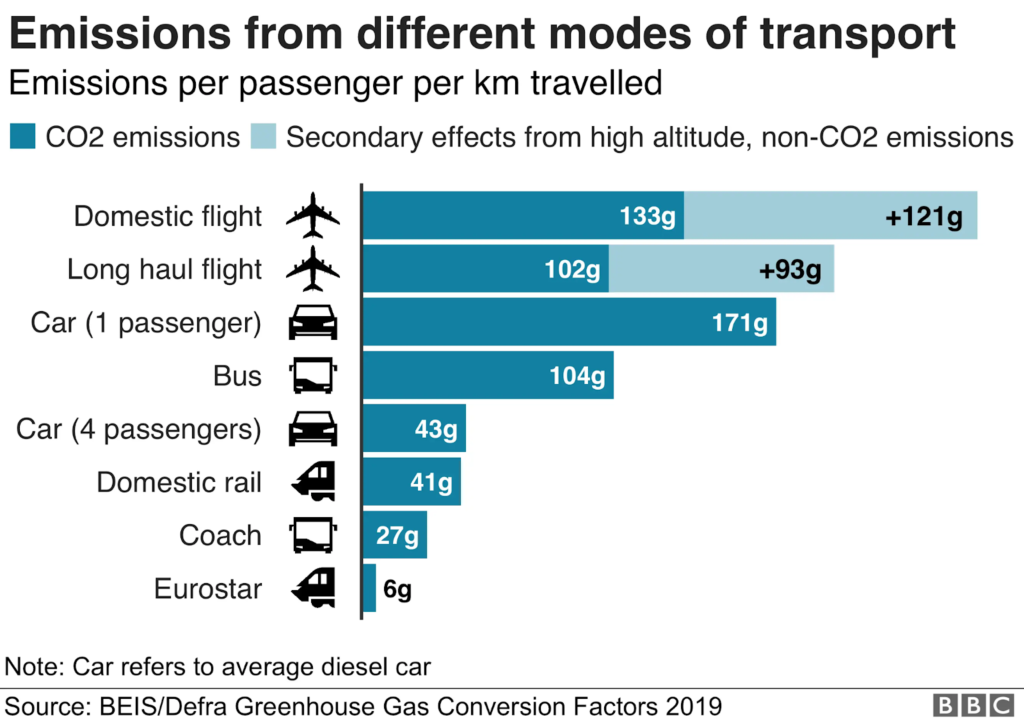
Air travel remains one of the most carbon-intensive activities many individuals undertake. Although flying has made the world more accessible, it also contributes significantly to greenhouse gas emissions. According to the International Air Transport Association (IATA), aviation accounts for roughly 2-3% of global CO₂ emissions, with considerable additional impact from non-CO₂ warming effects at high altitudes. Reducing your carbon footprint when flying isn’t just about offsetting— it’s about making smarter travel decisions that align with environmental responsibility without sacrificing the joy of discovery.
This article breaks down practical, research-based strategies to lower the climate impact of your flights.
Understanding the Emissions from Flying
Airplanes rely on jet fuel, which emits carbon dioxide (CO₂), nitrogen oxides (NOₓ), and water vapor. These gases trap heat in the atmosphere and contribute to warming.
Why Flying Has a Large Footprint
- High fuel intensity per passenger: Planes burn large quantities of fuel, especially during takeoff and climb.
- Altitude effects: Emissions released at cruising altitude contribute more to warming than ground-level emissions due to contrail formation.
- Frequent short flights: These are disproportionately impactful because takeoff and landing consume more fuel per mile flown.
For a deeper dive into how flight emissions affect the climate, see the International Civil Aviation Organization (ICAO) overview of aviation environmental impacts.
Choose Your Flights Strategically
Fly Less Often
The most effective way to reduce aviation emissions is to take fewer flights.
- Consider alternatives: Train or bus travel for regional trips often results in far lower emissions per passenger.
- Combine trips: If you must fly, plan longer vacations instead of multiple short ones.
Example: A train from Paris to Amsterdam emits about 90% less CO₂ than the same trip by plane.
Pick Direct Routes
- Reduce takeoff/landing toll: Each takeoff and landing phase burns more fuel than cruising.
- Look beyond price: A direct flight may cost more but often has a lower carbon footprint.
Tools like Google Flights and Skyscanner now allow you to compare flight carbon estimates at booking.
Fly Greener on a Given Trip
Choose Efficient Airlines and Aircraft
- Newer aircraft: Models like the Boeing 787 and Airbus A320neo are significantly more fuel-efficient than older jets.
- Airline practices: Some carriers invest in fuel-saving operations like continuous descent approaches and lighter onboard materials.
According to airline sustainability reports, modern fleets can reduce fuel burn and emissions by up to 20% per seat.
Opt for Economy
- Seat density matters: More passengers per flight means emissions are shared among more people, lowering the footprint per traveler.
- Premium seats take more space: Business and first-class seats occupy more room and thus indirectly lead to higher emissions per person.
Offset and Compensation Strategies
Understand Carbon Offsetting
Carbon offsetting involves investing in projects that reduce or capture emissions (e.g., reforestation or renewable energy).
- Choose verified programs: Use high-integrity standards like the Gold Standard or Verified Carbon Standard (VCS).
- Offset beyond mandatory fees: Airline offset schemes often underprice the true cost of emissions; consider supplementing with independent offsets.
On-Ground Behaviors That Help
Pack Light and Smart
- Every kilogram counts: Reduced weight means less fuel burned on takeoff.
- Carry-on only: When feasible, travel with carry-on luggage alone to lower aircraft weight.
Example: Removing 10 kg from a flight with 150 passengers can save several hundred liters of fuel over time.
Bring Your Own Comfort Items
Towels, reusable bottles, and noise-canceling headphones avoid single-use plastics and reduce waste onboard.
Advocate for Systemic Change
Individual choices are important, but systemic shifts can drive industry-wide emission reductions.
Support Sustainable Aviation Fuel (SAF)
SAF is made from renewable sources and can cut lifecycle emissions significantly.
- Advocate for airlines to adopt SAF commitments.
- Support policies that scale up SAF production and infrastructure.
Promote Transparent Reporting
Encourage airlines and travel platforms to publish verified emissions data per flight.
Everyday Examples of Greener Flying
- Route choice: A family flying direct to a holiday destination instead of connecting through multiple hubs can reduce emissions by 30% or more.
- Offset complement: A business traveler offsets their trip through a Gold Standard-verified project and chooses airlines with newer, fuel-efficient fleets.
These small choices, accumulated over time, contribute to substantial climate benefits.
Conclusion
Reducing your carbon footprint when flying is both a personal responsibility and a collective opportunity. From choosing fewer or direct flights to flying economy, packing thoughtfully, and offsetting with credible programs, every decision helps lower the environmental toll of air travel. While technology and policy advancements will continue to improve aviation’s sustainability, informed traveler choices today make a measurable difference.
